

Digital sovereignty highlights the importance of maintaining control over digital technologies to protect national and regional interests in the context of rapidly evolving geopolitical dynamics. Nations must strike a balance between the benefits of technological advancements for economic growth and citizen welfare, and the requirements of digital sovereignty.
European Digital Sovereignty Criteria
Sovereignty, in its strictest sense, implies national independence — a fully autonomous supply, delivery, and operations chain within a country, based on national technology (i.e., nationally controlled intellectual property). Any non-national or open-source components must be architected and integrated to also meet this definition. This level of sovereignty, however, is largely unattainable due to increasing globalization, and cost/performance considerations. Therefore, a thorough risk assessment and mitigation strategy is essential to determine a balanced approach to digital sovereignty, based on the sensitivity of data and applications. Transparency from Cloud Service Providers (CSPs) is critical to allow organizations to make informed cloud adoption decisions.
We typically observe three main objectives when assessing digital sovereignty:
- Data protection: Helping ensure that only data owners have access to their data, with no unauthorized access possible.
- Operational resilience: Providing continuity of IT systems in the face of major disruptions such as pandemics, physical incidents, or geopolitical events.
- Freedom of choice: Maintaining the flexibility to switch providers or technologies in response to evolving technology landscapes, geopolitical changes, or cost considerations.
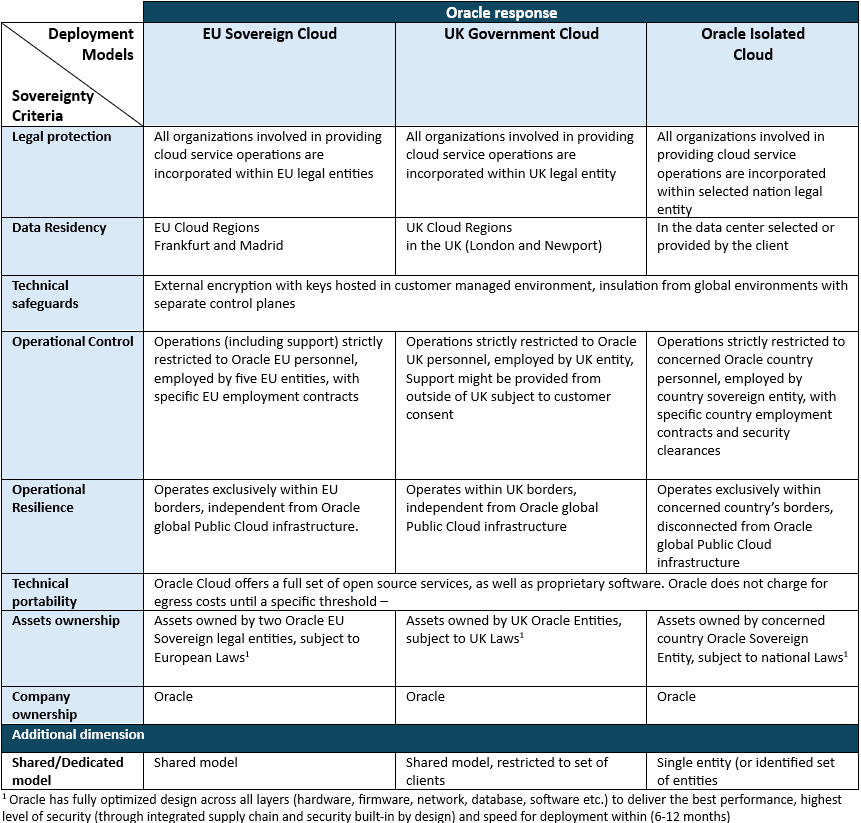
To achieve these objectives, several dimensions must be considered when defining a cloud strategy:
- Legal protection: The European Union sets a high bar in data privacy and regulatory enforcement through frameworks like GDPR, DORA, NIS2, and the Data Act. Critical public and private services must comply with various legal frameworks that often overlap in jurisdictional scope. EU best practices include strong safeguards, where cloud operations and data centers are located within national (or regional) boundaries and governed by local laws.
- Data residency: Data localization complements legal protection by providing physical control over data and infrastructure, subject to national jurisdiction.
- Technical safeguards: These include encryption, access controls, insulation from global macroenvironmental events, and other cybersecurity measures to help ensure data confidentiality, integrity, and resilience.
- Operational control: This refers to the ability to govern all aspects of cloud operations and support. When service entities are incorporated under national (or regional) law, governments can exercise full oversight and legal enforcement.
- Architectural and operational set-up: This allows continuity of cloud operations in the event of systemic shocks, such as pandemics, geopolitical conflicts, or physical disruptions. A resilient architecture requires a regionalized or country-specific cloud, with operations and support isolated from global public cloud infrastructure.
- Technical portability: In line with the EU Data Act, digital sovereignty implies freedom of choice and change. This includes the use of open standards and minimizing switching barriers between CSPs. One major barrier is egress fees—the cost of data transfers out of a provider’s infrastructure—which can hinder provider switching. New EU regulations aim to address this issue.
- Asset ownership: Retaining control over physical infrastructure and hardware is a key enabler of sovereignty.
- Company ownership: This refers to the ownership structure of the company delivering the digital solution (software, SaaS, and cloud). Since modern solutions are often made up of multiple components from different vendors, the analysis can be complex, but transparency and control remain crucial.
In addition to these dimensions, governments also focus on broader goals: fostering digital ecosystems, supporting national digital champions, advancing digital skills, and promoting research and innovation.
Achieving European Sovereignty Criteria with Oracle Cloud
Oracle has over 47 years of experience working with governments and public sector organizations worldwide. We help deliver value to citizens and public servants while helping them meet critical requirements in cybersecurity, operational resilience, and sovereignty—including in the most sensitive environments such as intelligence and military systems. Oracle has made sovereignty a cornerstone of its cloud strategy.
Oracle Cloud Infrastructure (OCI) provides multiple deployment models tailored to the needs of governments and enterprises seeking to leverage AI and cloud while assisting them in addressing their strict sovereignty and security requirements. Under our “everything, everywhere” principle, every deployment model offers the full functionality of Oracle Cloud services. A key differentiator of Oracle’s approach is the clear separation between each deployment model. This helps ensure independent control planes and enables enhanced security and customization. Unlike other market players that extend their public cloud through on-premises hardware, Oracle’s models are truly standalone. This helps ensure that tenancy and control remain fully within the designated model—whether public or private cloud. Oracle Cloud also supports more than 100 languages, facilitating adoption in multilingual contexts.
Oracle’s portfolio of cloud deployment models provides varying levels of sovereignty to help address the most sensitive and classified workloads. These different models are designed to align with national security, legal, and operational requirements, offering governments and organizations alike the flexibility to select the right level of control and independence based on the criticality of data and applications being deployed.
Each deployment model includes built-in security and compliance features, such as:
- Dedicated infrastructure: Isolation at the physical and logical levels helps ensure that workloads are protected from interference or exposure to other tenants.
- Independent control planes: Administrative and operational separation gives full autonomy to the local cloud team, with no dependency on global Oracle services or staff outside the chosen jurisdiction.
- Customer-managed encryption: The customer maintains full control of encryption keys, helping ensure that only authorized national personnel can access sensitive data.
- Support and operations under national or regional jurisdiction: For Oracle’s EU Sovereign Cloud, Oracle offers EU sovereign support where all personnel involved in operations and incident response are based in the EU country of residence, and operate under EU legal frameworks.
- Comprehensive offerings for customer’s compliance needs: Oracle Cloud is aligned with key international and regional standards; and is continuously updated to help customers address evolving regulatory requirements (e.g., GDPR, ISO 27001, NIST, DORA, and national certification schemes).
Our Value Proposition for a Successful Modernization of Critical Applications with Digital Sovereignty
In line with our “everything, everywhere” principle, Oracle delivers the full spectrum of services, over 150+ services in total—including Infrastructure as a Service (IaaS), Platform as a Service (PaaS), and Software as a Service (SaaS)—across all cloud deployment models mentioned above. This helps ensure that both governments and public sector organizations can access the same breadth of functionality and innovation, regardless of the sovereignty level required.
Each Oracle Cloud deployment model can also be equipped with a stack of Artificial Intelligence capabilities, including:
- AI infrastructure optimized for high-performance computing and large language models
- Data platforms to support real-time, secure, and scalable data management
- Generative AI and machine learning services, with fine-tuning and data privacy options
- Pre-built AI services that accelerate time-to-value across industries
- AI embedded natively within Oracle’s SaaS applications to automate and optimize business processes
Oracle delivers these capabilities across a wide range of public sector and highly regulated domains, including: Healthcare, Public Safety, Defense, Social Protection and Benefits, Taxation, Justice, Education and Labor, and many more mission-critical areas.
With this comprehensive and sovereign-by-design offering, Oracle empowers governments not only to meet their digital transformation objectives securely and efficiently, but also to lead innovation that delivers tangible outcomes for their citizens. Learn more about OCI’s capabilities through the Oracle Distributed Cloud resource links below, or Contact Us to discover how Oracle can help you meet your European or UK digital sovereignty requirements today!
Additional Resources:
Blog: Oracle Delivers Sovereign AI Anywhere Using NVIDIA Accelerated Computer
Brief: AI Innovation – 5 Pillars to Enable Sovereign AI