
Choosing the right Database Cloud Service for your mission-critical and business-critical workloads comes down to more than just picking a database. It’s about finding the right combination of capabilities, performance, availability, and cost. And for many organizations, the answer starts to become clear pretty quickly. You want the capabilities that come with Oracle Database Enterprise Edition – Extreme Performance (EE-EP). You want Oracle Real Application Clusters (RAC) for availability and scalability. You want Oracle Active Data Guard (ADG) for resilience and disaster recovery. And you want Database In-Memory for faster analytics and better performance across demanding workloads. Why compromise when you can bring all these capabilities together with EE-EP?
The Power of Enterprise Edition – Extreme Performance
EE-EP helps your database keep pace with your business, whether it’s with providing always-on applications for your customers or running your business. These capabilities aren’t just technical features. They’re here to help protect revenue, improve customer experience, and give your teams more time to grow the business rather than worrying about keeping the lights on.
For Oracle Maximum Availability Architecture (MAA), you have Oracle Real Application Clusters (RAC) which lets you run a single Oracle AI Database across multiple servers for high availability. RAC is an Oracle AI Database cloud-exclusive capability, inclusive of Oracle AI Database@Hyperscaler. And that matters when your business can’t afford downtime.
It’s never too early to think about holidays, so let’s set the scene. You’re having a major sale, it’s one of the busiest times of year for you. So, you need your database to keep up. With RAC, you can help support continuous database availability so the business can keep running around the clock, and you can scale out to support peak shopping demand. That can mean fewer frustrated customers and help support revenue. And it’s not just about retail. The same need exists for airline reservation systems during peak travel seasons, streaming and media platforms handling large spikes when a new episode drops, and any other workload where availability is mission-critical.
Another MAA feature is Oracle Active Data Guard, which extends the capabilities of Data Guard for stronger resilience, better disaster recovery, and more flexibility to stay online when it matters most. Take a pharmaceutical company running clinical trials across multiple countries with thousands of patients. That’s critical data that needs to be protected. With ADG, the company can help protect clinical data, help address applicable regulatory requirements, reduce business risk, and improve operational efficiency, all while staying focused on bringing solutions to market faster.
And with Database In-Memory you get to accelerate analytics and turn operational data into faster business insight. Check out how much faster Database In-Memory compared with the traditional row store in this LiveLab.
That’s the power of EE-EP. It helps you run business-critical workloads with the performance, availability, and speed modern organizations need.
Exadata for Everyone with ExaDB-XS
But the capabilities of the database are only part of the story. The infrastructure you run on matters just as much. That’s where Oracle Exadata Database Service on Exascale Infrastructure (ExaDB-XS) comes in. ExaDB-XS brings together the best of Exadata and the best of cloud, giving EE-EP the infrastructure it was built for, with the intelligence to support OLTP, analytics, and AI workloads at scale. That means you can get Exadata-grade performance and cloud agility without the cost or complexity of deploying a full dedicated system.
People often tend to associate Exadata only with large-scale deployments and dedicated infrastructure. But it’s more than just that. ExaDB-XS brings the power of Exadata to organizations that want enterprise-class database performance without the cost or complexity of provisioning an entire Exadata system. Because Exadata infrastructure is consumed as a shared, elastic service, you can start smaller, scale as your needs grow, and pay based on the resources you use.
Plus, with Exadata on the cloud, you get all the features in the image below as part of the service! That means you’re not just getting Exadata AI Smart Scan, Smart Scan Offload, RoCE fabric, and Smart Flash Cache as technical add-ons. You’re getting the built-in Exadata intelligence that helps your applications run faster, your analytics move quicker, and your teams spend less time fighting performance bottlenecks. Exadata AI Smart Scan and Smart Scan Offload help reduce unnecessary data movement and speed up query processing, while RoCE fabric and Smart Flash Cache help deliver the low latency and fast access needed to keep business-critical workloads performing consistently under pressure. The results can be better application performance, faster insight, and more efficient use of infrastructure. The included value you’re getting with Exadata in the cloud really is a great deal.
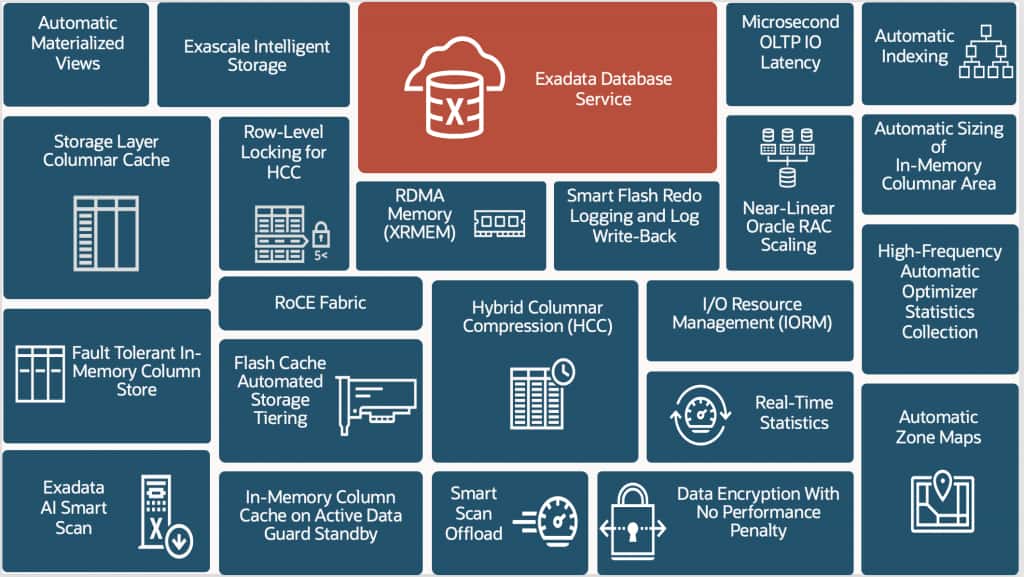
Now you don’t have to wait for your workloads to grow or requirements to become more complex to justify an Exadata, you can start on Exadata right away. “Exadata for everyone” brings Exadata within reach for a much broader range of customers. To learn more about how extreme performance meets low cost with ExaDB-XS, check out this blog.
EE-EP Belongs on ExaDB-XS
RAC, Active Data Guard, and Database In-Memory are powerful on their own. But to get the most from EE-EP, you need to run it on the infrastructure it was built for: Exadata. And when you want the best mix of performance, scale, and cost efficiency, to me, ExaDB-XS is the clear choice. That’s why ExaDB-XS is the right home for EE-EP across OCI and Oracle AI Database services in Azure, Google Cloud, and AWS.