
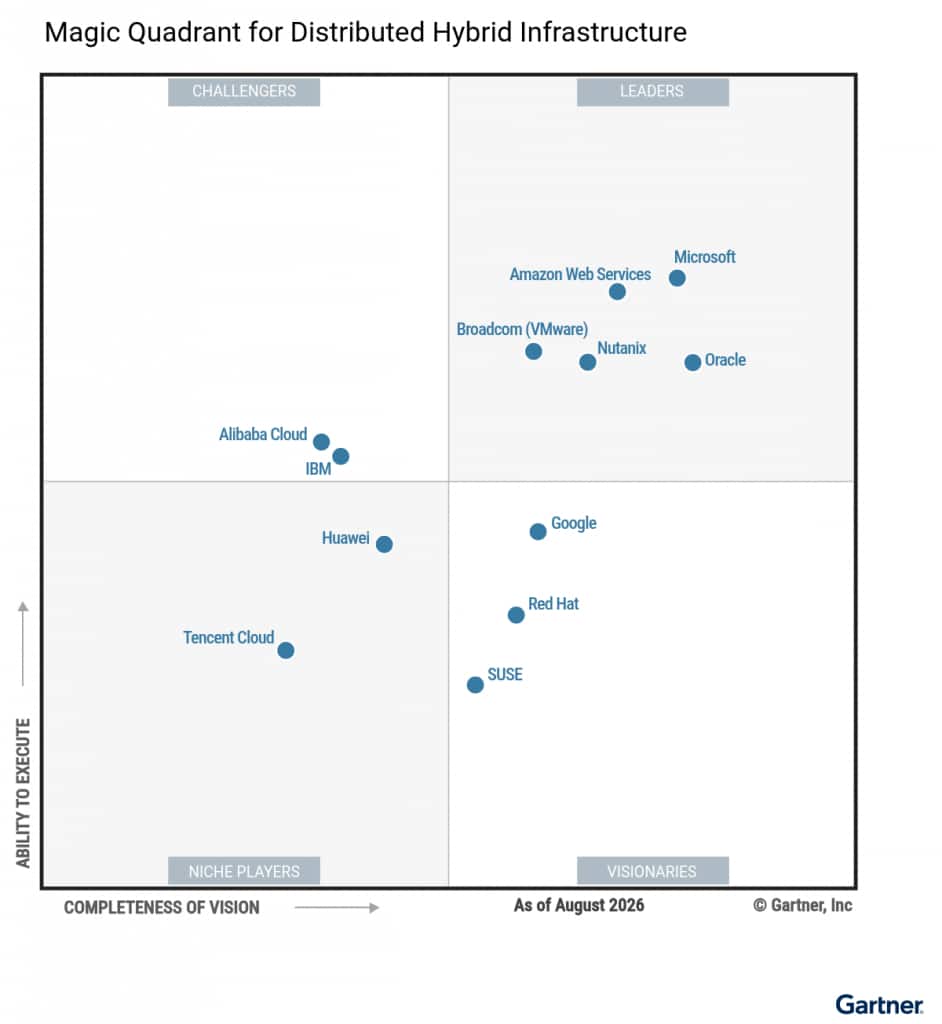
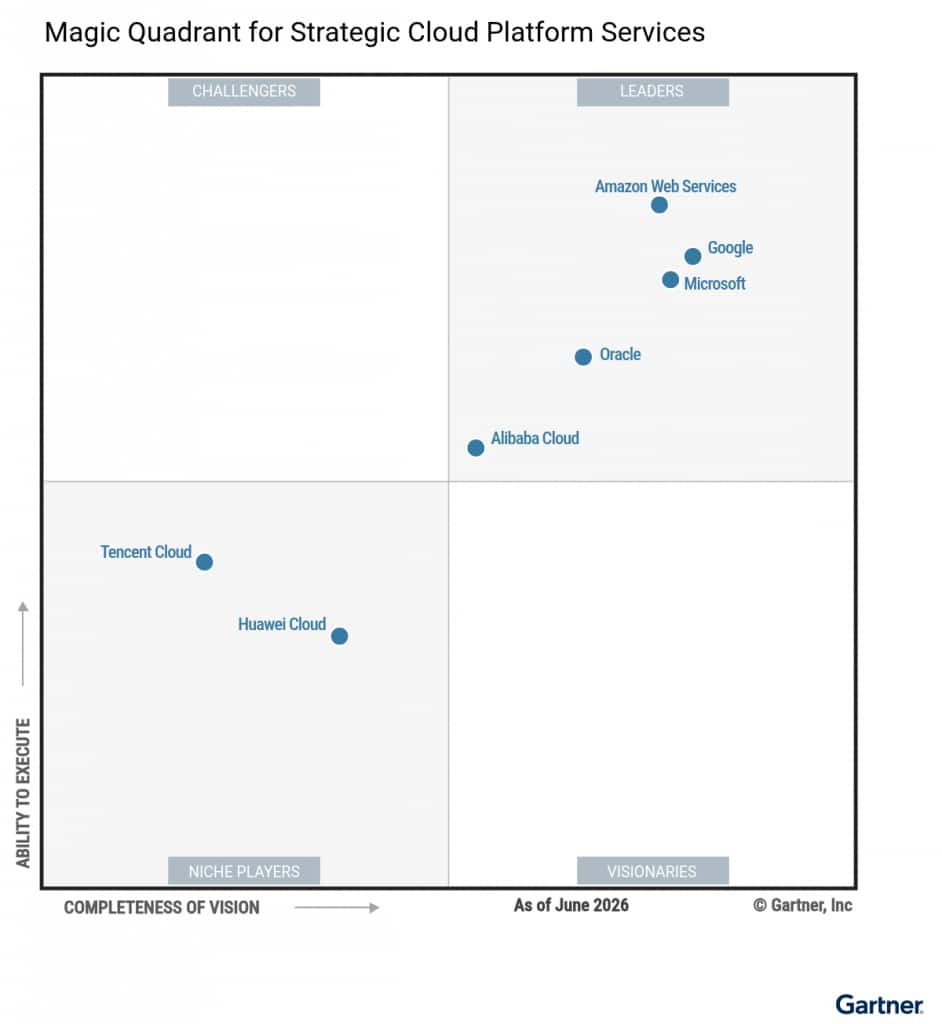
A few weeks ago, Oracle was named a Leader in both the 2026 Gartner® Magic Quadrant™ for Strategic Cloud Platform Services and the 2026 Gartner® Magic Quadrant™ for Distributed Hybrid Infrastructure. This is the fourth consecutive year Oracle has been named a Leader in both categories.
We believe this recognition reflects what we’ve focused on since the beginning of OCI, which is to build cloud infrastructure that gives customers the performance, security, flexibility, and economics they need to run their most demanding workloads.
We’re seeing that approach scale around the world. OCI now has more than 225 live and planned cloud regions, and we added 850 MW of data center capacity this past quarter.
Infrastructure engineered for AI and enterprise scale
AI and enterprise workloads are getting larger and more demanding. More compute is only part of the answer. The network, storage, security, and economics all have to scale with it.
OCI was designed around a few fundamental architectural choices that become increasingly important as these workloads grow.
- Oracle Acceleron offloads network and storage virtualization from compute hosts, helping customers get more of the CPU for their workloads while delivering higher throughput, lower latency, and strong isolation.
- OCI Supercluster combines bare metal GPUs with high-speed RDMA networking to build some of our largest AI clusters. OCI Superclusters can scale beyond 100,000 NVIDIA GB200 Superchips or 800,000 to 1 million GPUs for large-scale AI training and inference.
- Cloud economics are part of the architecture too. Flexible compute sizing, consistent global pricing, and lower data egress costs help control the cost of running at scale. For specific published configurations, Oracle’s cloud economics comparison shows OCI at 50% less for compute, 70% less for block storage, and 80% less for networking compared with other hyperscalers.
- Security by design starts with isolation. Custom SmartNICs separate network virtualization from compute hosts, while a hardware-based root of trust helps ensure servers start from known firmware when provisioned for a new tenancy.
Gartner highlights OCI’s massive-scale AI infrastructure, including superclusters exceeding 800,000 to 1 million GPUs and non-oversubscribed RDMA networking.
We believe this is what AI infrastructure increasingly requires. Compute, networking, storage, and security have to be engineered to work together as the infrastructure scales.
Customers putting this infrastructure to work at scale
Uber runs thousands of microservices, large-scale data workloads, and dozens of AI models on OCI, supporting more than one million trips per hour and up to 14 million AI predictions per second.
OpenAI chose OCI to provide additional infrastructure capacity for its AI workloads, using OCI’s high-performance compute and networking to scale AI training and inference.
These are very different workloads, but both depend on infrastructure that can deliver compute, networking, and data access at significant scale.
Bring the cloud to where workloads need to run
Not every workload can or should move to a public cloud region. Sovereignty, regulation, latency, security, and operational requirements can determine where infrastructure and data need to reside.
We built OCI to operate across those environments, including customer data centers, partner-operated clouds, sovereign environments, and disconnected locations.
- Oracle Alloy enables partners to operate an OCI-based cloud with more than 200 services under their own brand and commercial model. Partners have greater control over operations and change management to address customer regulatory and sovereignty requirements.
- OCI Dedicated Region deploys a full OCI region in a customer’s data center with access to more than 200 OCI services. Customers can start with a three-rack footprint and expand as their requirements grow.
- OCI Cloud Isolated Region delivers OCI capabilities in highly secure, air-gapped environments. Customers maintain control over their data and operations while addressing sovereignty, security, and regulatory requirements.
Gartner highlights Oracle’s public cloud parity, broad use-case suitability, and multicloud support across tactical edge, rack-scale database, Oracle-hosted, air-gapped, and white-labeled environments.
We believe this reflects a fundamental part of the OCI architecture. Instead of asking customers to adapt their workloads to a single cloud model, OCI can be deployed based on where those workloads and data need to run.
Customers putting this model to work around the world
NRI runs OCI Dedicated Regions in Tokyo and Osaka and uses Oracle Alloy to operate OCI cloud and AI services in Japan, with the governance and data sovereignty needed for financial services.
Vodafone is consolidating 40 data centers into six OCI Dedicated Regions across three countries, moving thousands of databases and applications to OCI while maintaining local control and low-latency access.
SoftBank is deploying Oracle Alloy across eastern and western Japan to offer more than 200 OCI cloud and AI services, including locally operated GPU infrastructure for sovereign and generative AI.
The Government of the Sultanate of Oman selected OCI Dedicated Region for a national initiative to move more than 120 government and semi-government entities to a single government cloud platform, keeping sensitive government workloads and data in country.
These deployments are very different, and that is the point. OCI can support different technical, operational, and regulatory requirements without forcing every workload into the same deployment model.
Accelerating AI directly in the database
Enterprises already have the data they need to get value from AI. The challenge is that it sits across databases, applications, data centers, and clouds. Moving that data to another platform for AI adds cost, latency, and complexity.
Our approach is to move AI closer to the data and make the database available where applications already run.
- Oracle AI Data Platform makes enterprise data available to AI without creating another data silo. It works across structured and unstructured data while preserving lineage and business context, supporting model choice, and connecting AI agents to operational workflows.
- MySQL HeatWave runs transactions, real-time analytics, lakehouse, machine learning, and generative AI in one managed MySQL service. Customers do not need separate systems for each workload or the data movement that comes with them.
- Oracle AI Database 26ai runs AI where enterprise data already lives. AI Vector Search, natural-language-to-SQL, RAG, vector indexing, and AI agents work directly with relational, JSON, graph, spatial, and vector data.
- Oracle Exadata is engineered for demanding Oracle Database workloads, combining scale-out compute, intelligent storage, PCIe flash, and high-speed RDMA networking in a single system.
- Multicloud AI Database runs Exadata-based Oracle Database services directly inside AWS, Azure, and Google Cloud data centers. This puts the database close to applications and native AI services while reducing the need to move data across clouds.
Gartner highlights Oracle’s multicloud database architecture as a differentiator, including Exadata-based Oracle Database infrastructure deployed directly inside AWS, Azure, and Google Cloud.
We believe this architecture matters because enterprise AI should not require enterprises to reorganize where all their data lives. Customers can use AI with their enterprise data and run Oracle Database close to their applications, whether those applications are in OCI, AWS, Azure, or Google Cloud.
Customers running mission-critical workloads on this architecture across clouds
Fidelity Investments is adopting Oracle Database@AWS, running Exadata Database Service and Autonomous Database on OCI infrastructure inside AWS. This puts Oracle Database close to its AWS applications with the low-latency connectivity needed for financial services workloads.
PepsiCo is using Oracle Database@Azure for mission-critical systems and data in Microsoft Azure, putting Oracle Database directly alongside the Azure applications and services it uses across its global operations.
The idea is simple. Run Oracle Database where the applications already run, rather than moving data between clouds to get to the database.
Built for what comes next
AI is changing what customers need from cloud infrastructure. Clusters are getting larger. Networks are getting faster. And where compute and data reside is becoming just as important as how much of each a customer can access.
That is what we are building OCI for. Give customers the performance to run their most demanding workloads, the ability to deploy cloud infrastructure where they need it, and access to AI where their enterprise data already resides.
We believe Oracle’s recognition across the 2026 Gartner research provides customers with another perspective as they evaluate the infrastructure they will need for what comes next.
You can learn more by reading the 2026 Gartner® Magic Quadrant™ for Strategic Cloud Platform Services and the 2026 Gartner® Magic Quadrant™ for Distributed Hybrid Infrastructure.
Gartner, Inc. Critical Capabilities for Strategic Cloud Platform Services. Dennis Smith, Dougles Toombs, etl. 1 September 2026.
Gartner, Inc. Magic Quadrant for Distributed Hybrid Infrastructure. Julia Palmer, Elaine Zhang, etl. 7 September 2026.
Gartner, Inc. Magic Quadrant for Strategic Cloud Platform Services. Alessandro Galimberti, Carolin Zhou, etl. 1 September 2026.
Gartner and Magic Quadrant are trademarks of Gartner, Inc. and/or its affiliates.
Gartner does not endorse any company, vendor, product or service depicted in its publications, and does not advise technology users to select only those vendors with the highest ratings or other designation. Gartner publications consist of the opinions of Gartner’s business and technology insights organization and should not be construed as statements of fact. Gartner disclaims all warranties, expressed or implied, with respect to this publication, including any warranties of merchantability or fitness for a particular purpose.
This graphic was published by Gartner, Inc. as part of a larger research document and should be evaluated in the context of the entire document. The Gartner document is available upon request from Magic Quadrant for Distributed Hybrid Infrastructure and Magic Quadrant for Strategic Cloud Platform Services.