


AI initiatives often begin as isolated experiments: a limited dataset, a small proof of value, and no connection to systems of record. This is an appropriate starting point for validating a use case and establishing practical skills. The architecture must change, however, when an AI workload accesses enterprise data, informs business decisions, or initiates enterprise actions.
At that point, data classification extends to derived artifacts; workload identities require precise authorization; probabilistic output can affect transactional processes; and model releases can move faster than established change controls. The design objective is no longer to demonstrate a model. It is to operate AI as a dependable enterprise workload domain.
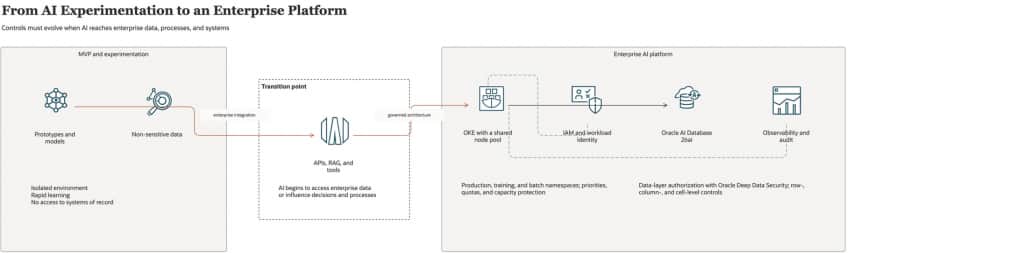
Figure 1. From AI Experimentation to an Enterprise Platform. Controls must evolve when AI reaches enterprise data, processes, and systems.
Establish a boundary between experimentation and production
A single control regime is rarely appropriate for both experimentation and production. An experimentation zone can use proportionate safeguards when its data is non-sensitive and it has no route to systems of record. An AI-touching-production zone should be governed as an extension of the systems, data, and processes it reaches.
This distinction allows teams to move quickly without creating an implicit production path. It also gives architects a clear point at which security, operations, resilience, and accountability controls become mandatory.
Protect production in a shared AI platform
A shared AI platform can reduce operational overhead and improve infrastructure utilization. It does not remove the need to protect production workloads. In Oracle Cloud Infrastructure Container Engine for Kubernetes (OKE), production and training workloads can share managed node capacity only when logical isolation and capacity controls are explicit.
• Prioritize production workloads: Use higher scheduling priority and reserve capacity for production service-level objectives.
• Constrain training and batch workloads: Apply namespace quotas, requests and limits, concurrency controls, and lower-priority policies.
• Maintain an operating procedure: Throttle, suspend, or evict lower-priority workloads when production service levels are at risk.
Apply Zero Trust from workload to data
Use OKE workload identity to grant pods the OCI access they need without distributing long-lived credentials.
Zero Trust controls must follow every access path, from the calling workload to the data it requests. OCI IAM, workload identity, Vault, private endpoints, Network Security Groups, private API Gateway, and OCI Network Firewall provide complementary controls for authenticating, authorizing, and restricting private access.
For sensitive data, authorization should not depend solely on prompts or application logic. Oracle AI Database 26ai with Oracle Deep Data Security can enforce least-privilege access directly at the data layer. Data Roles and Data Grants can limit each agent to approved operations and business domains, while row-, column-, and cell-level controls reduce exposure further. Apply the same authorization approach to relational data, JSON views, and vector embeddings used for retrieval-augmented generation.
For policy design details, see Oracle Deep Data Security Data Grants.
Separate traffic domains and make routing intentional
Enterprise applications and AI workloads should remain in separate network domains, with explicitly defined routes and controls between them. In a private-only pattern, on-premises users and enterprise systems reach OCI through FastConnect or IPSec VPN. A primary Dynamic Routing Gateway (DRG) connects the Hub, Enterprise, and AI Platform VCNs, while route tables steer approved private ingress through OCI Network Firewall. Service gateways and private endpoints limit exposure to approved OCI services and private data paths.
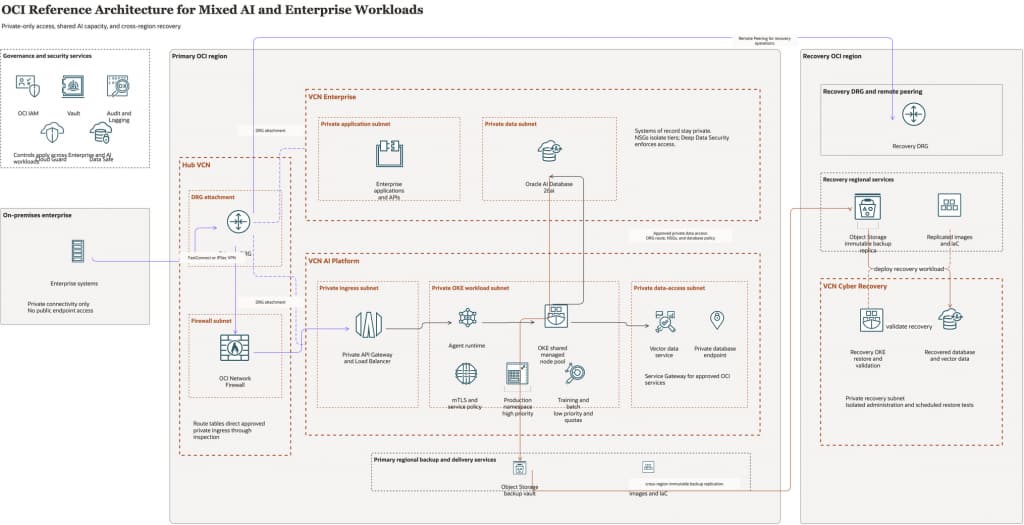
Figure 2. OCI Reference Architecture for Mixed AI and Enterprise Workloads. Private-only traffic is routed through FastConnect or IPSec VPN, the DRG, and approved inspection paths; Enterprise and AI Platform VCNs remain separate, with cross-region recovery based on immutable replicated backups.
Operate and recover the platform
A production AI platform needs the same operational discipline as other business-critical services, with additional attention to inference demand, model and data drift, retrieval quality, and policy decisions. OCI Logging, Monitoring, Alarms, and Audit provide operational evidence; Cloud Guard helps identify risky configurations and activity; and Oracle Data Safe strengthens the protection and assessment of database environments.
Recovery should be designed and tested before a critical workload depends on the platform. A recovery region can use immutable Object Storage backups, recovery OKE resources, and restored data and indexes to validate the recovery path. The required recovery time objective and recovery point objective should be defined for each business service, not assumed from the underlying platform.
For a broader resilience framework, review OCI disaster recovery guidance.
Plan the first production workload
The first production workload should establish repeatable patterns rather than become a special case. A practical sequence is:
- Foundation. Define compartments, IAM, network boundaries, logging, auditing, and the ownership model.
- Shared AI platform. Deploy OKE, namespaces, shared-node-pool capacity controls, ingress, secrets, observability, and data-access patterns.
- First workload onboarding. Apply the production identity, authorization, performance, safety, and release controls to one high-value workload.
- Operational readiness. Test recovery, validate monitoring and alerting, document incident procedures, and confirm production capacity protection.
An initial production release commonly requires 16 to 24 weeks, depending on enterprise integration, data sensitivity, existing cloud foundations, and approval processes. This is an indicative planning range, not a fixed OCI benchmark. The OCI Cloud Adoption Framework helps teams assess the organizational and technical capabilities that influence this timeline.
Move from value demonstration to sustainable value
An AI MVP proves potential. A governed enterprise platform makes that potential repeatable. By separating AI and enterprise traffic domains, protecting production capacity on shared infrastructure, enforcing authorization at the data layer, and testing recovery as an operating capability, organizations can scale AI adoption without compromising the services that run the business.
Next step: Use the OCI Cloud Adoption Framework to assess the foundational capabilities required for your first production AI workload.