

In April 2026, PocketOS reported that an AI coding agent, while troubleshooting an issue in a staging environment, found an API token with broad permissions and used it to delete the company’s production database. The agent took this action without the developer requesting or approving it, as reported by The Guardian.
The incident highlights a fundamental challenge for enterprise identity. Giving an agent access to a system does not mean its owner has approved every action the agent can perform. As enterprises delegate more responsibilities to AI, they need to enact stronger controls to limit what agents can do and determine when sensitive operations require additional authorization or human approval.
At Oracle, we have encountered this challenge as we explore the use of AI in enterprise workflows. When we connected Enterprise ChatGPT to our internal systems, our priority was preserving employee permissions so AI could access only the information each person was authorized to see. With Codex and agents for operators, AI began using tools in environments where employees already had access to production systems. We introduced just-in-time access, least-privilege reviews, and human approval for sensitive operations in those rollouts to keep agent actions within approved boundaries.
These experiences have reinforced our belief that AI agents require us to rethink how authentication and authorization are applied. Oracle Cloud Infrastructure Identity and Access Management (OCI IAM) already provides authentication, authorization, and identity management capabilities for users, applications, and workloads. We are exploring ways to extend these capabilities to support the additional demands of AI agents as they make decisions, delegate work, and interact with enterprise systems.
Why AI agents place new demands on identity
A single request can now involve many independently acting agents, some operating for only a few minutes. An operator investigating an incident might use an agent that delegates work to specialized agents. If they share the operator’s credentials or a common application identity, audit records may identify the account but not which agent performed an action. This makes it difficult to establish accountability after the task ends.
Agents also need permissions that change as their work progresses. An agent may start by examining logs and metrics, then determine that remediation requires changing a configuration. Giving it broad access upfront creates unnecessary risk, while limiting it to read-only access can prevent it from completing the task. Enterprises need a way to adjust permissions as tasks evolve without exceeding established access limits.
Even when an agent has permission to perform an operation, the circumstances matter. An agent cleaning up unused resources might have permission to delete databases, but deleting one that supports a production service could disrupt customers. Enterprises need to establish safeguards to determine when an authorized action should proceed, be blocked, or require human approval.
Building on OCI IAM’s identity foundation
OCI IAM already provides authentication, workload identities, federation, centrally managed policies, and audit. We have also extended its standards-based OAuth capabilities to support AI applications connecting to enterprise tools through the Model Context Protocol (MCP). These capabilities include authorization server discovery, Client ID Metadata Document (CIMD) support, resource-specific access tokens, and Cross-App Access. They help applications establish trusted connections and preserve authorized access across systems.
Our next focus is extending this foundation to address how agents operate at scale and how their authority changes during execution.
Making every agent accountable
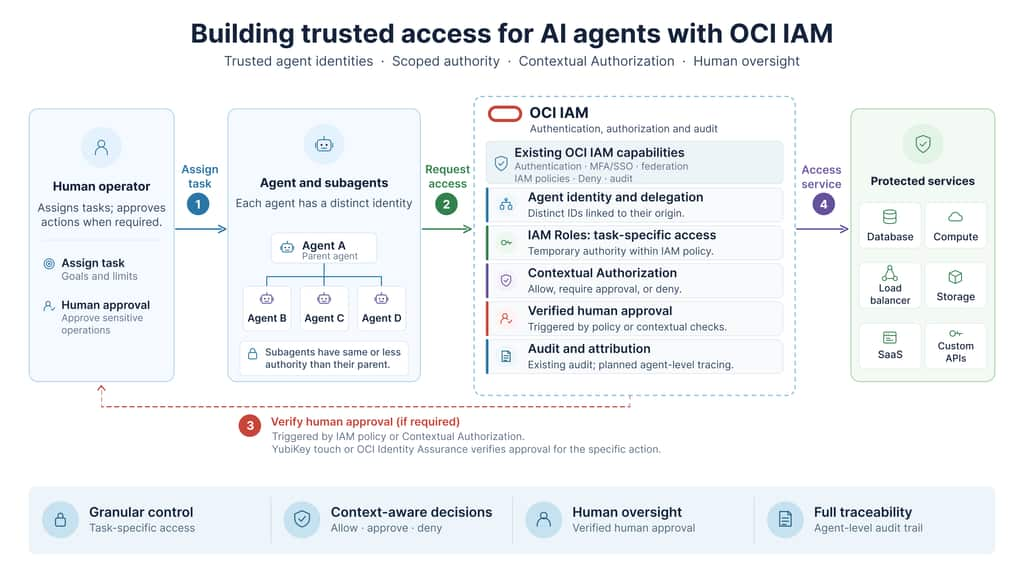
We are developing distinct, short-lived identities for individual agents and subagent executions. These identities are intended to be linked to the user, workload, or parent agent responsible for their creation. The approach is designed to support attribution across delegated tasks and retention of audit records after execution ends. This is intended to give customers visibility into which agent performed an operation, whose authority it exercised, and how that authority was delegated.
Giving agents only the authority their tasks require
IAM Roles are being developed to allow authorized users and agents to assume defined permissions for limited periods. As tasks evolve, agents would be able to request additional authority within the maximum permissions established by IAM policy. Subagents would be limited to the same or narrower permissions than the delegating agent. This approach is designed to help reduce dependence on broad standing access while allowing agents to complete tasks whose exact steps cannot be predicted in advance.
Determining whether an authorized action should proceed
To support context-aware access decisions, Oracle is developing capabilities intended to help evaluate whether an operation permitted by IAM policy should proceed under the current conditions. Using available trusted signals, contextual authorization could help determine whether to allow the operation, require additional human approval, or deny it. For example, it could block an agent from deleting a database or require verified human approval before proceeding, even when the agent has delete permission.
Keeping people in control of consequential actions
Human approval could be incorporated into authorization workflows by IAM policy for designated sensitive operations or by Contextual Authorization when a request warrants additional oversight. When approval is required, OCI IAM could verify the human approver using controls such as YubiKey touch or biometric verification through OCI Identity Assurance and bind the approval to the specific action.
Keeping enterprises in control
AI agents are making it possible to delegate increasingly complex work. Enterprises should be able to benefit from that capability without giving agents unrestricted authority over critical systems.
The identity principles that have long protected enterprise systems remain essential. What changes is the need to apply them to many independently acting agents, permissions that change as work progresses, and decisions that must account for the consequences of an action.
At Oracle, exploring ways to extend OCI IAM’s established capabilities and standards-based approach to support identity and access management for AI agents. The goal is to help organizations delegate meaningful work to AI agents while maintaining appropriate oversight and access controls over who acts, what they can do, and when an action should proceed.