
In the world of life sciences, the speed of discovery is everything. From sequencing a human genome to simulating molecular interactions for a new drug, researchers are in a constant race against time where the stakes couldn’t be higher. The cloud revolutionized this race by providing unprecedented access to massive-scale computing. Yet, for the most demanding high-performance computing (HPC) workloads, a hidden bottleneck persists within the standard cloud model: the virtualization layer.
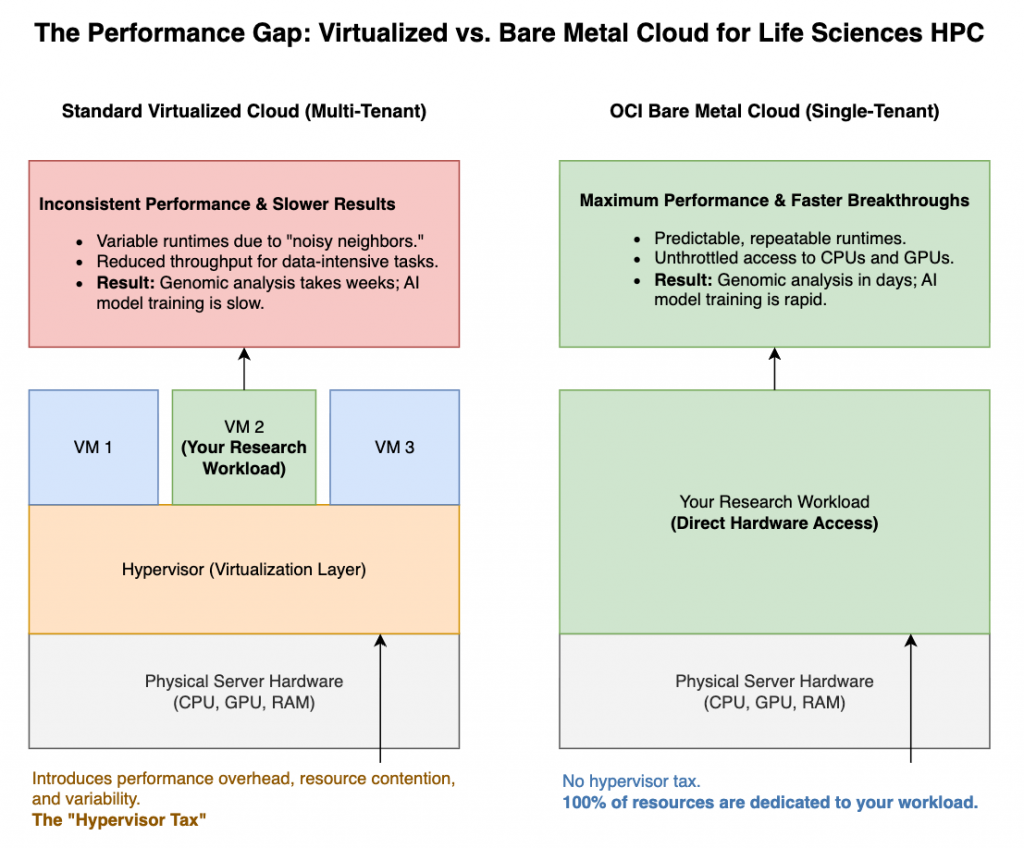
For years, virtual machines (VMs) have been the workhorse of the cloud, allowing multiple tenants to share the resources of a single physical server. This is made possible by a hypervisor—a layer of software that sits between the hardware and the operating system. While brilliant for general-purpose computing, this virtualization introduces a “hypervisor tax” for high-performance workloads. This tax isn’t monetary; it’s a cost paid in performance, predictability, and precious time.
It’s time for a new paradigm. To unlock the next generation of medical breakthroughs, researchers need to move beyond virtualization and harness the raw, unmediated power of bare metal infrastructure.
The Hidden Cost of the “Hypervisor Tax”
In life sciences research, consistency is paramount. Scientific experiments, whether in a wet lab or a computational cluster, must be repeatable. However, the hypervisor in a multi-tenant environment can introduce performance variability, or “jitter,” as it juggles resources between different VMs. This “noisy neighbor” effect means a complex genomic analysis might run in 48 hours one week and 60 hours the next, for no apparent reason.
This unpredictability is detrimental to research timelines and budgets. Furthermore, the hypervisor itself consumes a portion of the server’s CPU and memory, creating an overhead that prevents applications from accessing the full power of the underlying hardware. For workloads like molecular dynamics or training medical imaging AI models, which are incredibly sensitive to latency and require every ounce of available processing power, this performance tax can be the difference between a breakthrough and a bottleneck.
The Bare Metal Advantage: Direct, Predictable, and Secure Power Bare metal cloud infrastructure eliminates the hypervisor tax by giving you what the name implies: a dedicated, single-tenant physical server. There is no virtualization layer, no resource sharing, and no noisy neighbors. Your workload runs directly on the hardware, commanding 100% of the server’s resources.
For life sciences, the advantages are transformative:
- Maximum, Predictable Performance: By removing the hypervisor, applications gain direct access to the server’s full CPU, memory, and specialized hardware like NVIDIA GPUs. This results in consistently lower latency and higher throughput, turning computational tasks that once took months into a matter of days.
- Enhanced Security and Isolation: Handling sensitive patient data, genomic information, and proprietary research demands the highest level of security. The single-tenant nature of bare metal instances provides physical isolation, creating a more secure environment that helps meet stringent compliance and data sovereignty requirements.
- The Ideal Platform for HPC: Oracle Cloud Infrastructure (OCI) was purpose-built to run the most demanding enterprise and HPC workloads. OCI’s bare metal compute instances, combined with low-latency RDMA cluster networking, create an environment that mirrors the performance of on-premises supercomputers with the elasticity and scale of the cloud.
From Faster Compute to Faster Cures
What does this mean in practice? It means a genomics lab can process raw sequencing data faster, accelerating the journey toward personalized cancer treatments. It means a pharmaceutical company can run more complex protein folding simulations, drastically shortening the pre-clinical phase of drug discovery. It means data scientists can train more accurate diagnostic AI models on medical images in a fraction of the time, empowering clinicians with better tools to improve patient outcomes.
The era of compromising performance for the sake of scale is over. For the life sciences industry, where every second counts, the raw power and predictable performance of bare metal aren’t just a technical advantage—they are a strategic imperative. The next breakthrough is waiting to be discovered, and it won’t be found on a platform that makes it wait in line.