



Rafael Marcelino Koike
Master Principal Cloud Architect
Video is growing fast in many industries: sports, security, healthcare, and industrial automation. This creates a lot of visual data, hard to analyze without the right tools. Human pose estimation, part of computer vision, helps by detecting and understanding human movement in video.
There are many pose estimation models, but it is not easy to choose the right one. In this post, we compare three models: Poseidon, YOLO, and AlphaPose. We focus on their strengths and use cases, while showing how Oracle Cloud Infrastructure (OCI) enables you to deploy and scale them effectively. Oracle Cloud Infrastructure (OCI) provides a powerful platform for running video AI workloads, offering GPU-based compute, managed data science services, seamless storage and streaming integration to process and analyze video data efficiently.
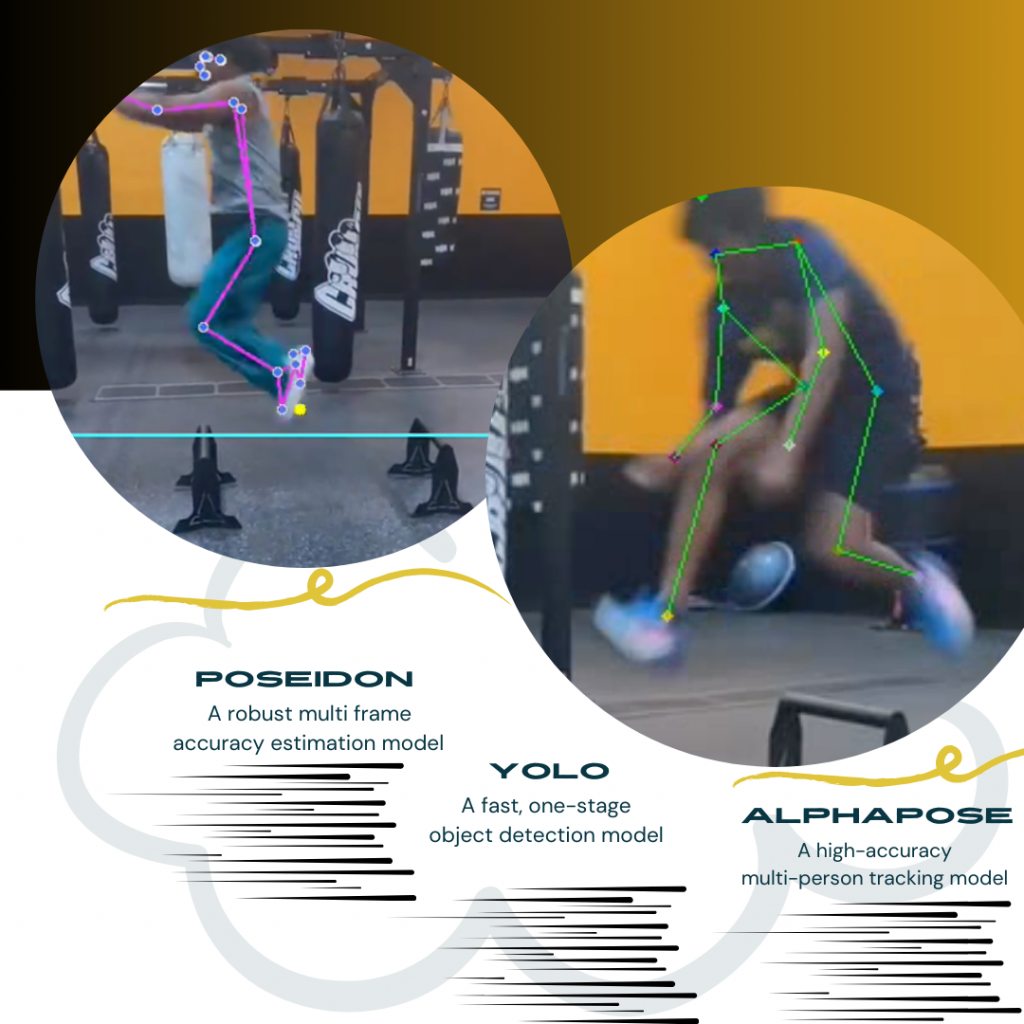
Three Pose Estimation Models
The Landscape of Pose Estimation Models
Different models are designed for different purposes, balancing factors like accuracy, speed, robustness, and specific analytical capabilities. Let’s explore our three contenders.
1. Poseidon: Multi-Frame Accuracy
- What it is: Poseidon is a new model based on ViTPose. It uses information from several frames in the video, not only one frame, to increase accuracy.
- Strengths:
- Uses temporal information to handle occlusion (when body parts are hidden).
- Detects people first, then estimates poses (top-down).
- Exchanges information between frames to improve results.
- Mixes details and high-level patterns together.
- Chooses the most important frames to improve accuracy.
- Use Cases: Sports analytics, robotics, biomechanics, action recognition.
- Considerations: Being a newer research model, it require more technical expertise compared to more established libraries.
2. YOLO (You Only Look Once): Real-Time Speed
- What it is: YOLO is famous for object detection. YOLOv8-Pose extends it for pose estimation. It detects and estimates poses in one pass.
- Strengths:
- Very fast, works in real-time.
- Does detection and pose estimation together.
- Can run on small hardware, even edge devices.
- Easy to use, with large community support.
- Use Cases: Live video monitoring, sports broadcasting, smart cameras, edge AI.
- Considerations:Less accurate in crowded or occluded videos compared to top-down models.
3. AlphaPose: Reliable Multi-Person Tracking
- What it is: AlphaPose is a popular and established model for multi-person 2D pose estimation. Known for accuracy and reliability.
- Strengths:
- Detects fine body parts with high accuracy.
- Tracks full body, including face, hands, and feet.
- Can track people across frames, even with occlusion.
- Works in many areas like AR/VR, healthcare, and surveillance.
- Uses detection first, then pose estimation (top-down).
- Use Cases: Surveillance, crowd analysis, retail analytics, general-purpose.
- Considerations: Strong but heavy. Needs more compute. Newer models may be better in some cases.
Comparative Snapshot
| Feature | Poseidon | YOLO | AlphaPose |
| Primary Focus | High-accuracy, multi-frame pose estimation | Real-time, single-stage detection + pose estimation | General multi-person 2D pose estimation |
| Temporal Aware? | Yes (multi-frame, AFW, Cross-Attention) | No (default), but trackers can be added | Yes (via PoseFlow tracking) |
| Output | Keypoint coordinates, heatmaps | Bounding boxes, keypoints, confidence scores | Keypoint coordinates, tracking IDs |
| Real-time Cap. | Designed for efficiency, but research-focused | Yes, its primary strength | Yes, optimized for real-time |
| Complexity | High (advanced architecture, newer research model) | Low–Moderate (user-friendly libraries, simple) | Moderate–High (requires configs, more setup) |
| Age | Very recent (Jan 2025) | Recent (YOLOv8-Pose, 2023) | Mature, widely used for years |
| Pros | State-of-the-art accuracy, handles occlusion well | Extremely fast, efficient, easy to use | High accuracy, robust tracking, mature ecosystem |
| Cons | Requires advanced setup, harder to deploy | Lower accuracy than top-down models in occlusion | Computationally intensive, heavier resource usage |
Running Pose Estimation in the Cloud
When a customer wants to deploy pose estimation, the first step is to decide how much customization is needed. Some projects only need simple video analysis (for example, detecting people or objects in video clips). Others require advanced models for accuracy, speed, or multi-person tracking. OCI gives a path for both.
1. Start simple with managed services
If the need is basic detection or classification, OCI Vision offers prebuilt models. You upload video to Object Storage, and Vision can detect objects, labels, or text. This is the fastest way to prototype without training your own model.
2. Move to custom models when requirements grow
For use cases where prebuilt models are not enough, OCI Data Science helps you bring your own models like Poseidon, YOLO, or AlphaPose. You can:
- Train or fine-tune on GPU shapes.
- Save models in the Model Catalog.
- Deploy them as APIs through Model Deployments.
3. Match the model to the need
- Poseidon or AlphaPose: choose when accuracy and robustness matter most. Deploy on GPU instances.
- YOLO: choose when speed and cost efficiency are most important. Works even on smaller instances or edge hardware.
4. Scale and integrate
Once deployed, you can scale based on video volume or latency needs. Integration with Object Storage, Streaming, or Functions helps build end-to-end video pipelines. Security is handled inside your VCN.
Decision Flow: How to Get Started
- Need basic video analysis fast? Use OCI Vision.
- Need accuracy and robustness (sports, healthcare, research)? Use Poseidon or AlphaPose on GPUs.
- Need real-time speed (security, broadcasting, edge devices)? Use YOLO with a lighter deployment
Want to dive deeper?
Learn more about the open-source models featured in this post:
- Poseidon – Multi-frame transformer-based pose estimation
- YOLO – Real-time pose detection and estimation (check the latest YOLO-Pose code on the Ultralytics site)
- AlphaPose – Accurate multi-person pose estimation and tracking
Once you understand the models, try deploying them on OCI GPU shapes using OCI Data Science or Oracle Container Engine for Kubernetes (OKE) to experience scalable, high-performance inference firsthand.
Conclusion
Poseidon, YOLO, and AlphaPose are not one-size-fits-all. Each matches a different customer need: highest accuracy, fastest speed, or strong tracking. The key is to start from your business problem and map it to the right model.
On Oracle Cloud Infrastructure you can take two paths. If you need quick results with simple detection, start with OCI Vision. If you need advanced control, deploy custom models like Poseidon, YOLO, or AlphaPose. From there you can scale, integrate with video pipelines, and control cost.
By choosing the right model and the right deployment path, you can move from raw video to decisions that improve customer experience, safety, or efficiency.
Rafael Marcelino Koike
Master Principal Cloud Architect
Rafael M. Koike is a Master Principal Cloud Architect at Oracle Cloud Infrastructure (OCI), specializing in high-performance computing (HPC), artificial intelligence, and large language models (LLMs). With deep expertise in cloud-native storage, networking, security, and application development, Rafael helps enterprises architect cutting-edge solutions that accelerate innovation and transform complex workloads into scalable, OCI-powered platforms.