
Operational data already knows when revenue is at risk. A high-value order is inserted. A payment fails. A customer order is cancelled. A suspicious order is deleted and recreated. The problem is that business teams often discover these events through dashboards, batch reports, or manual checks after the moment to act has already started to pass.
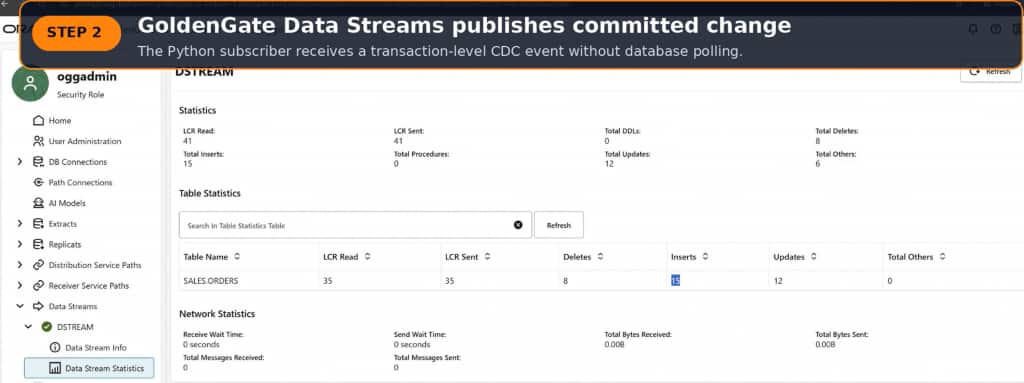
OCI GoldenGate Data Streams creates an opportunity to close that gap. Instead of asking applications to poll the database for changes, Data Streams exposes committed transaction changes captured by GoldenGate as event streams that applications can subscribe to. In Oracle documentation, Data Streams is positioned as an approach for developers and data scientists to access real-time transactional data captured by Oracle GoldenGate, helping streamline ingestion and reduce the need for intermediary systems. [1]
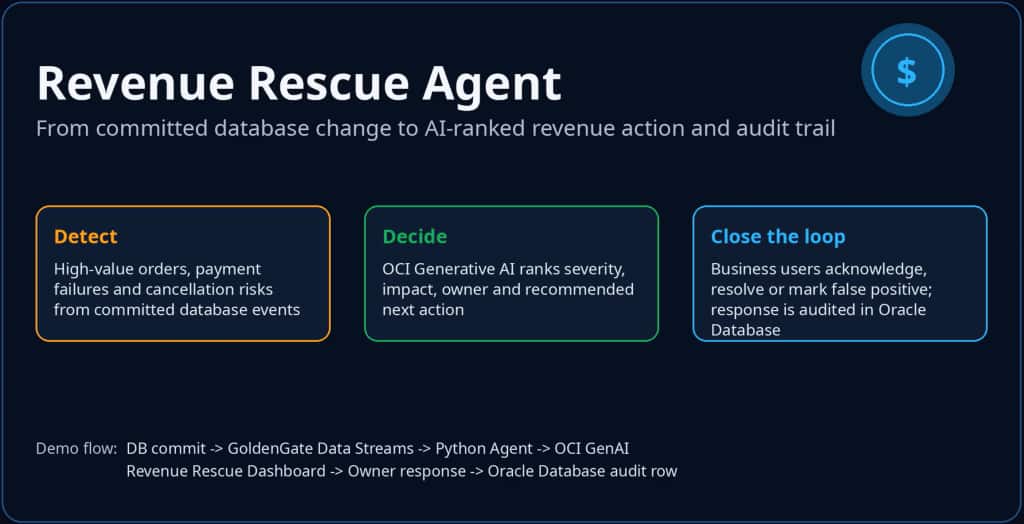
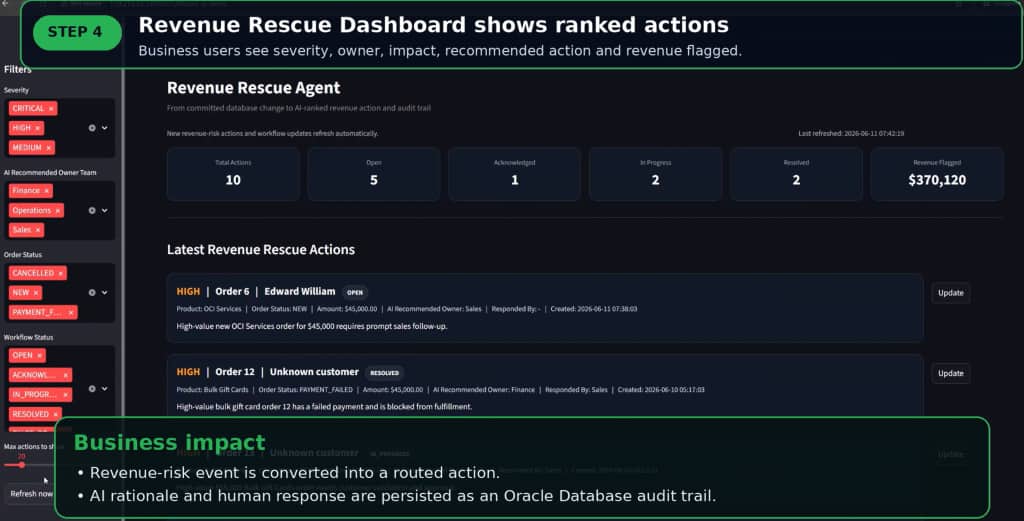
In my demo, I used this capability to build a small but practical pattern: Revenue Rescue Agent. The idea is simple: when a revenue-risk event is committed in the database, an AI agent evaluates the business risk, recommends the next action, assigns the right owner team, stores an audit record, and lets users close the loop from a dashboard.
Why Data Streams matters
Many teams already use GoldenGate for replication or change data capture. Data Streams extends the value of those captured changes by making them directly consumable by applications and agents. The feature uses a publish/subscribe model powered by AsyncAPI, and updates can be received as soon as changes are committed in the source database. It also supports flexible data formats, such as JSON, for easier integration with development frameworks and tools. [2]
- No polling loop: Subscribers receive pushed change events instead of repeatedly querying tables for updated rows.
- Committed transaction context: The agent reacts to changes that have actually been committed to the database.
- Application-friendly access: A lightweight client can subscribe over a secured WebSocket feed and consume changes in a familiar format.
- Event-driven AI pattern: Database change events become triggers for AI analysis, routing, and action rather than raw technical notifications.
Demo use case: Revenue Rescue Agent
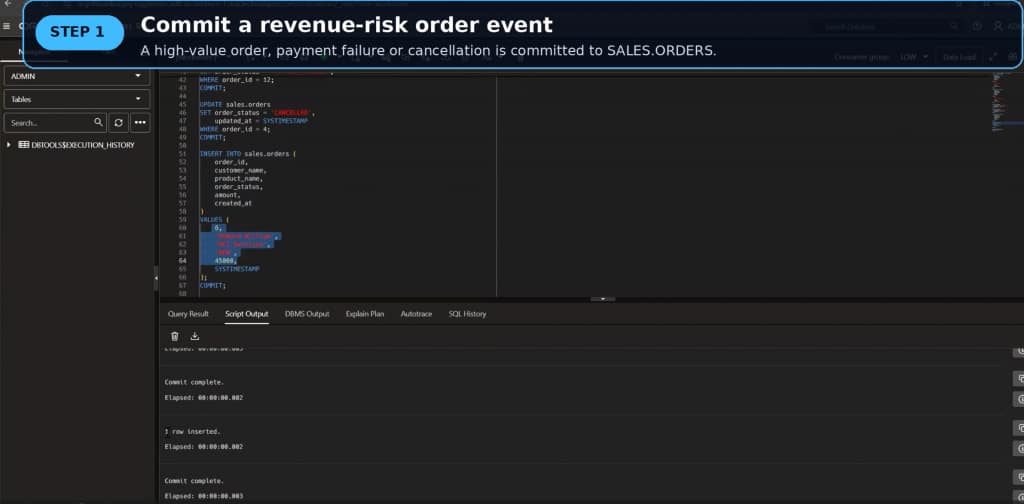
The demo uses a simple order table, SALES.ORDERS, with fields such as order ID, customer name, product name, order status and amount. The source database commits order changes, GoldenGate captures them, and Data Streams pushes the events to a Python subscriber.
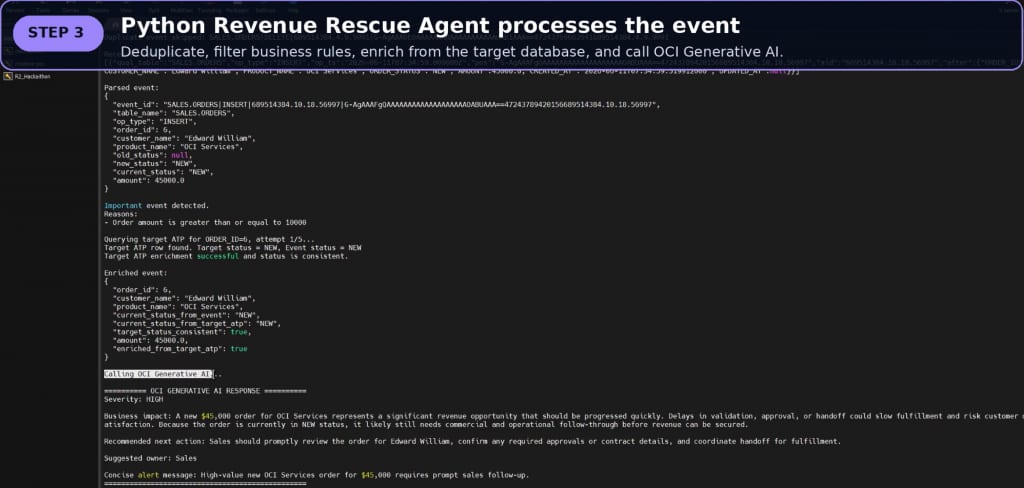
The Python agent is intentionally lightweight. It listens for pushed events, deduplicates by GoldenGate event position, filters for meaningful business exceptions, enriches the event with target database context, calls OCI Generative AI, and writes the result into an alert table for dashboard and audit history.
| Revenue-risk events detected | Agent action |
| High-value order amount crosses threshold | Rank severity and route to Sales for validation and follow-up |
| Payment failed | Explain revenue impact and route to Finance for retry or collection action |
| Order cancelled or deleted | Explain fulfillment/customer risk and route to Operations for validation |
| Target row lags behind the stream event | Flag possible apply lag or downstream consistency risk |
What makes this different from a normal alert?
A normal alert usually says something happened. Revenue Rescue Agent tries to answer the operational questions that matter immediately:
- How severe is this event?
- Why does it matter to the business?
- Who should own the response?
- What should they do next?
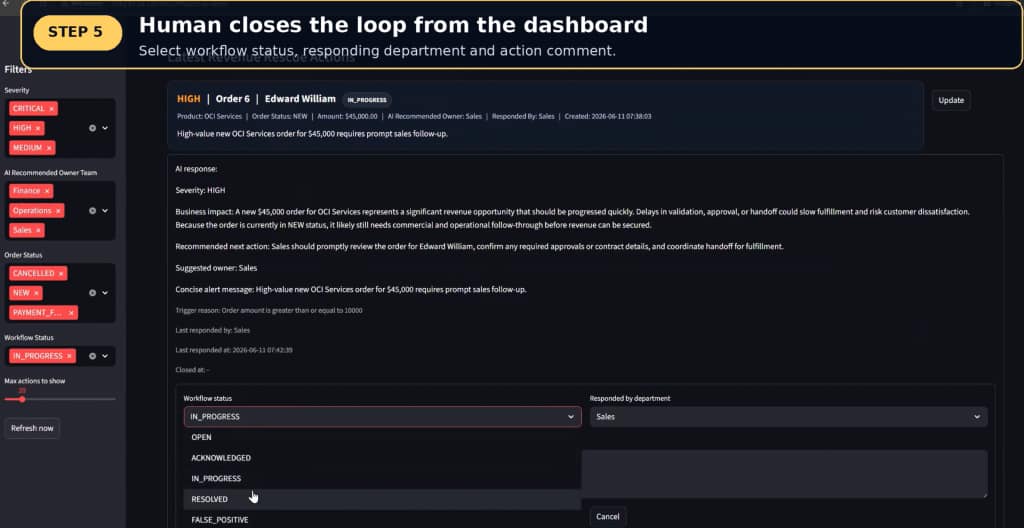
- Was the issue acknowledged, resolved or marked false positive?
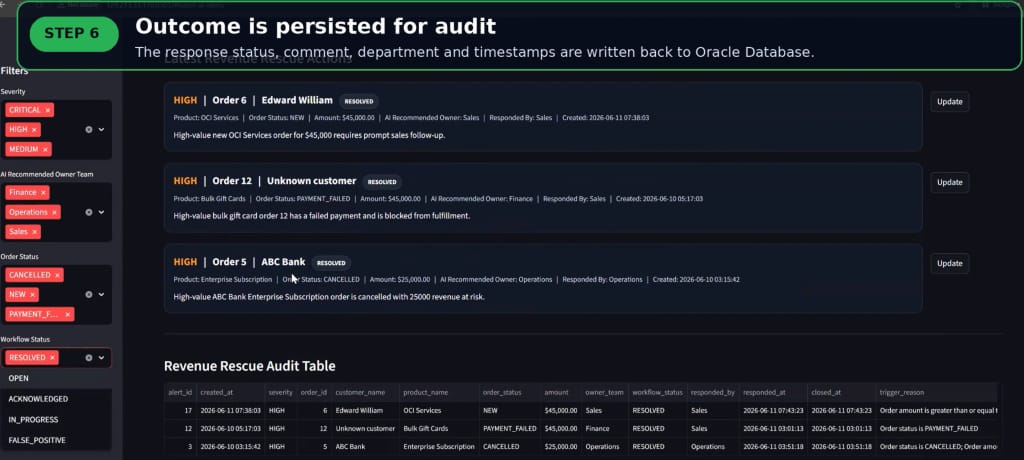
- Where is the audit trail?
This turns a database event into a governed action loop:
Detected → AI-ranked → Routed → Acknowledged → Resolved / False Positive → Audited
| Business value | What it means for users |
| Faster revenue-risk visibility | High-value orders, payment failures and cancellations surface as actionable events instead of waiting for manual checks. |
| Less custom polling code | The subscriber reacts to pushed change events, avoiding repeated SELECT jobs, last-updated tracking and polling state management. |
| More useful alerts | Each alert includes severity, business impact, recommended owner and next action rather than raw CDC payloads. |
| Closed-loop operations | Users can acknowledge, move to in-progress, resolve or mark false positive, with the outcome stored back to the database. |
| Auditability | AI rationale and human response are persisted in Oracle Database for review and reporting. |
Where this pattern can go next
Although the demo focuses on orders, the same event-driven AI pattern can apply to many operational domains:
- Renewal risk and contract changes
- Payment and refund monitoring
- Customer support escalation events
- Supply-chain exceptions
- Fraud or abuse signals
- Compliance-sensitive master data changes
The broader value is not that every use case needs a new dashboard. The value is that Oracle GoldenGate Data Streams can convert trusted database changes into real-time events that AI agents and applications can act on, while Oracle Database remains the system of record for both business data and the resulting action history.
Conclusion
OCI GoldenGate Data Streams makes it easier to move from database replication to event-driven action. In the Revenue Rescue Agent demo, committed order changes become revenue-risk actions that are ranked by OCI Generative AI, routed to the right owner team and stored in Oracle Database with a human response trail.
That is the shift worth highlighting: not another dashboard, and not just a chatbot. It is a reusable Oracle pattern for turning committed transaction changes into governed, AI-assisted business action.
References
[1] Oracle GoldenGate Data Streams documentation: About Data Streams: https://docs.oracle.com/en/middleware/goldengate/core/23/coredoc/distribute-oracle-goldengate-data-streams-service.html
[2] OCI GoldenGate documentation: Add Data Streams: https://docs.oracle.com/en-us/iaas/goldengate/doc/add-data-streams.html
[3] Oracle blog: Connecting to OCI GoldenGate Data Streams API Endpoints: https://blogs.oracle.com/dataintegration/connecting-to-oci-goldengate-data-streams-api-endpoints