
Business teams don’t struggle because they lack data, they struggle because they can’t get answers fast enough. Questions like “Where are we gaining or losing market share?”, “Which opportunities should we act on right now?”, or “What’s driving revenue growth this quarter?” often turn into a back-and-forth with analysts, delayed dashboards, or complex SQL queries that only a few people can write and maintain. That lag slows decision-making and in a market where speed matters, delays can hurt your business.
At the same time, data volumes are growing and business questions are becoming more nuanced. The expectation for real-time answers is no longer limited to technical teams. But access to data hasn’t kept up as most business users still rely on a small group of analysts or engineers to interpret and deliver insights. That model breaks down when decisions need to happen quickly and iteratively.
Oracle AI Database is changing that dynamic by allowing users to ask complex analytical questions in natural language and get answers back immediately. Because the AI is built directly into the database, users can query data where it already lives without moving it, stitching together multiple tools, or waiting on integrations. Anyone can ask a question and get a clear answer right away. No translation step. No waiting. Just faster answers, fewer bottlenecks, and a more direct, streamlined path from question to insights.
This isn’t about replacing analysts. It’s about removing the repetitive work that slows them down so they can spend more time on the interesting problems like building models, uncovering patterns, and driving new ideas forward. At the same time, more people across the business can get the answers they need without waiting in line.
One pattern, many industries
That challenge does not stay confined to one team or one industry. Across the business, the pattern is the same: people know the question they need to ask, but they still lose time waiting for the answer. What changes is the context, and what they do with that answer once they have it.
That challenge doesn’t stay confined to one team or one industry. Across industries, the pattern is the same, people know the question they need to ask, but they still lose time waiting for the answer. What changes is the context, and what they do with that answer once they have it.
In retail, a merchandising lead isn’t just asking which region is outperforming, they’re deciding where to invest next. Identifying high-value customers and top-performing regions help them adjust inventory, tailor promotions, and strengthen loyalty programs while the opportunity is still there.
In supply chain and logistics, the same pattern shows up as profitability questions. “Which regions are delivering the best margins?” and “Which customers are driving that performance?” With direct access to answers, teams can optimize routes, refine pricing, or renegotiate contracts based on current conditions, not last week’s report.
In telecommunications, it’s about revenue concentration and growth. Service providers need to understand which regions and accounts generate the most value so they can shape retention strategies, target upsell opportunities and make smarter network investments.
In manufacturing and B2B sales, the focus shifts to repeatable success. Sales leaders look for top-performing territories and accounts, not just to report on them, but to replicate what’s working and prioritize the relationships that drive the most impact.
Different industries, same underlying need. Ask a question. Get a clear answer. Act on it while it still matters.
What this looks like in practice on Base Database Service
At a technical level, the interaction is simple. A user provides a natural language prompt like:
- Who are the top 10 highest-value customers this year?
- Which customers are increasing their spending month over month?
- Which products should be promoted in underperforming regions?
What used to require deep schema knowledge and careful query construction becomes accessible through a single function call. The real shift isn’t just speed, it’s who can ask the question.
This demo can be done on any Oracle Database Cloud Service with Oracle AI Database 26ai, but for the purposes of this blog, I’ll be using Oracle Base Database Service (Base DB), a co-managed, cloud-native database cloud. What I like about Base DB is that I keep control where it matters, my own data, schema, and database environment without the operational burden that I don’t think anybody wants. Oracle takes care of the underlying infrastructure (hypervisor, storage, networking), and all the patching and security updates that usually eat up time.
Imagine you’re a market analyst or sales leader trying to figure out which region is driving the most revenue and which customers matter most. You need a fast, clear view across customer, region, order, and product data, but instead of writing SQL or waiting on an analyst, you can simply ask the question in plain language and get the answer right away. And lucky for you, because it’s all powered by Oracle AI Database, a converged database, the data stays unified and ready for instant analysis, making it easy to uncover top-performing regions, high-value customers, and new growth opportunities.
I’m going to highlight one of the queries but make sure to try it yourself with this code. Before running this code, you can install DBMS_CLOUD packages on your Base DB System. Or if you have several DB systems, I recommend using OCI Managed MCP Service for Oracle AI Database to connect AI agents and assistants to your databases through a managed MCP service, without the hassle of deploying/managing your own. Please note that this data is generated within the code and is not real.
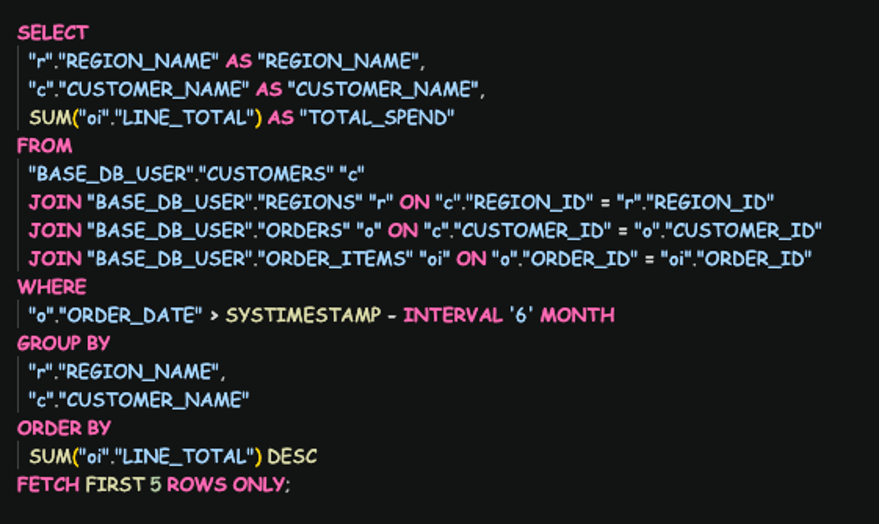
Let’s say you want to know: “Which customer region generated the highest total revenue to date, and who are the top 5 customers in that region by spend?” Normally, answering that would mean digging through multiple tables, figuring out joins, writing aggregations, and building the SQL yourself like in Figure 1. But because you can translate natural language prompts to generate, run SQL statements.
Get Insights Today
Oracle AI Database 26ai closes the gap between business questions and technical execution so the people who understand the business best can ask their own questions and get answers directly. When business users can move at their own pace without waiting on queries or handoffs they spot issues sooner, explore opportunities faster, and make decisions while the context is still fresh. Because when it’s easier to get answers, it’s easier to keep the business moving forward.
Make sure to try it Oracle AI Database 26ai today with our Oracle Free Tier or use the low cost Oracle Base Database Service for Developers.