

In modern warfare, hybrid threats are expanding, blurring the line between peace and conflict. As data becomes increasingly vital to maintaining a strategic advantage, nations need more than access to information. They must develop capabilities to generate, manage, protect, and exploit data at scale. Achieving this capability reinforces a nation’s commitment to digital sovereignty, extending beyond traditional defense and security organizations.
Winning a war requires unremitted access to both national and allied data. To achieve this, nations must maintain full control over digital capability from core-to-edge while enabling distributed command and control across sustained, multidomain operations. This is effectively “warfighting sovereignty,” and it cannot be achieved through merely using a single centralized cloud—let alone one located outside national or alliance boundaries—and less so by any cloud shared with or operated by unknown or unapproved entities.
This blog covers the three pillars of digital sovereignty and how Oracle’s sovereign cloud solutions can help support your digital sovereignty strategy.
What digital sovereignty means for government and defense
Digital sovereignty refers to a nation’s ability to build and operate a digital backbone that reflects, protects, and projects its own security and regulatory requirements. For government and defense organizations, digital sovereignty becomes a mission requirement.
Digital sovereignty can provide answers to the following questions:
- Where is my data?
- Who can access my data?
- How is my data managed?
As cloud environments grow increasingly distributed and global, these questions are becoming harder to answer.
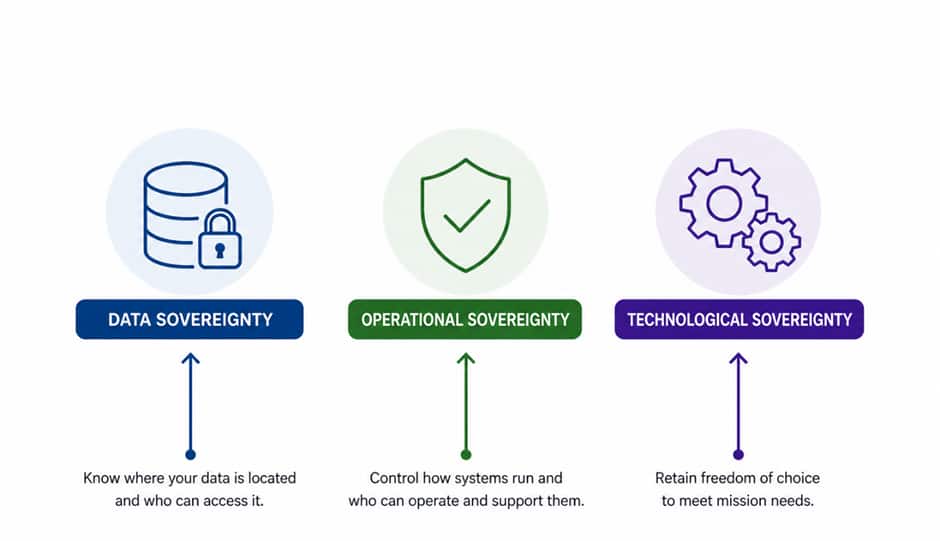
The three pillars of digital sovereignty
There are three pillars that underpin digital sovereignty, and each pillar is interdependent. Most nations, even superpowers, cannot fully achieve all pillars. For example, some technologies originate only from select nations, or an economic alliance may impact national policy. However, with strategic management of tradeoffs, every nation must maximize the elements they can to achieve the best possible sovereign capability.
1. Data sovereignty: know where your data is located
Data sovereignty ensures that sensitive data remains within defined geographic and legal boundaries.
Nations must retain control over the physical location of their critical data, limiting data access to authorized users only to help ensure that use of the data complies with national data protection laws, regulations, and policies. Without absolute assurance that a nation’s data is physically located where it’s expected, there is no sovereignty over that data, let alone control over who can access it.
2. Operational sovereignty: control how systems run and operate
Operational sovereignty defines who can manage, support, and access systems in practice.
This idea extends beyond system access to include the infrastructure that supports these systems, including data centers, networks, and supply chains that must remain under appropriate jurisdictional and physical control.
No external force should be able to access or adversely affect critical data through operations or support channels. Critical infrastructure should remain within national borders—isolated from non-national and non-government workloads—and operated only by national citizens or persons approved by the government.
3. Technological sovereignty: retain freedom of choice
Technological sovereignty refers to a nation’s ability to choose the best technology solutions for the mission—whether from a domestic or allied industrial sphere—without being locked into a single vendor or architecture. National defense shapes the requirements, which cannot be limited by vendor constraints.
No single government can match global investment in research and development. Global scale innovation is shared across allied ecosystems. But by maintaining control over how technologies are deployed, integrated, and governed, organizations can benefit from global innovation while avoiding dependency that limits flexibility or resilience. Nations should demand from industry what they need for the mission and for national security—industry will deliver.
How Oracle Cloud Infrastructure supports digital sovereignty
Oracle has supported defense and intelligence missions for over 45 years, and we recognize that digital sovereignty is key to mission success.
In today’s threat environment, highly sensitive government data often requires a sovereign cloud rather than public cloud or a private cloud operated outside national control. Oracle Cloud Infrastructure (OCI)’s distributed cloud includes sovereign cloud solutions that address all three of the digital sovereignty pillars, offering organizations flexibility to run workloads across any cloud environment, anywhere.
With OCI, organizations can maintain sovereign operations with full control over data access, infrastructure, and operational governance, while still benefiting from the same architecture and services used globally.
Oracle’s Everything Everywhere approach delivers a full, hyperscale cloud across sovereign and air-gapped regions, with the same services, tools, and functionality of our commercial public cloud regions. Organizations can align cloud adoption with sovereignty needs without forcing tradeoffs between control and innovation.
From cloud capability to sovereign control
Oracle’s approach to cloud for defense and intelligence missions helps ensure sovereignty over data, infrastructure, operations, and legal jurisdiction while helping mitigate risks to technological and solution sovereignty. Our sovereign cloud solutions are designed, scaled, and engineered to enable nations to protect and enhance their national digital sovereignty without compromising speed, capability, or national resilience. Defense and national security requirements drive our continuous innovation to help governments avoid the need to compromise on security, capability, or sovereignty.
Visit Digital Sovereignty to learn more or reach out to your Oracle sales representative to explore how OCI can support your sovereign cloud strategy.
Additional resources