
A soldier’s rifle just out of reach is useless—the same is true for GPUs and compute resources. The modern battlefield generates unprecedented volumes of data amid rapid technological change. Without immediate access to critical resources at the tactical edge in Denied, Disrupted, Intermittent, Limited (DDIL) environments, today’s warfighter is left at a severe disadvantage. To effectively leverage data analysis at the edge, commanders face two significant constraints.
- Data proliferation: To maintain the decision advantage and rapidly extract actionable insights, commanders must process massive amounts of data, on hand, while operating from tactical and mobile command locations. Sensors, drones, and defense technology produce or consume more data at the tactical edge than ever before. Satellite networks can provide some incremental bandwidth expansion, but not enough to sustain legacy tactical communications architectures.
- Contested cyber/electromagnetic warfare (EW) environments: Given the increase in data proliferation, conflict zones are increasingly contested in the EW and cyber domains, which permeate all domains of the fight. DDIL conditions and direction-finding are now a reality for tactical communications. This makes reliance on constant edge-to-core connectivity unreliable and dangerous. To reduce direction-finding risk and enhance survivability, transmissions should be minimized.
While facing DDIL threats, warfighters must be able to continue their mission with the world’s best technology on-hand and without constant connectivity. Compute for edge sensors, drone fleets, AI models, and the commander’s mission awareness cannot be outsourced. Mission-critical resources cannot reside in data centers outside of the mission area, let alone hundreds or thousands of miles from the fight. Commanders and maneuver elements must process massive amounts of data wherever they are, even while operating from mobile, tactical locations with limited external communications.
The dilemma: How can mission owners continue operations, despite DDIL effects, and retain 21st century capabilities?
Communications infrastructure is becoming an even greater component in battlefield maneuver—not merely a supporting function. For mission-critical data to empower every echelon, from general staff down to the squad level, and on every aircraft and maritime vessel, each must be able to leverage AI, compute, and cloud resources deployed alongside them. Militaries that confront and solve this dilemma will outpace those that have not. For commanders, the question is: how must your doctrine evolve to win tomorrow’s fight, and is your communications infrastructure deployable—and mobile—enough to enable it?
The solution
Only with cloud at the tactical edge can military data integration occur at the speed of mission. Oracle understands the strategic value in deploying a standardized cloud environment from core to edge. Innovations from the defense industry must be deployed to the mission area rapidly, even during operations.
When mission data is integrated with cloud resources at the tactical edge, warfighters and alliances can act on it rapidly. For example:
- Operate true “drone swarms” at exponential scale: Use nearby compute to minimize latency and mitigate EW and jamming effects.
- Enable model-gradient exchange: Allow tactical AI models to autonomously share learning—like tactics, techniques, and procedures (TTPs)—faster than the adversary’s learning curve.
- Deploy hyperscale private 5G environments to support joint and allied operations.
- Leverage federated AI/ML capabilities by running intelligent software, data storage, and compute in the mission area.
- Use post-quantum cryptography to secure sensitive communications across theater and core-edge-core dataflows.
- Integrate legacy technologies across cloud: Rapidly link isolated, legacy systems to contribute to real-time data strategies.
By leveraging Oracle Cloud as the data integration layer across the force, more challenges can be addressed with software solutions rather than additional, monolithic systems. Militaries can procure or develop bespoke defense solutions as needed and then deploy them at mission speed—even across entire alliances.
Oracle Cloud at the tactical edge
Oracle Edge Cloud devices can operate while continuously disconnected, with no reliance on core resources. Even Oracle’s classified core cloud, at the data center level, is isolated with no connectivity to external networks or data egress. Now, with Compute Cloud@Customer-Isolated (C3I), mission owners can forward-deploy classified, small-footprint cloud environments. Oracle GoldenGate can synchronize through cross domain solutions, enabling real-time DDIL resilience across tactical edge networks. By deploying a ubiquitous data integration layer across the force, commanders can radically evolve how they approach the fight.
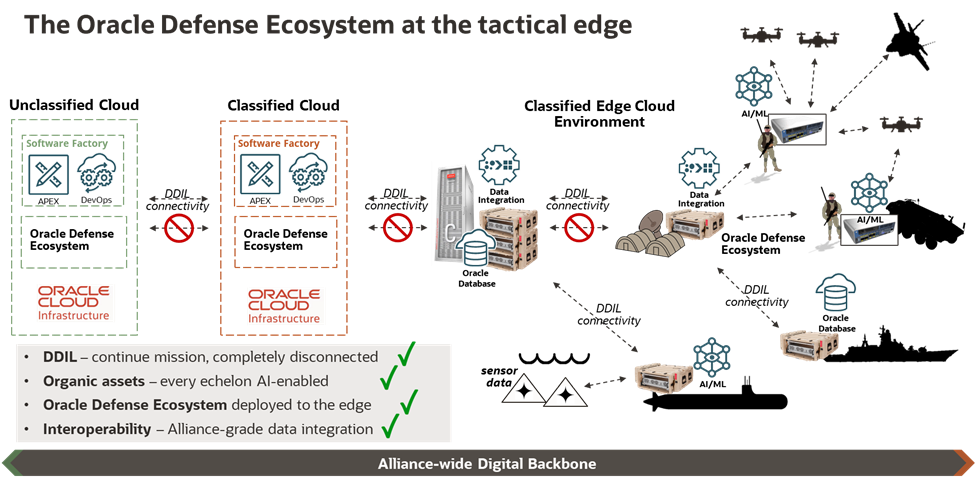
Oracle Defense Ecosystem
Launched in 2025, the Oracle Defense Ecosystem is a portfolio of some of the best defense technology available today. Oracle understands that cloud is the fundamental enabler of critical defense solutions, and Oracle Defense Ecosystem members can deploy their capabilities with Oracle Cloud Infrastructure from the core to tactical edge. Commanders, defense organizations, militaries, and global alliances can deploy these solutions wherever their mission requires.
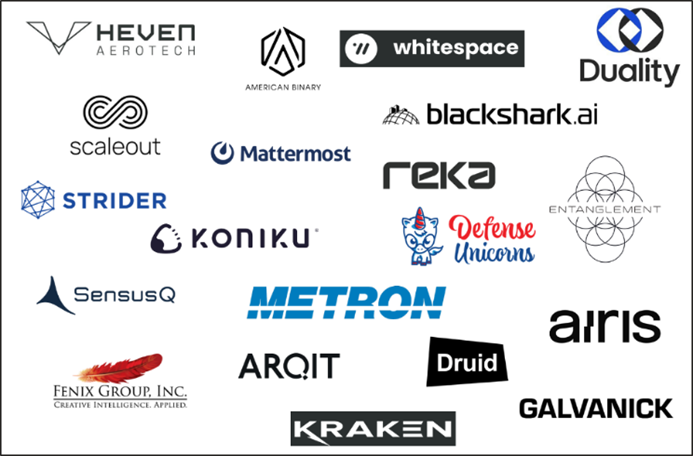
The general staff system is a widely used convention for organizing mission efforts, including Personnel, Intelligence, Operations, and Communications. The Oracle Defense Ecosystem offers robust defense solutions across all functions.
- Personnel management:
- Strider provides strategic counterintelligence threat insights that can be combined with Oracle Human Capital Management (HCM) for enterprise-scale personnel management and counterintelligence across allied organizations.
- Intel-ops fusion and automation:
- SensusQ provides multi-domain intelligence fusion for accelerating situational awareness and decision-making.
- Whitespace offers powerful, automated lessons-learned synthesis and knowledge management for faster refinement of allied operational approaches and doctrine.
- Blackshark.ai delivers powerful 3D simulation environments for wargaming and pre-mission analysis.
- Reka delivers best-in-class multimodal AI research capabilities with APIs built for defense use cases.
- Sensor-to-shooter ops platforms:
- Mattermost‘s collaboration suite offers code collaboration and targeting workflows.
- Metron provides airspace and maritime tracking and prediction software.
- Heven Aerotech builds hydrogen-powered drones capable of stealthy long-loiter operations carrying heavy payloads.
- Koniku provides chip-based chemical sensing technology capable of detecting specific chemical signatures.
- Kraken builds high speed, autonomous maritime surface vehicles.
- Airis Labs integrates raw multimedia feeds into mission-ready intelligence for early-warning and network illumination.
- Alliance-grade logistics and resource planning:
- Galvanick provides manufacturing and defense industrial base security at the IoT level, while Oracle Enterprise Resource Planning (ERP) and Supply Chain Management (SCM) provide enterprise-scale logistics solutions.
- Strategic and tactical communications (including private 5G networks, security, and edge cloud):
- Fenix Group and Druid Software can be combined with Oracle Roving Edge Infrastructure to deploy private 5G networks across any mission environment.
- Scaleout’s differentiated federated machine learning (ML) technology enables secure gradient sharing across DDIL environments at scale.
- Duality enables federated data analytics supporting distributed mission command across the force.
- Entanglement delivers cybersecurity anomaly detection and fuses quantum-inspired algorithms with AI.
- American Binary and Arqit provide Post-Quantum Cryptography (PQC) solutions seamlessly integrated into OCI workloads.
- Defense Unicorns delivers a DevOps platform that enables software factories to develop and deploy critical capabilities at the speed of mission.
Winning in DDIL environments requires bringing secure cloud, AI, and data integration to the point of need. With Oracle Cloud at the tactical edge and the Oracle Defense Ecosystem, commanders can fuse data, deploy mission software rapidly, and sustain operations without constant connectivity. The result is a resilient, interoperable foundation that accelerates decision advantage across allied forces—at mission speed and scale.
Resources