
Why Modernization Fails — and How OCI Enables an Evolutionary Approach
Introduction
Enterprises across industries rely on large, business-critical monolithic applications that contain decades of domain knowledge. While these systems run core business workflows, they are difficult to change, making innovation slow, scaling complex, and updates risky.

Modernization is no longer optional; it is essential for business competitiveness. However, many modernization initiatives fail not because microservices are flawed, but because the approach to modernization is flawed.
This blog introduces an evolutionary, phased methodology for modernizing monolithic applications on Oracle Cloud Infrastructure (OCI)—one that minimizes risk, preserves business continuity, and leverages OCI’s cloud-native capabilities.
Modernizing Monoliths: What Are the Options?
When moving a monolith to the cloud, enterprises generally have five strategies:
| Approach | What It Means | Pros | Cons |
| Rehost (“Lift and Shift”) | Move the monolith as-is to OCI Compute or OCI DBaaS | Fast, minimal changes with the ability to right-size infrastructure on OCI. | Application remains monolithic, limited scalability and agility |
| Replatform | Move to cloud-managed services (OCI Load Balancer, Managed DB, OCI Cache) with minor changes | Leverages managed PaaS for improved reliability, scalability, and reduced operational effort. | Still largely monolithic, minimal flexibility |
| Refactor / Rearchitect | Incrementally extract microservices, decouple data, and adopt cloud-native patterns | Cloud-native benefits, incremental, lower risk | Requires planning and careful service decomposition. Requires managing parallel production systems during transition. |
| Rebuild / Rewrite | Rewrite entirely as microservices | Clean architecture, modern best practices | High risk, high cost, long timeline |
| Replace / SaaS | Retire the monolith and adopt a SaaS solution | Quick adoption if suitable | May lose business-specific logic, dependency on vendor |
In this series, we focus on the refactoring approach, an evolutionary modernization strategy that gradually transforms your monolith into cloud-native microservices using OCI. This approach balances risk, cost, and agility, enabling enterprises to modernize incrementally without business disruption.
Why Monolith Modernization Efforts Commonly Fail
Despite good intentions, modernization projects often struggle due to predictable pitfalls:
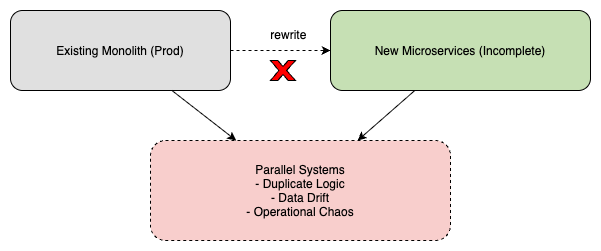
1. The Big-Bang Rewrite Fallacy
Organizations attempt to replace the entire monolith in one effort. This approach frequently results in:
- Long delivery timelines
- Loss of embedded business logic
- Parallel systems running indefinitely
- Eventual project abandonment
2. Underestimating Operational Complexity
Microservices are not simply “smaller applications.” They require:
- Mature CI/CD pipelines
- Advanced observability
- Automated infrastructure
- Strong operational and security discipline
Without this foundation, teams often trade one form of complexity for another.
3. Ignoring Business Context and Data Coupling
Modernization efforts often focus on technical decomposition without fully understanding the business outcomes the monolith was originally designed to support. Critical domain logic, regulatory constraints, and operational assumptions embedded in the monolith are easily lost when services are extracted without sufficient system comprehension.
At the same time, shared databases remain one of the most damaging anti-patterns. Without clearly defined data ownership, services remain tightly coupled regardless of how they are deployed, limiting independence and scalability.
4. Platform Readiness Comes Too Late
Teams often begin extracting services before establishing Kubernetes, CI/CD, security, and monitoring standards—leading to brittle, inconsistent systems.
Modernization as an Evolutionary Process
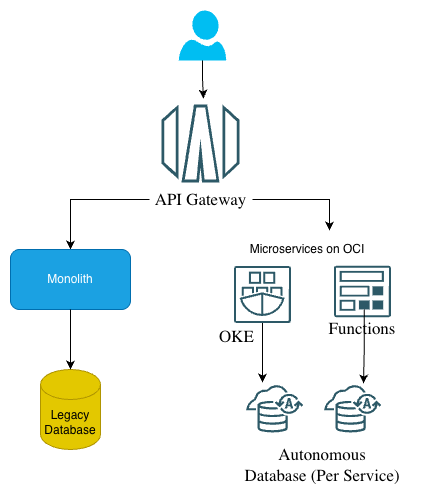
The refactoring approach focuses on incremental extraction of microservices and modernization of infrastructure, leveraging OCI cloud-native and serverless services:
- Keep the monolith running
- Avoid business disruption
- Gain time to observe and understand legacy behavior
- Incrementally extract microservices
- Apply the Strangler Fig Pattern
- Route new functionality via OCI API Gateway
- Deploy services on OCI Container Engine for Kubernetes (OKE) or OCI Functions (serverless)
- Decouple and modernize data
- Use a database per service, leveraging options such as Autonomous Databases, NoSQL, MySQL, or PostgreSQL
- Implement event-driven patterns with OCI Streaming or OCI Queue
- Enable observability and CI/CD
- Monitor logs, metrics, and traces using OCI Logging, Monitoring, and APM
- Automate deployments and governance using OCI DevOps
- Optimize for performance, cost, and governance
- Use OCI Application Performance Monitoring (APM) to gain end-to-end visibility across the monolith and newly extracted microservices, enabling performance optimization and faster root-cause analysis.
- Leverage OCI Audit Logs and OCI IAM to enforce governance, ensure compliance, and apply least-privilege access across users, services, and automation as the architecture evolves.
- Use OCI Billing and Cost Management to track cloud spend
- Use OCI Tagging to improve cost visibility, enforce policies, and enhance security governance.
Why Oracle Cloud Infrastructure Is Well-Suited for Modernization
OCI provides several advantages for enterprises modernizing monolithic applications:
Enterprise-Grade Foundations
- High-performance networking and predictable latency
- Strong isolation and security primitives
- Zero egress charges within regions and up to 10TB/month free outbound internet data, helping control modernization costs
Kubernetes and Cloud-Native Maturity
- OCI Container Engine for Kubernetes (OKE) enables production-grade container orchestration
- Deep integration with OCI IAM, networking, load balancing, and DevOps tooling
- Supports hybrid coexistence where legacy and cloud-native workloads run side-by-side
Database and Data Integration Strength
- Flexible Autonomous Database capabilities tailored for different application and data workloads.
- Same Autonomous Database platform can support both:
- Large petabyte-scale enterprise monolithic databases
- Smaller, agile microservice-aligned databases
- OCI GoldenGate enables safe, incremental data migration using change data capture (CDC)
- Keeps monolith databases and microservice databases in sync during refactoring
Observability and Governance
- Built-in logging, monitoring, and APM
- Strong cost governance and policy-driven security
These capabilities make OCI particularly effective for incremental modernization, rather than forced rewrites, by enabling controlled evolution, seamless coexistence, and cloud-native modernization with reduced risk.
A Structured Modernization Journey on OCI
To avoid common failure modes, modernization should follow a structured, phased approach:
- Understand and Stabilize the Monolith – Begin by gaining deep visibility into the existing monolithic application and establishing operational baselines. Stabilize what exists, improve reliability, and ensure comprehensive observability before change begins.
- Establish the Cloud-Native Foundation – Prepare the modernization runway by enabling the right platform capabilities early. Build the cloud-native foundation using OCI Kubernetes (OKE), CI/CD pipelines, identity and security controls, and strong observability. This ensures new services can be introduced with confidence.
- Evolve Functionality Incrementally – Modernize through controlled evolution rather than disruptive replacement. Apply the Strangler Fig Pattern to gradually route functionality away from the monolith. Introduce new, independently deployable services aligned to business domains using cloud-native design principles.
- Decouple the Data and Modernize Integration – Break shared database dependencies and move toward service-owned data with the right database technologies per workload. Adopt asynchronous, event-driven integration using OCI Streaming and related services, supported by capabilities like OCI GoldenGate to keep systems in sync during transition.
- Optimize, Govern, and Continuously Improve – As modernization progresses, focus on long-term performance, security, governance, and cost optimization. Leverage OCI’s monitoring, APM, IAM, audit, tagging, and cost management capabilities to ensure sustainability, compliance, and operational excellence as the architecture evolves.
Call to Action
Modernization starts with understanding, not rewriting.
Before breaking apart your monolith, take the first step by establishing deep observability and laying a secure OCI foundation. Enable logging, metrics, and tracing for your existing application, assess candidate services for extraction, and familiarize your teams with OCI’s cloud-native and serverless capabilities.
To accelerate your journey, consider:
- Engaging Oracle or your cloud strategy team to conduct an OCI readiness or modernization assessment.
- Starting with a focused pilot—select one component or domain to refactor first, demonstrating measurable value quickly.
By adopting a structured, incremental, OCI-powered approach, enterprises can modernize with confidence—maintaining business continuity while steadily accelerating innovation.