

Retail Checkout Meets the Perfect Storm of Tokenized Payments
Merchants are looking for more than another payment button at checkout. They need payment options that can connect to settlement, treasury, loyalty, supplier payouts, cross-border operations, refunds, reconciliation, and future agentic commerce workflows. There are four trends that are merging to create the “perfect storm” for retail payments:
- Evolving payment methods: Consumers are increasingly moving to payments via digital wallets over physical credit or debit cards
- Smartphone-Based AI: Mobile OS providers (such as Apple) are deeply embedding native AI digital assistants
- Agentic payments: Momentum is accelerating around agentic payments, with multiple vendors developing protocols and capabilities in this space (e.g. Stripe), often leveraging agent-ready blockchain infrastructure like Google’s AP2 protocol and Coinbase’s x402 standard
- Channel Expansion and Regulatory Clarity: Rapid growth in payment channels (multiple stablecoins and deposit tokens) met with regulatory clarity and easing for stablecoins in the US (e.g., the GENIUS act), UK (e.g., scrapping individual holding limits), and the EU (e.g., MiCA)
This convergence opens a path to a future where AI assistants autonomously execute payments on a user’s behalf utilizing digital wallets and blockchain rails. However, the broader opportunity is not simply accepting digital cash instruments (stablecoins, tokenized deposits, CBDCs) at the point of sale. It is connecting POS acceptance to enterprise-grade digital-asset infrastructure, including governance, wallet management, policies, smart contracts, ISO 20022 support, AI-enabled workflow orchestration, and integration with ERP and treasury systems.
To explore these exciting prospects, the Oracle Simphony POS and Digital Assets Data Nexus teams recently completed a joint Proof of Concept (PoC) together with SVRN. The project successfully integrated a stablecoin-driven payment flow directly into Oracle’s retail payment ecosystem, validating transaction completion while preserving the baseline user experience regarding execution time, cost, and latency.
Beyond handling stablecoin transactions, this PoC established a flexible, purpose-built architecture utilizing Digital Assets Data Nexus (the enterprise orchestration layer that makes the payment usable after it is received) to bridge POS and optimized blockchain rails with backend corporate systems running enterprise digital asset workflows and agentic payments.
The PoC shows that blockchain-based payments can be integrated into a POS checkout flow and explores the larger opportunity around post-payment workflows. When digital-asset acceptance is connected to enterprise systems, merchants can begin to link checkout with treasury operations, loyalty programs, supplier and employee payouts, cross-border settlement, compliance workflows, and eventually agentic commerce. This unified architecture is where Oracle provides unique, differentiated enterprise value.
Transforming Checkout Payments into Programmable Enterprise Workflows
Checkout is only the first step in the payment lifecycle. While modern credit cards excel at the point of authorization, the true value of digital assets resides in the use cases that may happen immediately after payment authorization: automated settlement, programmatic liquidity management, synchronized real-time loyalty updates, supplier or employee payouts, instant cross-border flows, and automated finance operations.
Digital cash instruments are also becoming more relevant because the surrounding policy, banking, and central bank infrastructure is maturing.
- United States: The GENIUS Act established a federal framework for payment stablecoins, including requirements around permitted issuers, mandatory reserves, disclosures, and strict regulatory compliance.
- Europe: The ECB has advanced the digital euro project into its technical implementation phase, intending to execute internal pilots in 2027 and prepare the Eurosystem to be ready for a projected first issuance targeted for 2029, assuming the necessary EU legislation is adopted in 2026.
- Globally: The BIS Project Agora brought together seven central banks and over 40 regulated financial institutions to prototype a shared programmable platform that combines tokenized commercial bank deposits with tokenized central bank reserves.
These global developments do not mean every retail payment will move on-chain, but they do make it increasingly practical for merchants and banks to evaluate digital cash as part of enterprise payment architecture and determine where they can gain or offer advantages for these new forms of payment.
The value of blockchain-based payments becomes most compelling in the programmable workflows triggered post-settlement. For forward-looking merchants, the question is therefore not only whether a blockchain rail can replace card payments at point-of-sale. The more relevant question is how digital cash payments using optimized blockchain rails can be leveraged to unlock capital flexibility, enable faster access to value, and execute new backend workflows that are difficult to coordinate through fragmented conventional infrastructure alone.
Why Global Commerce Anchors to Oracle Simphony
Oracle Simphony is already central to hospitality and food-service commerce workflows. As a premiere cloud POS platform for food and beverage venues worldwide, Simphony supports over 200 software integrations and processes more than 6.3 billion transactions annually. This massive footprint makes it an ideal environment to test how emerging payment networks can seamlessly integrate blockchain-based payments into existing POS environments without requiring merchants to disrupt or abandon traditional card payments.
Market penetration for digital payments varies sharply by geography as demonstrated by Worldpay/Global Payments’ 2026 Global Payments Report, which is precisely why a flexible, POS-level entry point matters.
- Global Baseline: Digital wallets represent 56% of global e-commerce transaction value and 33% of in-store spending
- The U.S. Market: The U.S. remains heavily card-led, with direct card use accounting for 71% of in-store spend, while digital wallets account for only 17% of POS transaction volume
- The APAC Region: APAC is aggressively wallet-led, with digital wallets accounting for 77% of online spending and 62% of in-store spend. Notably, payment apps command 89% of all POS transaction value in China.
This variation makes Simphony a practical, low-risk experimentation point because merchants can securely test emerging blockchain rails alongside region-specific wallet, card, and account-based payment preferences without changing the core checkout experience for the cashier or end customer.
Ultimately, this integration architecture is not intended to replace card networks. It is designed to give merchants access to additional payment rails, with the exact tools needed to build additional enterprise value on top of them. That positions Simphony as the practical entry point for exploring how a physical or online checkout event can connect directly to enterprise digital-asset workflows after settlement.
Multi-Ledger Power: Oracle Digital Assets Data Nexus and Oracle Blockchain Platform
This project was done as part of a use case exploration for Oracle Digital Assets Data Nexus, an enterprise-grade platform for issuing, transacting, and governing digital assets. Beyond simple transaction routing, Nexus delivers a suite of advanced capabilities designed to bridge blockchain transaction events and data with enterprise backend systems:
- Multi-ledger Blockchain: A flexible blockchain platform extended with compliance-focused smart contracts library tailored for regulated digital assets
- Intelligent Orchestration: Web3- and AI-enabled workflow tools that link on-chain events with off-chain systems
- Universal Wallet Service: Enterprise wallets management with flexible multi-chain adapter architecture backed by a granular policy engine
- Standardized Integrations: ISO 20022 messaging integration with payment hubs and ERP systems
- Advanced Indexing, Analytics & Governance: Automated replication of blockchain transaction history and smart contracts state into the Oracle AI Database 26ai for enterprise governed records supporting live analytics, real-time risk management, auditing, and regulatory compliance.
To anchor this infrastructure, Oracle offers Oracle Blockchain Platform (OBP)—an enterprise blockchain platform that can support digital assets deployments on a choice of popular permissioned ledgers. This enables financial institutions and non-financial enterprises to deploy a permissioned blockchain ledger to issue tokenized deposits and stablecoins.
The platform’s bank-grade reliability and enterprise fit is proven across a number of global deployments. It has been leveraged by central banks for wholesale CBDC pilots, such as Bangko Sentral ng Pilipinas’ (BSP) Project Agila in the Philippines, by individual banks for cross-border payments, and for micropayments in enterprise blockchain projects. Available across OCI, multicloud, and on-premises deployments, OBP and Nexus can help frame digital-asset payments as a robust tier of enterprise infrastructure rather than just an isolated checkout option.
Inside The Flow: Connecting Simphony Checkout to a Nexus-orchestrated Digital Asset Workflow
In this PoC, we mapped out a secure, high-efficiency stablecoin-based retail payment flow. To evaluate the architecture, we created a retail test environment comprising four core elements:
- The Frontend: A sample merchant app where customers could place and track orders.
- The POS Core: Direct API connectivity into Oracle Simphony POS to handle checkout processing.
- The Stablecoin Execution: A custom stablecoin issued on the public Ethereum testnet as a digital-asset payment instrument, integrated with a live settlement flow over the NEAR blockchain.
- Enterprise Digital Asset Layer: Post-settlement pipelines integrated via Digital Assets Data Nexus to govern transaction routing and backend system synchronization.
For the stablecoin settlement flow in this PoC, we collaborated with SVRN and used NEAR blockchain ledger because its architecture supported the checkout characteristics we wanted to validate: low-latency execution, low per-transaction network cost, multichain settlement abstraction through NEAR Intents, and delegated authorization through account abstraction. These capabilities made it possible to test whether a digital-asset payment flow could meet POS expectations for speed, cost, and user experience.
Quicknode supported the PoC’s connectivity to Ethereum testnet and NEAR mainnet by providing the infrastructure needed to connect simulated stablecoin issuance and settlement with the merchant application through a shared trial environment.
Leveraging NEAR enabled fast real-time settlement at POS using NEAR Intents, while connecting POS acceptance with governed digital-asset operations after settlement. During POC testing, the customer interaction proved seamless: a customer placed an order in the merchant app, selected a blockchain-based payment option, and paid using a simulated stablecoin. Once the payment was confirmed on NEAR, the merchant app updated Oracle Simphony and displayed order status to the customer, maintaining a target checkout speed of under three seconds.
The broader flow was designed to show how a POS payment event could instantly become part of an enterprise digital-asset workflow. In a production architecture, Oracle Digital Assets Data Nexus provides the control layer around that transaction lifecycle: wallet management and policy governance, enforcing rules-based asset acceptance, transaction lifecycle tracking, and workflow orchestration integrating with corporate ERP, treasury, loyalty, and supplier payout systems.
The PoC was designed around the following blockchain based payments flow shown in the diagram and detailed in the table below.
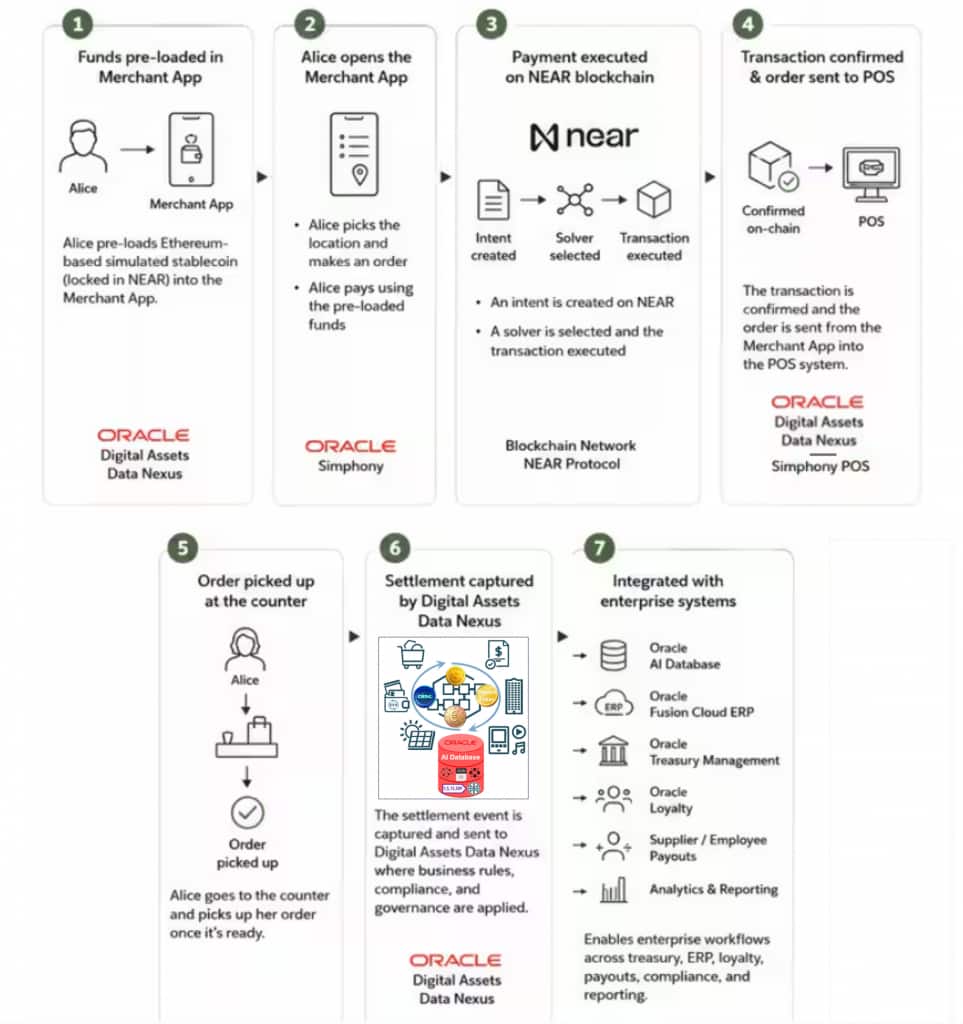
| Step | Action | Details |
|---|---|---|
| 1 | Funds pre-loaded in Web3 wallet accessible from the Merchant App | Alice maintains a liquid balance of simulated stablecoins inside her non-custodial embedded wallet account. Her keys are managed securely via user login and account abstraction. |
| 2 | Alice places an order in the Merchant App and authorizes payment | Alice selects her retail location and submits an order. The Oracle Simphony backend calculates the final invoice amount. She authorizes the payment, which allows Simphony to notify Digital Assets Data Nexus to create a NEAR cross-chain Intent bound to a unique sequential account nonce and broadcast it to the Solver auction marketplace. |
| 3 | Payment executed on NEAR blockchain | The marketplace programmatically selects the winning Solver bid based on speed and exchange rates. The NEAR blockchain network instantly validates the user’s intent signature, allowing the winning solver to advance their own capital directly to the merchant’s target wallet on the destination chain to complete the payment. |
| 4 | Transaction confirmed & order sent to POS | The transaction achieves fast on-chain finality, and the transaction payload is automatically routed from the Merchant App into the POS environment to close out the open register ticket. |
| 5 | Order picked up at the counter | With payment securely finalized, Alice picks up her order at the store counter. |
| 6 | Settlement captured by Digital Assets Data Nexus | The NEAR network reimburses the Solver from the user’s locked funds via cross-chain bridge protocols. The payment on merchant’s ledger and the settlement event are captured by the Oracle Digital Assets Data Nexus, which triggers the active evaluation of business rules, post-settlement compliance logging, and other asset governance policies. |
| 7 | Integrated with enterprise systems | Data Nexus orchestrates the payment details updates in parallel across backend networks to automate corporate accounting, treasury, ERP, loyalty, supplier/employee payouts, and compliance analytics. |
The primary economic advantages of this approach include reduced transaction costs, faster settlement, immediate availability of funds, and native future-proofing for agentic commerce workflows. The PoC’s fast-finality model executes the payment within seconds with settlement funds instantly accessible to the merchant on the NEAR blockchain. From there, corporate treasury can programmatically route these digital balances back to native base layers, such as Ethereum, via Digital Assets Data Nexus to power downstream enterprise workflows, like real-time supplier or employee payouts (e.g., shift payments) or instant loyalty ledger updates. If preferred, merchants can also off-ramp these tokens directly into traditional fiat banking accounts.
To have the PoC reflect real-world application we created a POS test instance, mock merchant app, API connectivity into Simphony, and simulated stablecoin issued on public Ethereum testnet. ERP integration was tested and evaluated in a separate track. It is important to highlight that this PoC focused on the payment flow and post-settlement orchestrations. There are a lot of peripheral aspects we did not cover, such as live order-delivery tracking, Ethereum/NEAR bridge, automated fiat on/off-ramps.
Digital Assets Data Nexus Orchestrates the Enterprise Flows for Stablecoin and Other Tokenized Payments
Settling a retail payment using a stablecoin or tokenized deposit on a blockchain rail is only one part of the enterprise value chain. To unlock true institutional utility, digital asset acceptance must be bound directly to post-settlement business controls: treasury networks, ERP platforms, automated governance rules, loyalty loops, payout lines, and policy-driven wallet operations.
The economic advantage is strongest when the merchant does not immediately convert all proceeds back to fiat cash after every single transaction. Constantly off-ramping tokens creates what Fed Governor Christopher Waller called a “stablecoin sandwich”: fiat in, stablecoin transfer, fiat out. That may still reduce some complexity, but the savings can be eaten by ramps, liquidity spreads, compliance costs, and support overhead. By contrast, maintaining digital value provides advantages when merchants can govern and reuse settled digital balances across treasury, supplier payments, tokenized loyalty programs, employee wage payments, or cross-border trade finance workflows. In those scenarios, the payment becomes part of a programmable enterprise workflow rather than an isolated checkout event. To demonstrate this utility, we explore three distinct post-payment capability tracks that can be orchestrated using Oracle Digital Assets Data Nexus.
Example 1: Supplier Payout From Settled Digital Balances
A restaurant group could accept a digital-asset payment at checkout, settle the proceeds into a governed wallet, and automatically routes a predefined percentage toward an approved vendor invoice. Instead of treating the blockchain checkout payment as an isolated transaction, the payment becomes the starting point for a supply chain workflow.
Digital Assets Data Nexus could route the balance into a treasury workflow connected to ERP. Business rules could determine whether the funds should be held, converted, or used to pay approved suppliers. For example, if a produce supplier accepts USD-denominated stablecoin payments, the merchant could use the settled funds directly for supplier payout.
Enterprise benefit: This avoids the “fiat in, stablecoin transfer, fiat out” pattern and makes the payment rail useful beyond checkout. The benefit becomes faster treasury availability, reduced idle cash, and more programmable supplier settlement eliminating exchange fees, reducing working capital lockup, and unlocking early-payment vendor discounts.

Example 2: Tokenized Loyalty After Checkout
A completed Simphony transaction could trigger a loyalty workflow – an automated, programmatic customer engagement. Digital Assets Data Nexus could issue permissioned loyalty tokens to the customer’s wallet, apply redemption rules, and maintain governance controls across participating merchants or locations.
For example, a merchant could define rules such as:
- “Mint 5 loyalty tokens for every $100 spent.”
- “Issue 2% of customer’s spend on specific products or at an underperforming locations as loyalty token.”
- “Programmatically expire unused digital rewards after 12 months.”
- “Allow rewards to be redeemed only at participating locations.”
Enterprise benefit: The checkout becomes more than payment acceptance. It becomes a programmable, closed-loop customer engagement flow where checkout, loyalty, wallet management, and governance are linked. By automating customer engagement directly at the transaction layer and embedding smart expiration rules, tokenized loyalty lowers customer acquisition costs while protecting the balance sheet from long-term liability risks.

Example 3: ERP Reconciliation and Governed Refunds
One of the largest operational barriers to adopting alternative payment networks is backend friction. Digital-asset payment events could be matched to Simphony orders, normalized for finance systems, and posted into ERP so treasury and accounting teams can see settled value, exceptions, fees, and outstanding balances without manual reconciliation.
If a dispute arises, a refund could be initiated from the merchant application, checked against order history in Simphony, approved according to business rules, and executed as a governed digital-asset transfer with a complete audit trail.
Enterprise benefit: This addresses one of the biggest practical barriers to new payment rails: finance operations, controls, reporting, and customer-support workflows after settlement. By natively automating cross-ledger reconciliation and policy-governed refund paths, this architecture eliminates manual accounting overhead, slashes back-office reconciliation costs and reduces dispute risk, and ensures immediate compliance with institutional audit standards.

Production Considerations
This limited PoC successfully explored integration of blockchain based payments (specifically stablecoin) into the retail POS infrastructure. However, readying such a solution for a live production would require additional work across regulatory, operational, and integration areas, such as:
1. Regulatory frameworks are evolving with jurisdiction-specific requirements. For example, EU’s Markets in Crypto-Assets (MiCA) regulation means a merchant would need to establish compliant custody framework, clear redemption rights, mandatory disclosures, and high-velocity AML/KYT screening processes.
2. Traditional payment card networks provide decades of established dispute resolution, transaction reversals, and chargeback protections implemented in enterprise-grade workflows. A production digital-asset solution would need processes that match customer expectations, even where the underlying rails rely on irreversible blockchain ledger, necessitating compensating transactions and other mechanics.
3. Integration with merchant’s existing solutions and enterprise systems is essential. A real production solution would need more integrations, including existing merchant apps, enterprise ERP ledgers, real-time treasury feeds, corporate financial reporting hubs, and front-line customer-support systems.
Preparing for Agentic Commerce
Agentic commerce is rapidly moving from an emerging concept into core product roadmaps. The formal introduction of Stripe’s Agentic Commerce suite, the Visa Intelligent Commerce, and the launch of Mastercard Agent Pay indicate the payments industry is working on mechanisms for agentic commerce. The strategic implication is clear: once AI software agents begin to source products, compare offers, authorize spend, and rebalance treasury capital on behalf of consumers and businesses, programmable on-chain value rails become more practical than human-centric card rails designed around manual checkout.
The underlying architectural principles established in this PoC, including intents, combined with the advanced MicroTx orchestration capabilities in Oracle Digital Assets Data Nexus, provide the ideal technical foundation for integrating agentic payments. In an expanded architecture, a merchant-authorized agent could source inventory, evaluate approved supplier rules, initiate immediate payment from a policy-governed wallet subject to its authority limits and related guardrails, and synchronize the transaction record straight into the corporate ERP systems. The underlying payment rail becomes programmable, while essential enterprise financial controls remain fully intact.
Conclusion
This PoC demonstrates how Oracle Simphony can seamlessly support emerging tokenized payment instruments, such as stablecoins, deposit tokens, and CBDCs (where applicable) without requiring merchants to abandon existing card rails or integrate directly with fragmented blockchains. It also shows how tokenized payment acceptance at checkout can connect directly to a broader digital-asset workflow.
With Oracle Digital Assets Data Nexus serving as the enterprise control layer, merchants can move far beyond simple transaction acceptance of digital assets at the point of sale. In doing so, they gain the native ability to govern, reconcile, dynamically route, and securely reuse settled digital value across treasury, loyalty, supplier payments, and cross-border operations. Furthermore, Oracle Blockchain Platform can further support enterprise multi-party blockchain workflows by providing shared ledger visibility, immutability, and distributed governance across multiple business entities, global subsidiaries, or supply chain partners.
While production deployments must still address regulatory, custody, compliance, and customer-support requirements, the architectural foundation is already viable. Connecting front-line POS acceptance to backend enterprise governance, treasury integration, automated ERP reconciliation, loyalty programs, and digital-asset infrastructure through Oracle Digital Assets Data Nexus and Oracle Blockchain Platform turns checkout into the starting point for governed digital-asset workflows. For merchants, the benefits are clear: additional payments flexibility, faster settlement, programmable value flows, and new ways to connect checkout with supplier payments, customer engagement, cross-border operations, and agentic commerce.
Evaluating tokenized payments, stablecoins, or agentic commerce? Connect with the Oracle Blockchain/Digital Asset Data Nexus team to schedule a workshop to prioritize use cases and shape an enterprise-ready proof of concept.
We are thankful to NEAR, SVRN, and Quicknode for their invaluable support throughout the PoC.
Sources/For More Information
- Oracle Architecture & Platforms: Simphony Cloud POS, Blockchain Platform, and the Digital Assets Data Nexus framework. See Simphony POS, Oracle Blockchain, and the Digital Assets Data Nexus.
- U.S. Federal Legislation: Public Law 119-27, Guiding and Establishing National Innovation for U.S. Stablecoins Act (GENIUS Act). Available via U.S. GovInfo.
- Federal Reserve System Insights: Governor Waller’s remarks on stablecoin utilization alongside structural cross-border monetary policy impact briefs. Review Waller’s Speech and the FEDS Notes Analysis.
- European Central Bank (ECB) Initiatives: Digital Euro implementation parameters and updates on regional payment strategic autonomy. See Digital Euro Timeline and the Payments Strategy Report.
- European Securities and Markets Authority (ESMA): Regulatory standards, white paper registries, and implementation milestones under the Markets in Crypto-Assets Regulation. Access ESMA MiCA Framework.
- Bank for International Settlements (BIS): Project Agorá operational prototype brief detailing shared programmable cross-border infrastructure. Read full Project Agorá Documentation.
- Worldpay & Global Payments Data: Global Payments Report 2026 macro findings tracking point-of-sale digitization, in-store wallet migration, and Gen Z consumer preferences. Download the Global Payments Report and associated Consumer Metrics.
- NEAR Protocol Technical Specifications: Network topology documentation covering account abstraction and cross-chain execution capabilities. Review NEAR Core Blockchain and NEAR Intents Protocol.
- Stripe Developer Resources: Structural protocol specifications and tokenization logic built for machine-to-machine transactions. Explore Stripe Agentic Commerce Suite.
- Card Network Infrastructure Frameworks: Enterprise network APIs and credential routing infrastructure supporting secure autonomous shopping ecosystems. See Visa Intelligent Commerce and Mastercard Agent Pay.