
Oracle AI Lakehouse provides live access across Oracle and non-Oracle databases and catalogs without moving the underlying data. It combines data access, governance, analytics, and AI across customers’ existing data estates.
Through its AI Data Catalog (AI-Cat), Oracle AI Lakehouse provides a shared semantic layer across Oracle and non-Oracle sources. It reuses business meaning defined in native Oracle Database annotations, Analytic Views, and relationships, preserving customers’ intellectual investment without moving data or rebuilding definitions in every application. Catalog annotations and enrichment extend this context across the wider data estate.
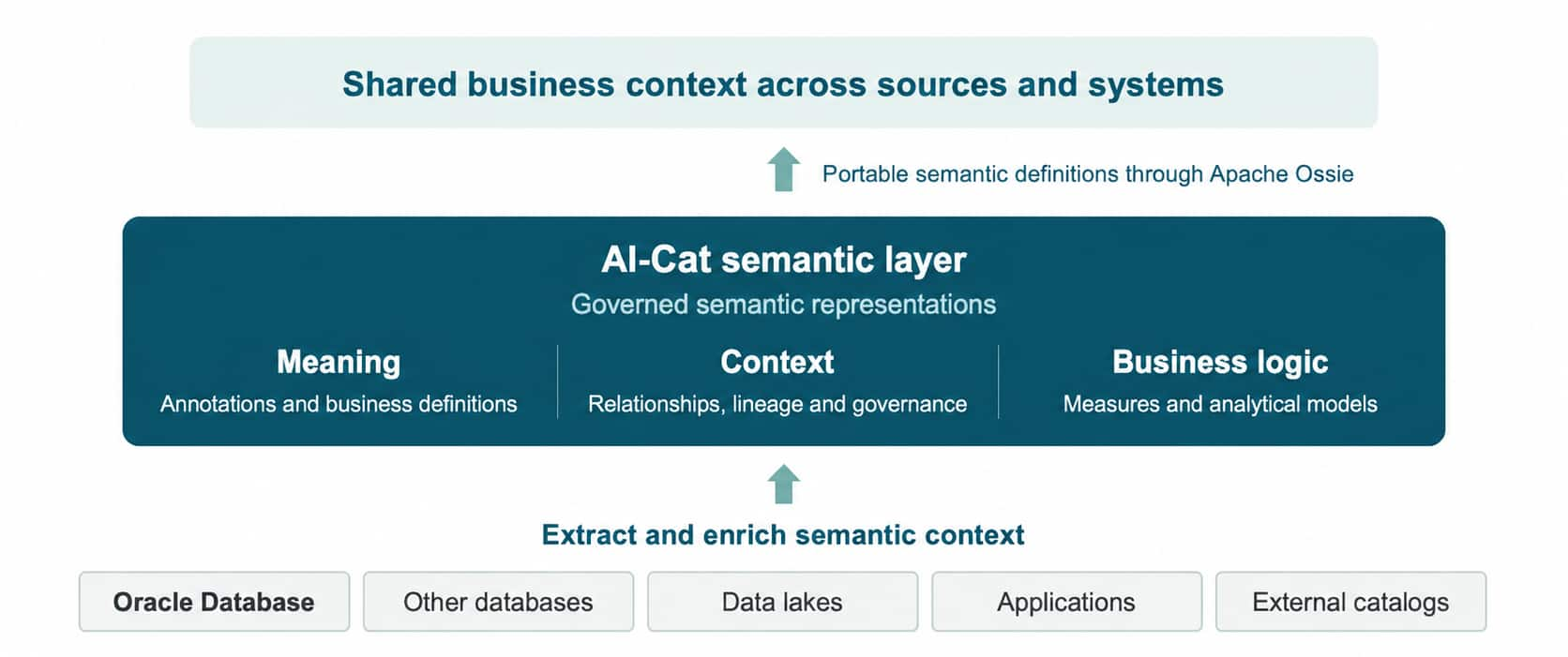
Figure 1. Semantic information from multiple sources forms shared business context across the data estate.
Why data needs semantic meaning
AI agents are becoming a way for users to explore enterprise data, generate SQL, and answer business questions. Before they can do that work, they need to discover which data is relevant and understand what it means.
As data and metadata grow, agents must navigate catalogs, schemas, tables, and columns whose technical names may reveal little business meaning. Broad retrieval consumes context and processing time, while discovery must respect user permissions.
Figure 2 compares answers to the question: “What are the year-to-date sales by region for each month in Q2 of FY2027?” Assuming calendar Q2 or filtering to Q2 before calculating YTD can produce misleading results. The Analytic View defines the fiscal calendar and accumulates sales from the fiscal year’s start before selecting Q2.
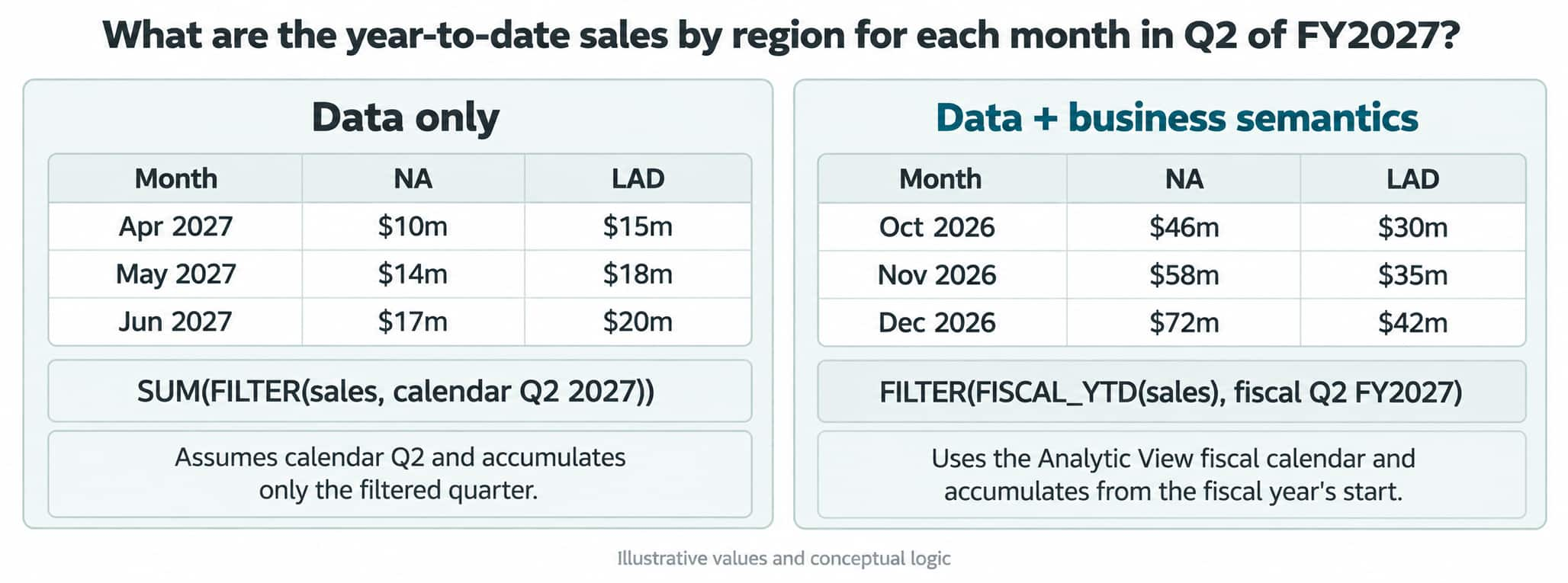
Figure 2. Without fiscal definitions, plausible YTD answers can use the wrong months and totals.
1 Agentic AI at Lakehouse Scale

Figure 3. The catalog hierarchy expands the context agents must navigate.
At lakehouse scale, natural-language analytics must interpret business meaning and select context across enterprise sources. The expanding hierarchy in Figure 3 is one of three challenges.
- Scale expands the search across catalogs, schemas, tables, and columns.
- Different modalities require agents to interpret different kinds of data and metadata.
- Governance and access rules vary across sources and determine what agents may use.
Passing broad metadata to an LLM without grounding it in the user’s question can increase latency and the risk of hallucinated answers. Irrelevant metadata also wastes tokens.
Semantic context and catalog agents

Figure 4. The semantic layer architecture connects catalog agents with governed representations.
Figure 4 presents the AI-Cat semantic layer architecture. The examples demonstrate Agentic Search and semantic enrichment; additional agent types and richer representations remain on the roadmap.
Catalog agents use annotations, relationships, and shared definitions to return relevant, authorized assets through AI-Cat APIs. Consuming agents then use that context to generate SQL or perform other tasks.
Agentic Search and pruning
Agentic Search uses an agent running directly within AI-Cat. It uses the user’s question to narrow catalogs and schemas, then inspects table and column metadata. Annotations can identify relevant tables even when names are uninformative. Catalog tools enforce the user’s permissions throughout, and the agent returns focused candidates for downstream use.
Role-based access control (RBAC) means the same question can return different results for users with different metadata permissions. Applications reuse AI-Cat authorization during retrieval rather than implement a separate metadata-access policy for each agent.
Why perform this exploration within the catalog
Standard catalog APIs also enforce permissions, but repeated broad retrieval adds client processing and context overhead. Applications retaining metadata outside AI-Cat must synchronize copies and maintain access controls. The Search API performs exploration within the catalog and returns focused candidates.
How agentic pruning works

Figure 5. Agentic Search prunes metadata inside the catalog; standard APIs leave repeated exploration to the user agent.
In Figure 5, the agent shortlists schemas the user is authorized to access, then plans which schemas and tables need inspection. Metadata tools fetch selected descriptions and properties in parallel batches, allowing the LLM to assess relevant details without receiving the entire catalog.
Agentic search in action
For the question “Which hospital procedures are the most expensive, and which physicians are associated with those procedures?”, a downstream agent must identify procedure costs, performed procedures, and physician information before constructing SQL.
Across Oracle and Iceberg catalogs, AI-Cat narrows 83 schemas to two and 736 tables to four candidates. Inspecting 17 columns leads to three Iceberg tables: Procedure, Undergoes, and Physician.

Figure 6. Hierarchical discovery across Oracle and Iceberg catalogs selects three Iceberg tables.
Reducing client metadata tokens and latency
Figure 3 illustrate enterprise-scale catalog complexity. In a separate experiment, we used 5,000 tables and approximately 50,000 annotations. We compared list APIs alone with the same APIs plus Agentic Search, using Codex with the latest OpenAI models available when we conducted the experiment.
Table 1. Results with and without catalog-side Agentic Search
| Metric | List APIs only | List APIs plus Agentic Search | Reduction |
|---|---|---|---|
| Catalog response size | 602 KB | 0.768 KB | 99.9% |
| Total tokens Codex plus AI-Cat | 1.14 million | 329,000 | 71% |
| Codex tokens | 1.14 million | 60,000 | 94.7% |
| Normalized client latency | 1x | 0.22x | 78% |
Takeaway: In the tested configuration, Agentic Search reduced Codex client latency by 78%, alongside lower metadata volume and total token use.
2 Bringing semantic information together across sources
Oracle Database holds rich semantic information in mission-critical workloads, including annotations, business definitions, workload information, and Analytic Views.
AI-Cat combines source-maintained definitions with catalog annotations and enrichment, making this semantic investment reusable across Oracle and non-Oracle data without moving data out of Oracle.
Reusing annotations across Oracle and other sources
AI-Cat reads existing annotations from supported Oracle databases into the catalog, preserving meaning defined with database objects for reuse across consuming applications.
For example, an annotation identifies CUSTOMER_EXT.PN as a US phone number. CUSTOMER_EXT is an Oracle external table over object-storage data; the annotation is defined on the Oracle column used to access it.

Figure 7. Source and catalog annotations extend business meaning across the data estate.
For other cataloged assets, teams can attach annotations directly in AI-Cat, including when the underlying source has no native annotation facility.
Leveraging rich Oracle Database semantic context beyond annotations
Query history records executed joins, including relationships not declared in schema metadata, alongside recurring filters, aliases, and expressions. Oracle Database already contains this context, but schema-only access does not expose it to agents. Data values further clarify how business concepts are represented.
In Figure 8, schema metadata alone produces an invalid year filter for negative reviews published in 2007. Data context supplies NEGATIVE; query history supplies SUBSTR(creationDate, 1, 4). Retrieving this context at query time grounds filter selection in actual values and established expressions.

Figure 8. Data values and query history contribute complementary context to generated SQL.
Analytic Views add curated measures, calculations, aggregation rules, dimensions, and hierarchies. Audit information records data use, while security policies define access constraints. Exposing this context through AI-Cat can help agents select assets and interpret business measures consistently.
3 AI assisted semantic definitions and portability across the data estate
We are making the semantic layer self-enriching by capturing meaning from queries, transformations, and data models as data evolves, without copying the underlying data into the catalog. AI Enrichment in Data Studio and Data Transforms illustrate this approach.
AI Enrichment in Data Studio

Figure 9. AI Enrichment proposes table and column descriptions and labels for user review.
AI Enrichment in Data Studio generates table and column descriptions and suggests labels, reducing manual work. The Oracle-connected product example covers identifiers, categories, costs, and prices. Users can review and refine the context before saving it.
Enrichment from Data Transforms pipelines
Data Transforms pipelines provide semantic context through filters that explain scope, joins that reveal relationships, and transformations that identify field provenance. Generated annotations describe how outputs were created.
The pipeline in Figure 10 filters PRODUCTS to CATEGORY = ‘SOCCER’ to create SOCCER_PRODUCTS. The annotation in Figure 11 records this filter and unchanged column pass-through, helping agents distinguish the subset from the full product catalog.

Figure 10. The Data Transforms pipeline filters PRODUCTS to create SOCCER_PRODUCTS.

Figure 11. AI-assisted annotations capture the subset condition and column provenance.
Users can review and refine these AI-generated annotations in Data Transforms before they are reused as semantic context.
Takeaway: Existing Oracle context and AI-assisted enrichment provide reusable business meaning across Oracle and non-Oracle assets, supporting discovery and query generation.
Reusing semantic definitions across the data estate
How can we extend this rich semantic information to other data sources while enabling users to bring their own semantic definitions and models?
Oracle AI Lakehouse uses open standards such as Apache Iceberg for table data and OpenLineage for lineage. Semantic interoperability follows the same approach.
We support Apache Ossie (incubating), formerly known as Open Semantic Interchange (OSI), an open specification for exchanging semantic metadata across analytics, AI, and BI platforms. Its common representation includes datasets, fields, metrics, and relationships (ossie.apache.org).

Figure 12. Analytic View and Essbase semantics can be represented in a common format for use by compatible systems.
For example, a compatible tool or agent could apply an established revenue definition, mapped to corresponding sales data in an Iceberg table, when constructing a query. This extends Oracle semantic models to additional data with less repeated modeling.
We contribute to Apache Ossie to represent supported Oracle semantic definitions in a common format that can be mapped to fields and relationships in other sources. Users can describe their own datasets, metrics, and relationships in the same representation for reuse by compatible consumers.
Conclusion
AI-Cat reuses rich Oracle semantics and extends them through self-enrichment, giving agents shared business context across the lakehouse. Agentic pruning uses that context to narrow the search to relevant, authorized assets, helping consuming agents work faster and more efficiently with less metadata and fewer tokens.
For broader platform context, see Activate AI Agents on your entire enterprise data estate with innovations in Oracle Autonomous AI Lakehouse.