
Closing the Decision Confidence Gap with Business Semantics and AI
Every executive has experienced it.
Dashboards refresh in real time. AI summarizes reports in seconds. Every meeting seems to begin with another chart, prediction, or recommendation. Yet many executive teams still spend the first half of their meetings debating the numbers instead of deciding what to do next.
The problem isn’t business analytics. It’s that every function often speaks a different business language.
Imagine asking a simple question:
“How profitable are we?”
Finance calculates recognized revenue. Sales looks at bookings. Operations measures fulfilled orders. Each answer is correct within its own context, but they’re answering different questions.
What should have been a decision becomes a reconciliation exercise. The conversation shifts from “What should we do next?” to “Do we agree on what we are seeing?”
AI can analyze every number in seconds, but it can’t determine which definition your business intended unless those business semantics already exist.
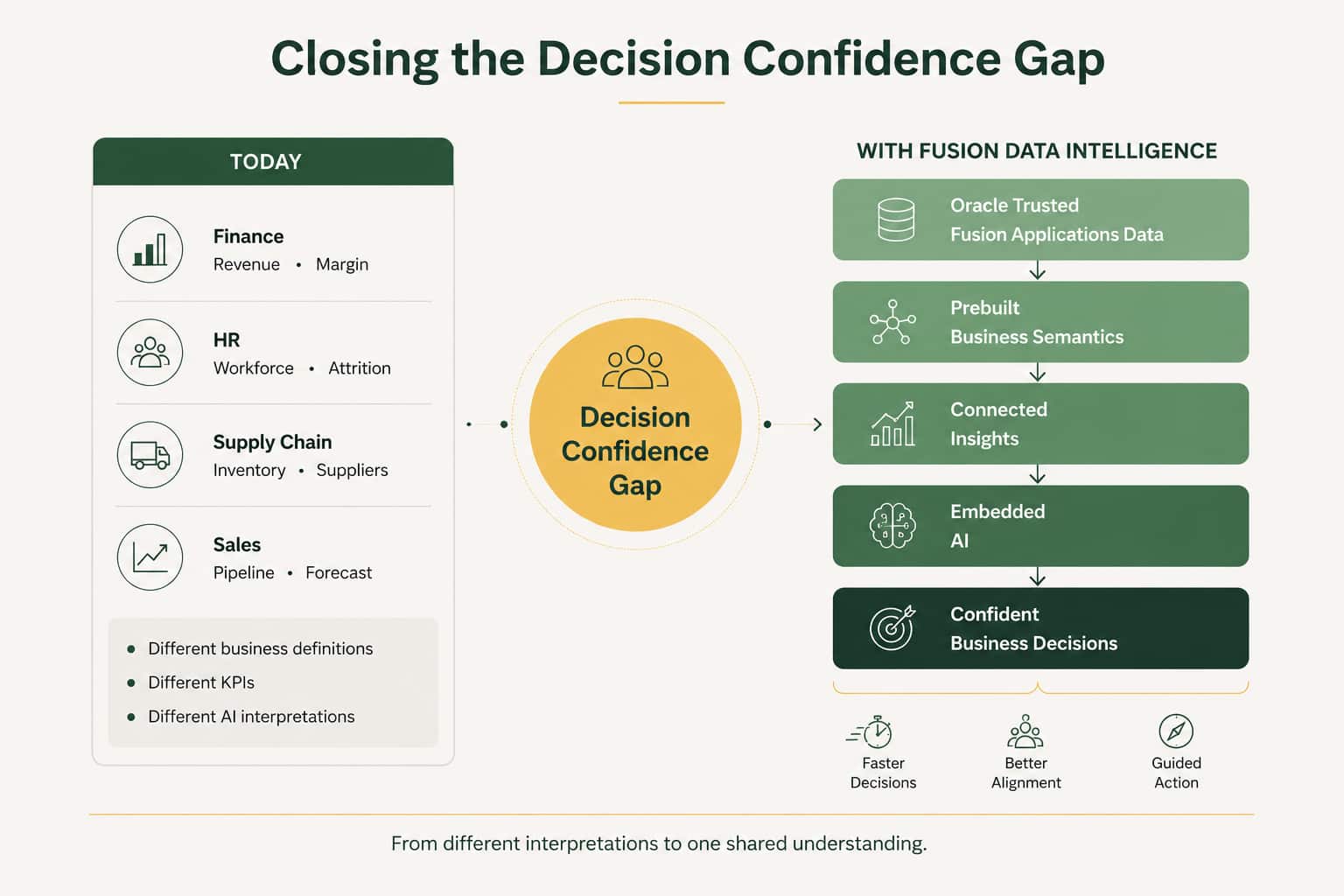
This is the decision confidence gap many organizations are now facing. It isn’t created by a lack of data or AI. It emerges when people, metrics, and AI operate from different business definitions instead of a shared understanding of how the business works.
Gartner recently reinforced this point by highlighting that organizations without business semantics risk inaccurate AI outcomes and unnecessary complexity. While the research focuses on AI agents, the message is equally relevant for business leaders. Before organizations can trust AI driven recommendations, they first need to trust the business definitions behind them.
The Good: Business Truth
The best analytics environments don’t overwhelm people with more information. They create confidence.
Confidence that revenue means the same thing across Finance and Sales, workforce metrics remain consistent from HR to Operations, and supply chain KPIs are measured consistently across the organization.
When business semantics are shared, meetings become shorter, conversations become more strategic, and teams spend less time validating reports and more time deciding what to do next.
AI becomes more valuable because it can connect signals that people rarely analyze together. Grounded in business semantics, it can explain business performance, surface emerging risks, identify opportunities, and recommend actions before issues become business outcomes.
That’s the real promise of business analytics: less time interpreting data and more time acting on it.
The Bad: Business Guesswork
Many organizations have invested heavily in analytics, yet every department still builds reports differently. KPIs evolve independently and business logic often lives inside spreadsheets, custom reports, or the knowledge of individual analysts.
Finance may define revenue one way, Sales another, and HR measure workforce metrics differently from Operations. Every perspective is valid within its own function, yet the business still struggles to agree on one shared view.
Everyone has data.
Everyone can defend their dashboard.
Everyone may even be technically right.
As organizations embrace AI, these inconsistencies become even more visible.
As Gartner highlights, inconsistent business semantics don’t just create different reports. They create different AI interpretations of the same business reality.
The challenge isn’t the intelligence. It’s the business semantics behind it. AI is most powerful when it can connect trusted business semantics across the enterprise.
The Ugly: Decision Chaos
The greatest cost isn’t another dashboard. It’s delayed action.
Leadership meetings become reconciliation sessions. Reports are compared instead of decisions being made, and cross functional initiatives slow because every function is optimizing against a different version of reality.
Now add AI generated insights into that environment. Instead of one conflicting report, there are multiple intelligent explanations built on different assumptions because the business never established a shared language in the first place.
This isn’t because people lack intelligence, effort, or intent. They simply lack a common business language.
The result isn’t poor analytics.
It’s decision chaos.
From Analytics to Action
Leading organizations are taking a different approach. Rather than treating analytics as a collection of dashboards, they’re building a trusted enterprise data foundation enriched with business semantics, governed metrics, connected insights, and embedded AI.
This is exactly the challenge Fusion Data Intelligence was designed to solve.
Fusion Data Intelligence combines trusted data from Oracle Fusion Applications, prebuilt business semantics, embedded AI, and packaged analytics to help finance, HR, supply chain, and revenue leaders make faster, more confident decisions.
Rather than requiring organizations to define business logic from scratch, Fusion Data Intelligence starts with trusted data from Oracle Fusion Applications enriched with business semantics. Curated business models and governed KPIs provide the shared context that embedded AI needs to explain performance, connect patterns across functions, surface risks, identify opportunities, and recommend actions.
It becomes trusted intelligence that helps leaders understand what is happening, why it matters, and what to do next. The conversation changes from “Whose number is right?” to “What should we do next?”
Closing the Decision Confidence Gap
The future of business analytics isn’t about seeing more. It’s about understanding more and acting with greater confidence.
Organizations that establish business semantics on a foundation of trusted data don’t just improve analytics. They close the decision confidence gap, accelerate decision making, strengthen governance, improve cross functional alignment, and drive better business outcomes.
AI is most powerful when it can connect trusted business semantics across the enterprise. That’s how organizations move from insight to confident decisions.
Continue the conversation
- Explore the one pager: 5 Ways Oracle Fusion Data Intelligence Drives Better Decisions
- Read the press release: Oracle Fusion Data Intelligence Oracle Fusion Data Intelligence Helps Organizations Across the World Accelerate AI-Driven Decision-Making
- Watch the video: Oracle Fusion Data Intelligence: Trusted Data for Enterprise AI
- Experience the Innovation Trial: Oracle Fusion Data Intelligence Analytics Relay
- Watch the on demand webinar: Unlock the Next Era of AI Powered Analytics
- Explore the Content Library: Fusion Data Intelligence Content Library