
Bringing analytical insight into applications, workflows, and AI experiences.
Nucleus Research has named Oracle a Leader in its 2026 Embedded Analytics Technology Value Matrix. The recognition comes as organizations rethink how they deliver analytical insight across applications, workflows, and AI experiences.
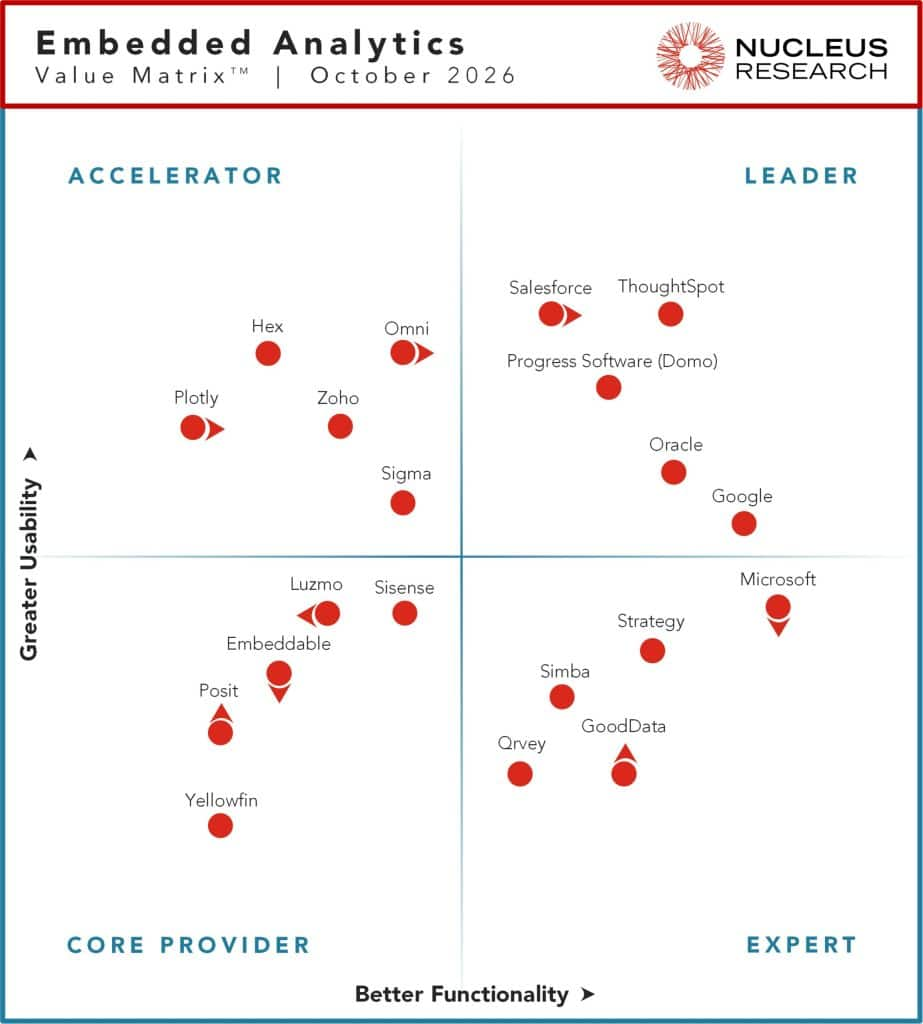
Nucleus highlights a growing emphasis on reusable consistently defined business logic, natural-language interaction, and analytics delivered across multiple channels. As organizations create more applications and AI-assisted experiences, the ability to distribute consistent insights and manage deployments efficiently becomes increasingly important.
For business leaders, this raises a practical question: how can more people – and AI agents – use analytical intelligence while working from a shared understanding of the business?
More ways to ask questions can help simplify analytical work
People can now explore business information through dashboards, applications, and AI assistants. But easier access only helps if they can understand and use the answers.
If a dashboard and an AI assistant calculate supplier performance differently, someone must explain the difference. If each new application needs its own calculations and business rules, teams have more to build and maintain.
Customers need consistent answers they can use, while helping reduce the effort involved in checking how those answers were produced.
Bring understanding closer to the decision
Consider a procurement manager investigating a late delivery. Knowing that an order is late establishes the immediate problem. Deciding how to respond requires more context: Is this an isolated exception? Has the supplier’s performance deteriorated? What evidence supports a wider review?
Answering those questions may mean opening several reports, comparing figures, and asking an analyst for help.
Bringing relevant analytical context into the manager’s workflow can make that investigation easier. Analysts can continue deeper investigations, while the manager reviews the evidence and determines the appropriate next step within applicable permissions and approvals.
The opportunity is straightforward: helping teams spend less time assembling information and more time evaluating the appropriate next steps.
Bring Oracle Analytics into the applications people use
Oracle Analytics Cloud (OAC) supports embedding interactive visualizations and conversational analysis within applications, portals, and web pages. Users can explore information and ask follow-up questions through the Oracle Analytics AI Assistant while staying within the application where they’re working. This puts analytical insight closer to the decision and can help reduce the need to switch tools. See the embedded experience.
Embedded analytics also helps organizations share information with wider audiences. The University of Texas at Arlington, for example, publishes sustainability dashboards covering energy, water, waste, and greenhouse gas emissions on its website. Explore UTA’s sustainability dashboards.
Oracle Analytics Cloud’s public access capability further supports this type of experience. Organizations can make selected workbooks, analyses, and dashboards available without requiring viewers to sign in to OAC, subject to the applicable configuration and access settings, helping them bring approved analytical content to public websites. Learn about public access and embedding.
Embedded analytics also extends into AI-powered experiences. Through its Model Context Protocol (MCP) server, OAC enables compatible AI applications and agents to access analytical data and capabilities subject to the applicable authentication, authorization, and configured access controls. Developers can bring these capabilities into their own applications, helping users find relevant information, explore business questions, and work with analytics content within an AI experience. Learn more about OAC’s MCP server.
Build on the analytics your teams need
Oracle Analytics Cloud supports embedded experiences in custom applications and portals. Fusion Data Intelligence (FDI) provides prepared application data, business measures, and packaged analytics for supported Oracle Fusion Applications customers. Oracle AI Data Platform (AIDP) supports broader custom data and AI solutions.
Start with one recurring decision that takes too much preparation. Identify what people must reconcile, which definitions need agreement, and where insight would be most useful.
Call to Action: Explore Nucleus Research’s perspective
Visit the 2026 Embedded Analytics Technology Value Matrix for Nucleus Research’s overview, Oracle’s Leader positioning, and options to access the full report. Explore the trends shaping embedded analytics – and consider what they mean for the decisions your organization needs to make.
Explore Nucleus Research’s perspective
Visit the 2026 Embedded Analytics Technology Value Matrix for Nucleus Research’s overview, Oracle’s Leader positioning, and options to access the full report. Explore the trends shaping embedded analytics – and consider what they mean for the decisions your organization needs to make.
For more information:
- Nucleus Report Gated page: https://nucleusresearch.com/register/
- Oracle Analytics Product page: https://www.oracle.com/analytics/
- Fusion Data Intelligence product page: https://www.oracle.com/fusion-data-intelligence/
- AI Data Platform product page: https://www.oracle.com/de/ai-data-platform/