
How Fusion Operational Analytics helps bring broader business understanding together with relevant operational context
Business questions don’t all require the same kind of information.
Some questions are best answered with analytical context: trends across time, comparisons across organizations, performance against targets, and patterns across large volumes of business data.
Other questions require operational context: the current state of a specific transaction, worker, order, opportunity, process, or exception.
Both perspectives are important. The challenge is that the information needed to answer them can be spread across analytical views, operational reporting, spreadsheets, and specialist workflows.
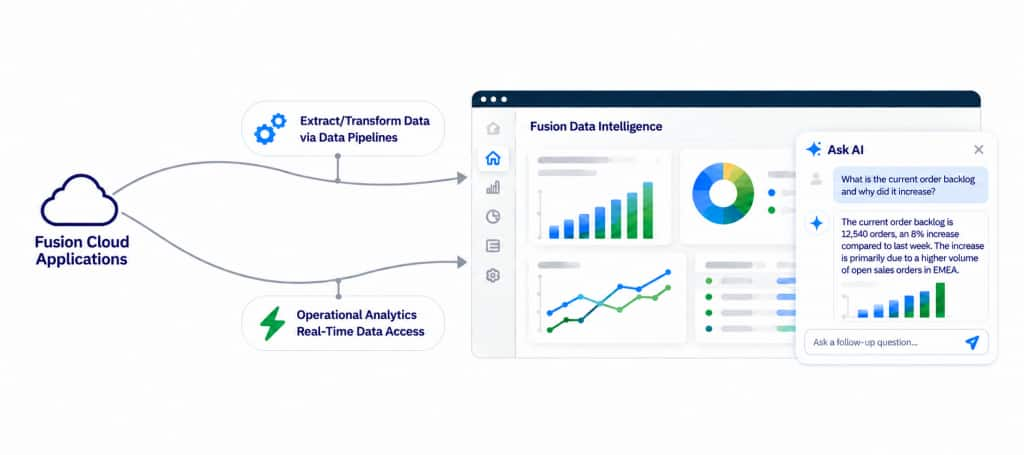
Fusion Operational Analytics helps bring these complementary perspectives closer together in the Fusion Data Intelligence (FDI) experience, supporting users as they move between understanding the broader business picture and examining relevant operational information.
Two types of contexts, two types of questions
FDI helps teams understand the broader business picture through curated Fusion data, business semantics, and packaged analytics. It helps answer questions such as: What changed over time? Where are trends or patterns emerging? How does performance compare across periods, organizations, or other dimensions?
Fusion Operational Analytics supports a different kind of question: What is happening with a specific transaction, worker, order, opportunity, process, or exception? What still requires attention?
These questions complement one another, but they shouldn’t be confused. Operational information isn’t simply a more current or more detailed version of an analytical dataset. The right context depends on the business question.
Fusion Operational Analytics, an FDI add-on, brings real-time operational context from supported OTBI subject areas into the FDI experience for supported business questions, bringing these complementary ways of understanding the business closer together.
Business questions in context
The value becomes tangible in everyday business questions.
ERP / Finance. Analytics can show how expenses changed, where variances occurred, or how results compare with prior periods. Operational context can help teams examine which journals are awaiting approval, what may be preventing a process from completing, or the current state of a particular transaction.
HCM. Analytics can reveal changes in headcount, attrition, or workforce patterns. Operational context can help teams examine a specific worker, assignment, requisition, or HR process, where supported.
SCM. Analytics can identify trends in supplier performance, inventory, or order cycle times. Operational context can help teams examine a particular purchase order, shipment, inventory position, or exception, where supported.
CX. Analytics can help sales teams understand pipeline and performance patterns. Operational context can help them examine specific opportunities and business activity that may require follow-up, where supported.
Across these scenarios, the goal is the same: bring the right context to the question and make it easier for users to understand what requires attention.
Bringing analytical and operational context together
FDI provides the analytics foundation with curated Fusion data, business semantics, and packaged analytics. Fusion Operational Analytics complements that foundation by bringing real-time operational context from supported OTBI subject areas into the FDI experience for supported investigation use cases.
As an FDI add-on, it complements Fusion Applications, FDI, OTBI, and existing BI investments.
Focus on the questions that matter
The best starting point isn’t a feature checklist. It’s a business question.
Where do users lose time moving between analytical and operational views? Which recurring questions require both a broader understanding of the business and operational information about a specific transaction, process, or exception?
Start with that question. Then identify the analytical and operational context needed and what is supported in the environment. This creates a practical way to validate one focused use case before expanding further.
Ready to explore Fusion Operational Analytics? Talk with your Oracle team about bringing real-time operational context into the FDI experience to help your teams investigate current transactions, processes, and exceptions and make better-informed decisions.
Additional Resources
Explore the power of data, analytics, and AI with FDI – Visit webpage
Operational Intelligence Across Every Business Pillar: Discover how Operational Intelligence is incorporated across SCM, HCM, ERP, and CX to deliver deeper, actionable insights within each business function.
Explore the documentation and guidance for using Fusion Operational Analytics – Start today.
Try FDI for free – Get your free trial.
Unlock the next era of AI-powered analytics – Watch Replay