
Oracle AI Data Platform empowers organizations to unlock the full potential of their data with a modern, AI-ready foundation. Designed for speed, simplicity, and scale, it unifies data lake storage, cataloging, ingestion, preparation, and analysis into one seamless experience—enabling teams to move from raw data to real insights faster than ever.
With just a few clicks, users can create a secure AI-ready data workspace, build rich catalogs across their entire data estate, and manage access using enterprise-grade RBAC(Role-Based Access Control). Built-in Spark-powered notebooks make it easy to explore, transform, and enrich data, while automatic metadata ingestion from supported services keeps everything organized and up to date.
Oracle Analytics Cloud (OAC) integrates directly with the platform, enabling business users to instantly analyze curated datasets without complexity or delays. The result is a single “pane of glass” that streamlines the entire data and AI lifecycle—backed by Oracle’s proven security and reliability.
Core Capabilities
Data Integration – Seamless access to any data source—live or ingested—backed by deep integration with Oracle technologies and applications, and enhanced by zero-ETL data sharing from Fusion AI Data Platform (formerly Oracle Fusion Data Intelligence).
Unified Catalog – Unified master catalog that governs both data and AI assets and supports the full medallion architecture—from bronze to silver to gold. This enables fast ingestion, curation, and delivery of data products, AI applications, and AI (artificial intelligence) and ML(machine learning) models across diverse formats, all with governance built in at every layer.
Data Governance- AI Data Platform ensures secure, well-managed, and organized data across all catalogs. With RBAC metadata management, and audit features, teams can maintain data quality and confidently run their AI and analytics workloads.
Data Engineering and Data Science -AI Data Platform provides a unified development experience for both data engineers and data scientists, with flexible CPU andGPU compute to match any workload. Developers can work in their preferred languages—from Python to Spark SQL supported by seamless, unified workflow orchestration.
AI Models and Framework: AI Data Platform seamlessly integrates with Oracle’s Generative AI services, supporting leading foundational LLMs like Cohere, GPT, and Llama. It also works effortlessly with open-source frameworks—including PyTorch, TensorFlow, and LangChain—providing full flexibility to build and deploy AI models in any architecture.
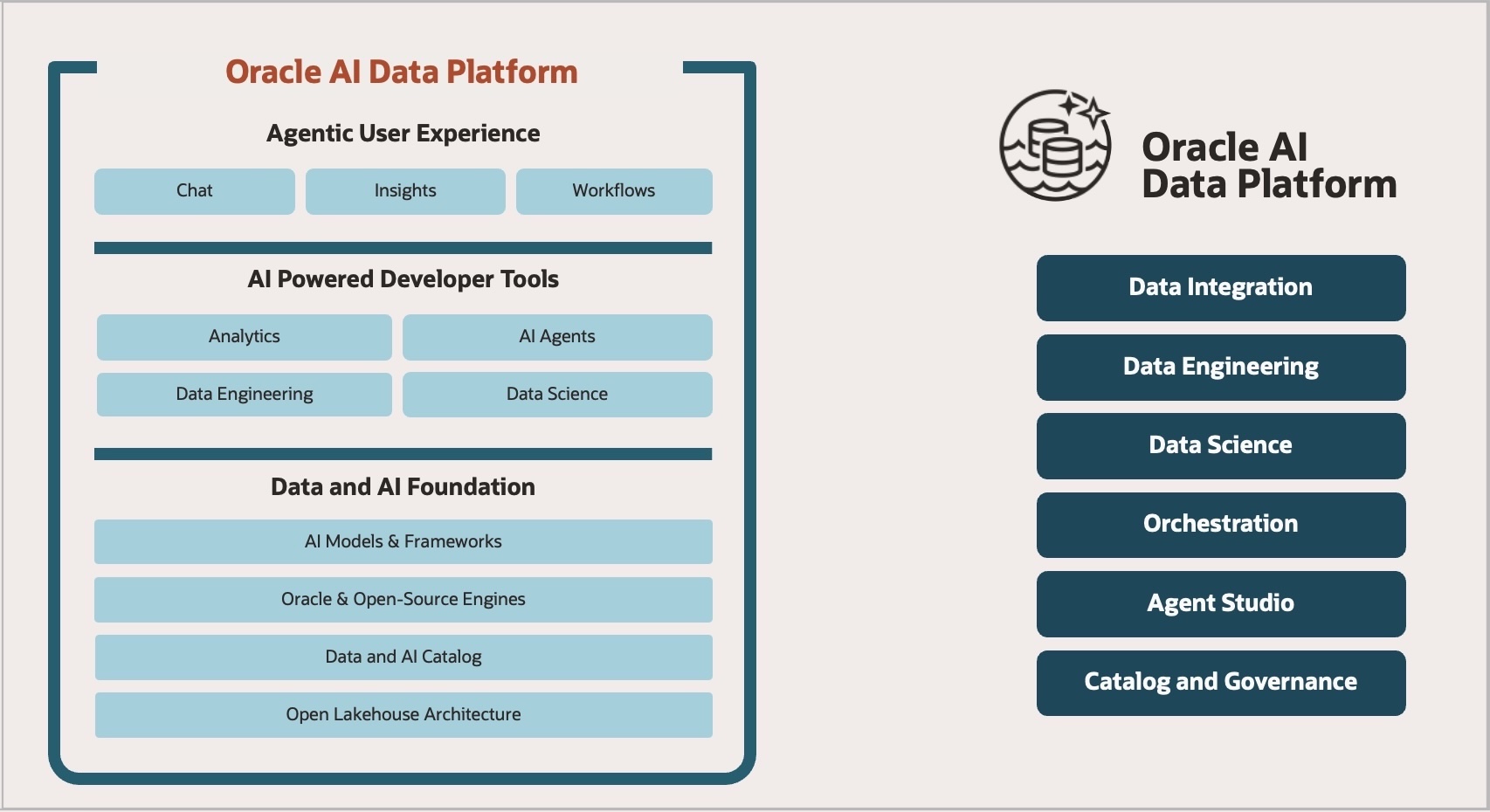
How the AI Data Platform Delivers Value Through the Medallion Architecture
To showcase the power of the Oracle AI Data Platform and its Medallion Architecture, let’s explore a telecom customer churn use case. This example shows how data flows from raw ingestion to refined analytics and AI-driven insights.
Objective
The objective of this use case is to show how the Oracle AI Data Platform, using the Medallion Architecture, predicts customer churn and uses an AI model to analyze customer sentiment, uncover issues, and improve retention.
How We Built This Use Case
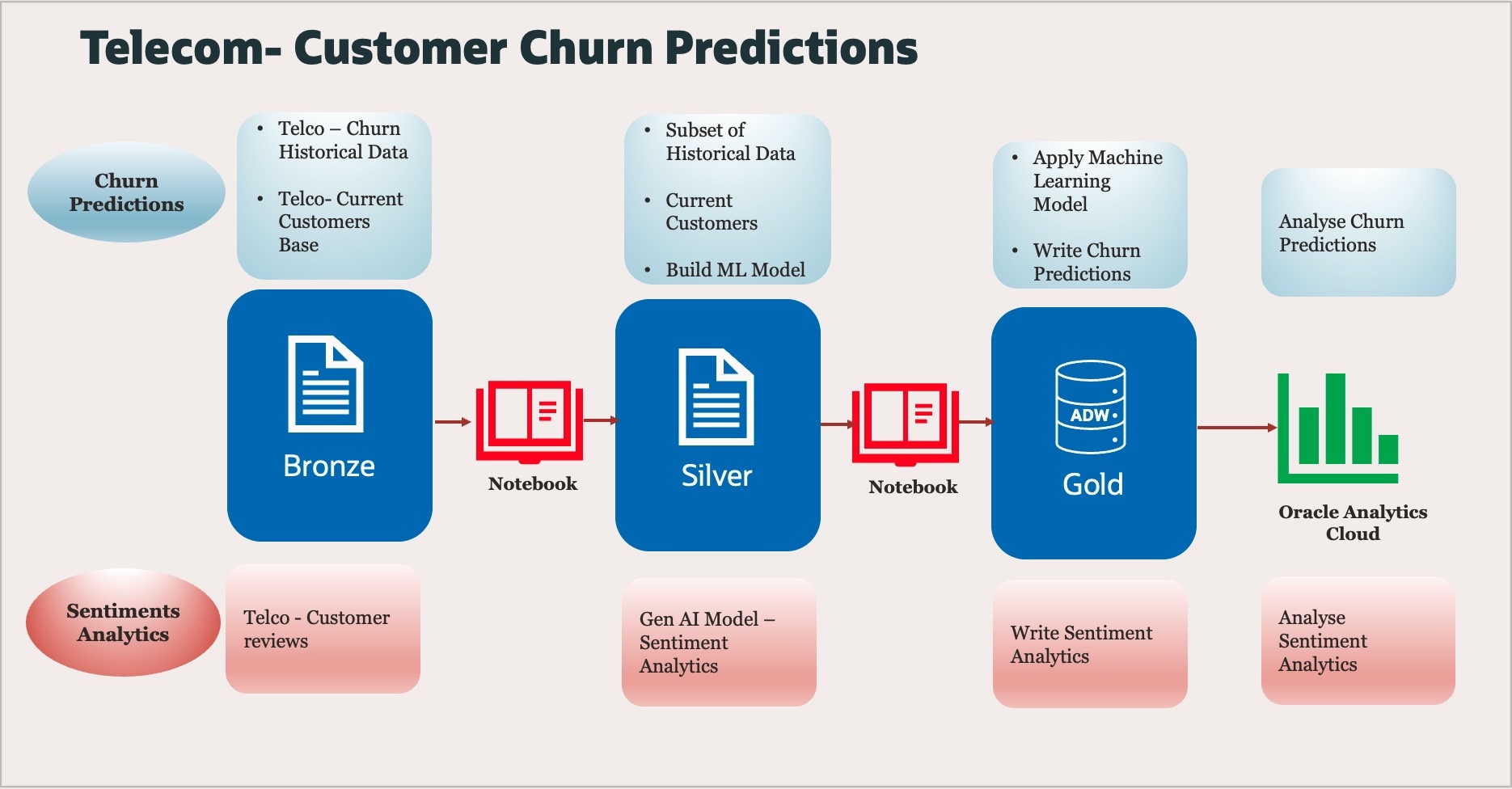
In this use case, we demonstrate how Oracle AI Data Platform, built on the Medallion Architecture, can drive actionable insights for telecom customer retention.
We start by ingesting both historical churn data and current customer information into the Bronze layer. This data is then refined (subsetting, transforming, and denormalising) in the Silver layer, where we also train a ML model to predict customer churn. The model’s predictions for current customers are stored in the Gold layer within an Autonomous AI Database and visualized in Oracle Analytics Cloud to provide clear, actionable insights.
Next, we analyze customer sentiment from unstructured reviews. The review data is refined in the Silver layer and processed using a Generative AI LLM to extract sentiment and highlight key topics. These insights are then saved in the Gold layer and visualized in OAC, helping identify customer pain points and areas for improvement.
Catalogs
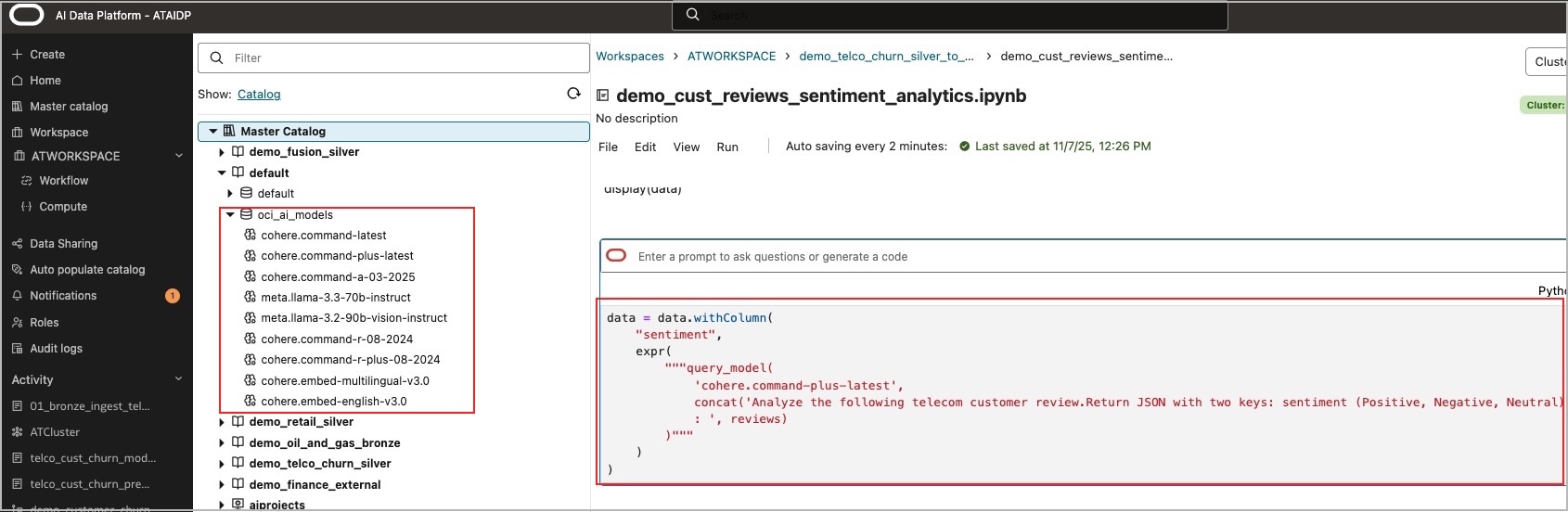
As part of the Medallion Architecture, we set up three catalogs—Bronze, Silver, and Gold—within AI Data Platform, providing a structured foundation for data processing, analytics, and AI-driven insights.
Bronze Catalog – Raw Data
The Bronze catalog stores all raw, unprocessed data in object storage. For this use case, it includes 10 years of historical customer churn data as well as current customer data. This catalog serves as the foundation for future processing.
Silver Catalog – Refined Data and Machine Learning
In the Silver catalog, we refine the raw data from the Bronze catalog. This involves cleaning, subsetting, and transforming the data, which we then store as Parquet files in object storage. Using the historical churn data in this catalog, we also train a ML model for churn prediction, which is saved in the Silver catalog for later use.
Gold Catalog – Analytics-Ready Data
The Gold catalog is the consumption-ready catalog backed by an Autonomous AI Database for analytics and reporting. Here, we apply the churn prediction model to the current customer data, calculate the churn probabilities, and store the results in an Autonomous AI Database table for visualization and insights.
Sentiment Analysis – From Raw Reviews to Actionable Insights
For sentiment analysis, unprocessed customer reviews are first stored in the Bronze catalog. After refinement in the Silver catalog, we run an AI Model to extract sentiment—positive, negative, or neutral—as well as key topics or aspects. These insights are then stored in the Gold catalog as a database table, ready for analytics in OAC to uncover customer pain points and improvement areas.
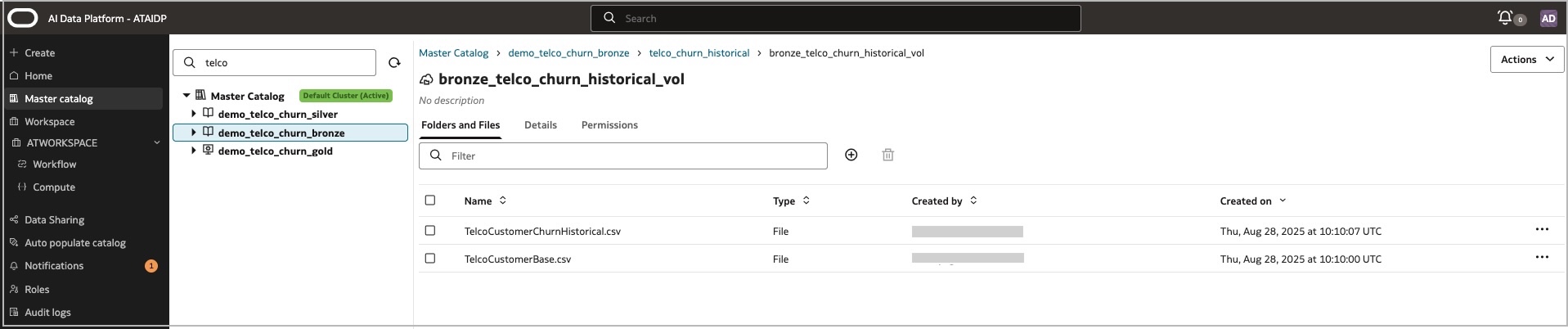
Notebooks
We developed a set of Python notebooks to move data across catalogs, build the ML model, and perform sentiment analysis using an AI Model.
Notebook 1 – Process Historical Churn Data
- Reads historical churn data from the Bronze catalog.
- Filters data to include the last four years and selects relevant attributes.
- Writes the processed dataset in the Silver catalog.
Notebook 2 – Process Current Customer Data
- Reads current customer data from the Bronze catalog.
- Performs similar cleaning and transformation steps.
- Writes the processed dataset in the Silver catalog.
Notebook 3 – Train and Apply Churn Prediction Model
- Trains a churn prediction model using the historical dataset in the Silver catalog.
- Applies the trained model to current customer data to generate churn risk predictions.
- Stores the prediction results in the Gold catalog for analytics and reporting.
Notebook 4 – Sentiment Analysis on Customer Reviews
- Uses an AI Model, like Cohere to process customer review text.
- Extracts sentiment scores (positive, negative and neutral) as well as key topics and aspects.
- Writes the enriched sentiment results to the Gold catalog for further analysis and insights.
Workflows
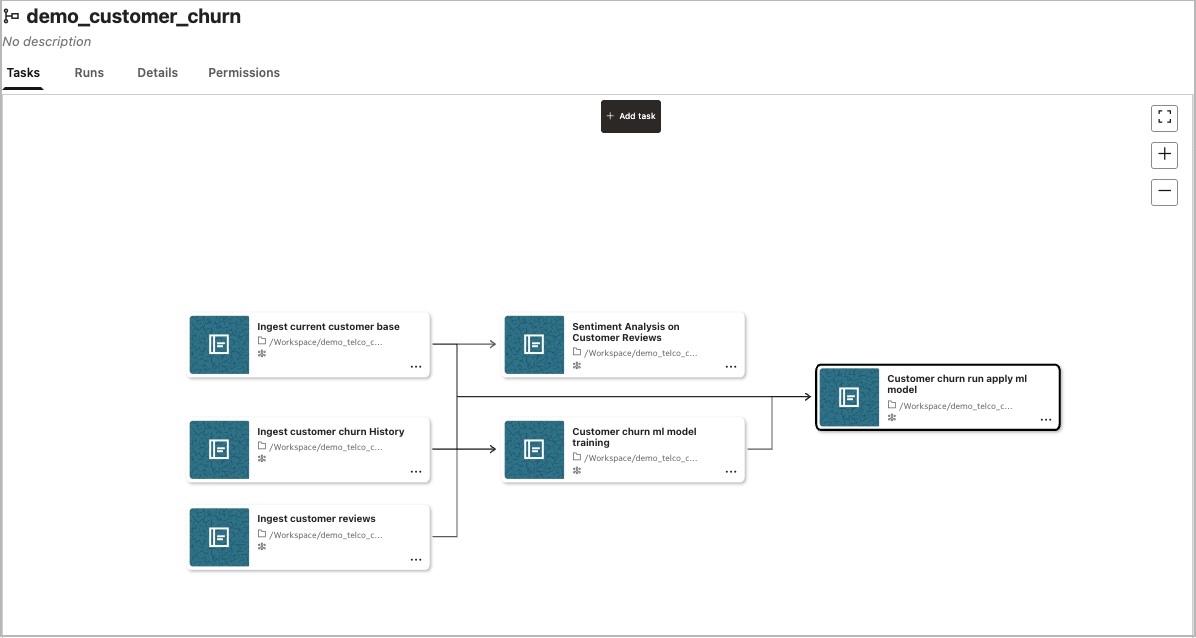
Workflows in AI Data Platform enable users to automate and orchestrate complex data pipelines. They can run workflows on-demand or on a schedule and may consist of multiple tasks with features like dependencies, triggers, and error handling.
We created a workflow that orchestrates all notebooks, covering every task from data ingestion to ML model predictions and sentiment analysis. When executed, this workflow runs the entire process end-to-end automatically.
Explore Gold Catalog Insights with OAC
OAC provides a direct connector for the AI Data Platform, allowing you to access catalog data and analyze it directly through the OAC workbook.
We connected OAC to the Gold catalog, enabling us to explore churn predictions and sentiment analysis results interactively within an OAC workbook, turning raw data into actionable insights.
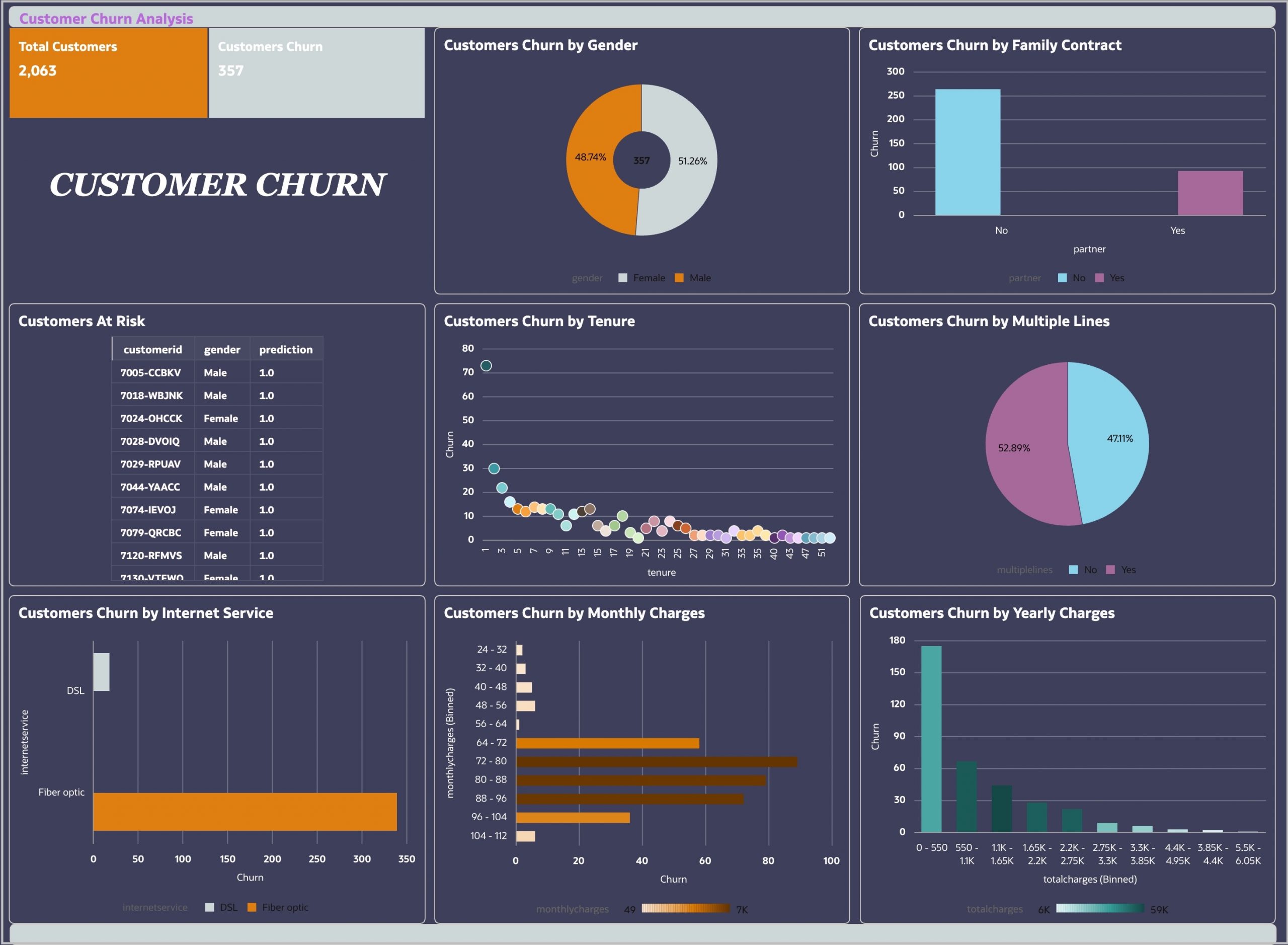
The first dashboard lets us see which customers are at risk of churn according to our ML model. By exploring patterns across gender, contract type, tenure, and billing details, we can uncover the factors driving churn and pinpoint strategies to retain customers.
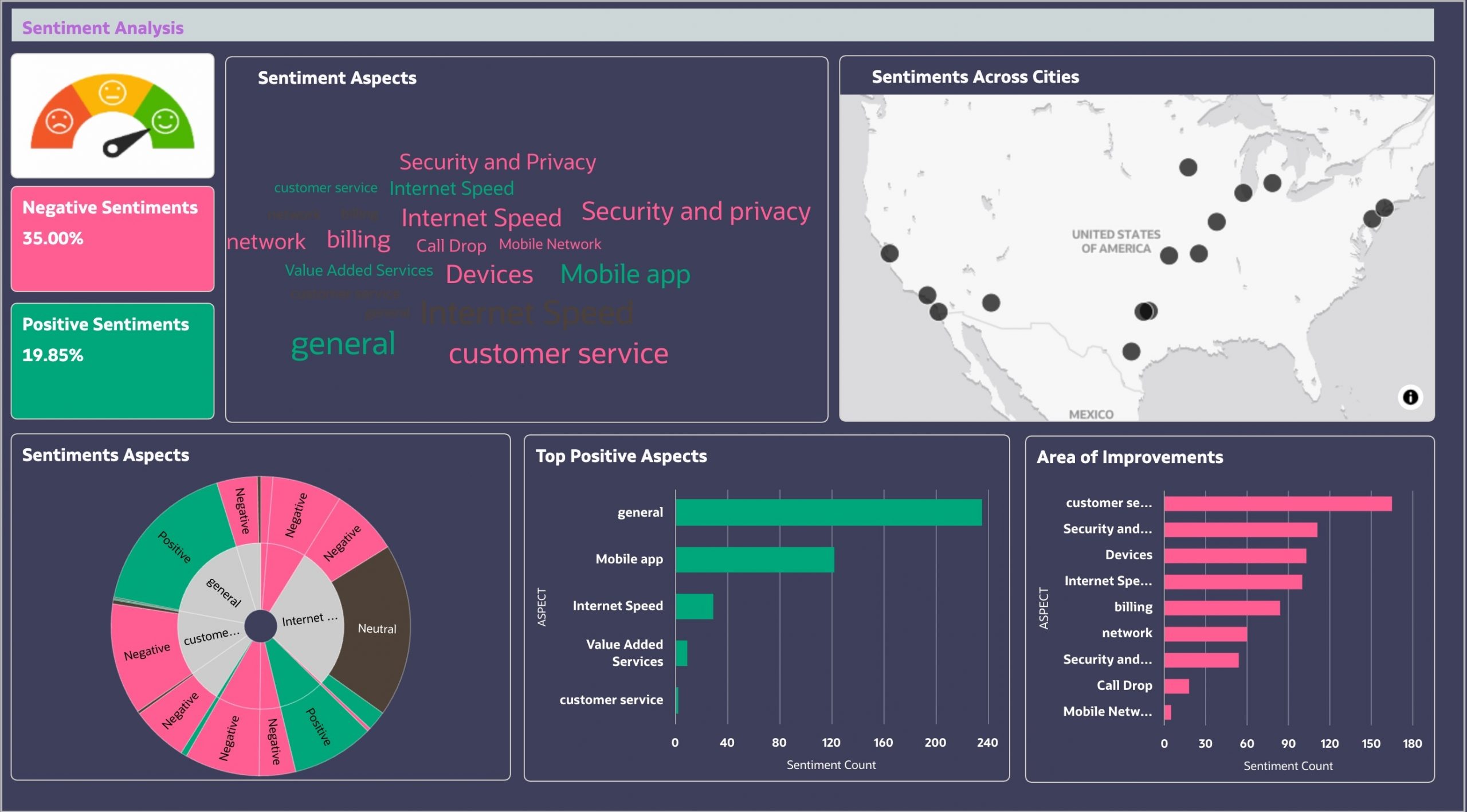
In the second dashboard canvas, we explore sentiment insights from customer reviews. Negative aspects, such as network quality or customer service, are highlighted in red, while positive aspects like mobile app features or value-added services appear in green. We also compare sentiments across cities to uncover regional trends, highlighting strengths and opportunities for improvement.
To conclude, this use case demonstrates how the AI Data Platform, leveraging the Medallion Architecture, unifies data engineering, machine learning, and AI-driven analytics to deliver actionable customer insights and drive smarter retention strategies.
There is a roadmap for AI capabilities, which will complement the functionalities discussed in this article. The AI Data Platform will enable pipelines that incorporate AI and GenAI using both built-in and external models. For dedicated AI development, it will offer low-code and code-first experiences powered by Oracle Cloud Infrastructure (OCI) Gen AI and Oracle 23ai, including its vector store. Developers will be able to manage AI assets end-to-end, and these agents are expected to integrate with Oracle Fusion AI Agent Studio, extending the overall experience.
Call to Action
To explore more about the Oracle AI Data Platform, check out these resources:-
Oracle AI Data Platform Documentation