

How OCI helped turn live race data into dashboards, AI/ML predictions, and broadcast-ready insights.
When Max Verstappen, one of the world’s fastest racers, is chasing 100 drivers, every second creates a new story. Who is gaining, who is losing time, and which strategy could change the outcome?
For Red Bull Max vs 100, Oracle Cloud Infrastructure (OCI) helped turn live race signals into real-time intelligence for race control, event teams, customer systems, and live broadcast channels. The goal was not just to move telemetry from the track to the cloud, but to support live decisions and storytelling with dashboards, curated data streams, and AI/ML-powered predictions.
The real-time race intelligence challenge
Red Bull Max vs 100 was not a traditional karting race. The format included shortcuts (joker paths) and penalty routes that drivers could use only under specific conditions. A standard lap-and-position model was not enough. The platform needed to understand where each driver was, which route they were taking, and how that choice affected race progress.
The data challenge was unusual, too. Historical race data was limited to a small number of previous events with smaller fields of roughly 50 drivers. For Max vs 100, the system had to support a larger, more dynamic race while producing meaningful predictions from limited history, live lap-level data, current positions, route choices, and evolving race state.
At the same time, the platform needed to ingest live GPS and timing data, derive race state, power dashboards, expose curated streams, and stay ready for replay, fallback, and validation.
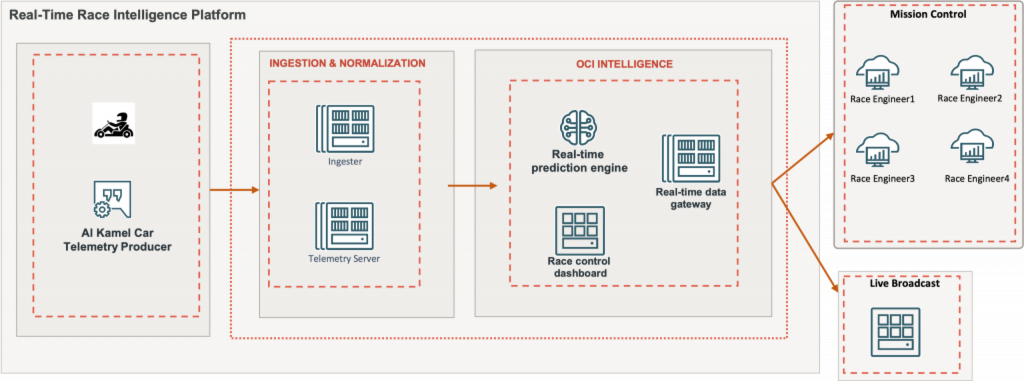
Capturing the race as it happened
The first step was to capture the race reliably as it unfolded. The MaxV100 ingestion layer connected to the live timing and GPS feed from Al Kamel, parsed incoming messages, and transformed GPS payloads into a normalized internal race-feed format.
That normalization gave the platform a consistent source of observed race data. It kept the pipeline simple: ingest the feed, preserve the signal, and make it available without forcing every dashboard or consumer to understand the raw timing protocol.
Turning live signals into race context
Live GPS and timing data can show where a driver is, but race intelligence requires context. The MaxV100 telemetry layer enriched the normalized feed into derived race state: distance around the lap, race progress, speed deltas, gaps, joker and penalty route usage per kart, featured-driver status, and driver status.
The shortcuts (joker paths) and penalty routes could change the logic and meaning of position and progress around the lap and race. By turning live signals into consistent race context, OCI helped support an intelligence layer for race control, broadcast systems, and external consumers.
Giving race control a live operating picture
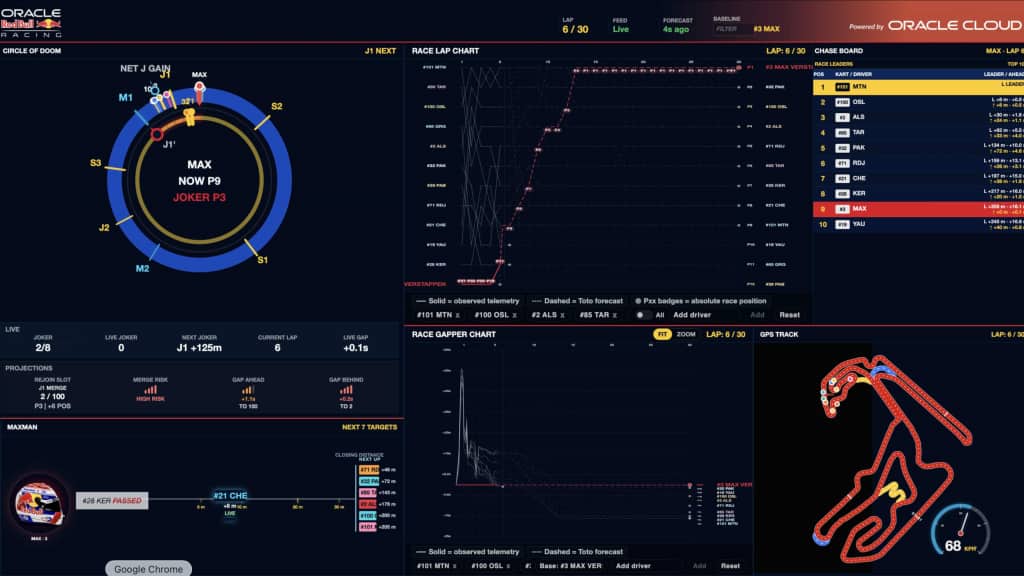
Race control needed more than raw telemetry. They needed a live operating picture that made the race data easy to scan, interpret, and act on.
The MaxV100 dashboard brought that context together through live maps, leaderboards, gap views, chase boards, joker status, lap charts, and race status views. With a large field, route rules, shortcut choices, and evolving race state, the dashboard helped give teams a shared real-time view to support live decisions.
Delivering curated data beyond the dashboard
The same race intelligence also needed to reach systems outside the control room. Broadcast channels and customer systems needed timely race data, but not every raw telemetry packet.
The MaxV100 Data API Gateway exposed a curated WebSocket contract from OCI-hosted infrastructure. Instead of publishing raw high-frequency telemetry, it delivered structured streams such as race snapshots, race forecasts, joker strategy, and featured-driver chase data. Authentication and health checks supported race-day monitoring.
Predicting the next chapter of the race
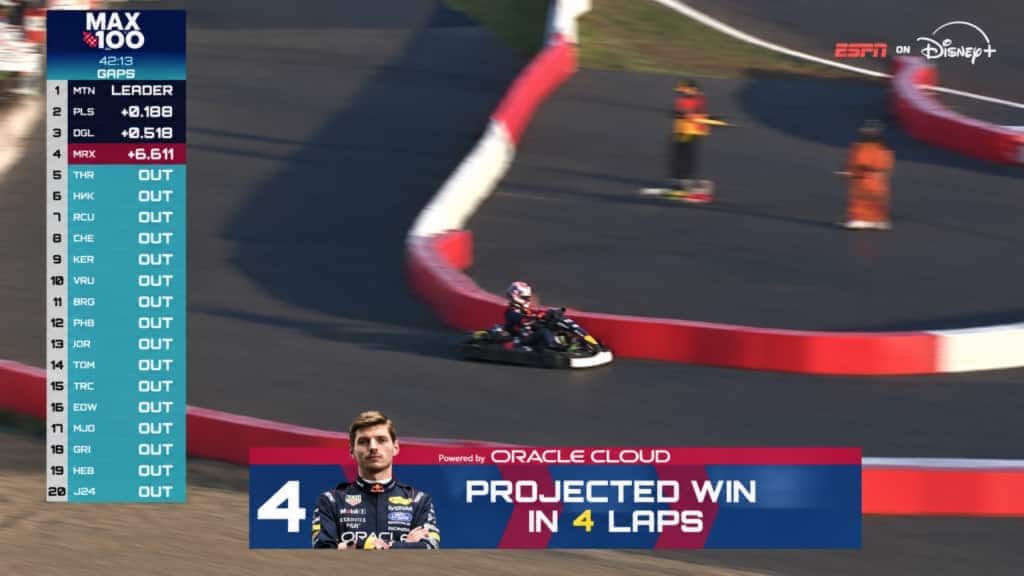
Real-time intelligence is not only about knowing what is happening now. The AI/ML-powered prediction layer used live lap-level race history, current positions, field size, featured-driver context, route choices, and evolving race state to forecast how the race could develop.
It helped estimate who might be caught, where gaps could close, and how the featured-driver chase might unfold. It also supported joker and shortcut strategy insights, identifying when a route choice could create an opportunity, become risky, or affect projected position or overtake windows.
The goal was not to predict the future perfectly. It was to turn current race signals into timely, explainable predictions that supported race control and helped broadcast teams tell a clearer story.
Why OCI
OCI provided the cloud foundation for turning Max vs 100 from a live data feed into a real-time race intelligence experience. The platform needed to process live data and support multiple audiences at once.
The race intelligence stack ran on OCI across the live data ingester, telemetry server, prediction models, real-time data gateway, and dashboard experience. Together, these services captured race data, enriched it into context, produced forecasts, and delivered curated streams to race control, customer systems, and broadcast channels.
The real-time data gateway used Oracle Cloud Infrastructure Compute and an Oracle Cloud Infrastructure Flexible Network Load Balancer for external access, with Oracle Cloud Infrastructure Bastion, Terraform, and health checks supporting repeatable operations.
OCI helped separate ingestion, telemetry processing, prediction, visualization, and external data delivery while keeping the architecture organised into distinct functional layers for live operations. The same pattern can be applied beyond racing wherever there is a need to turn live signals into real-time decisions with AI/ML-powered insight.
What we learned
Max vs 100 reinforced three principles for real-time data applications: create a stable data contract early, separate raw telemetry from curated intelligence, and design for live operations from the beginning with synthetic feeds, health checks, status endpoints, and replayable data.
Conclusion and call to action
Red Bull Max vs 100 showed how live race data can become much more than telemetry. With OCI as the cloud foundation, the platform turned fast-moving signals into real-time intelligence for race control, broadcast-ready predictions, and curated data streams.
The same approach can help organizations act on live operational data from vehicles, manufacturing lines, logistics networks, energy assets, or customer-facing systems while decisions are still unfolding.
To explore how to build similar real-time data applications, visit the Oracle Cloud Infrastructure Architecture Center and learn more about Oracle Cloud Infrastructure Compute, networking, load balancing, and AI/ML services.
“I was lucky enough to be one of the 100 racing against Max and, from the kart, you’re completely focused on your own race. Behind the scenes, though, there were 100 different stories unfolding at the same time. OCI helped us make sense of that complexity in real time, giving the teams running the event valuable insight while also helping us bring the story of the race to life for the audience.”
– Jack Harington
Head of Technical and Performance Partnerships at Red Bull Racing & Red Bull Technology