
Oracle is announcing the upcoming general availability (GA) of Oracle Cloud Infrastructure (OCI) Enterprise AI, an end-to-end developer offering that brings together the capabilities needed to build, manage, and deploy AI workloads—helping teams move from experimentation to production with greater speed and confidence, regardless of structured or unstructured data sources.
This new era of AI at Oracle was driven by the leadership and dedication of Elena Sunshine, Jason Creighton, Saket Goel, and Lyudmil Pelov from the OCI AI product management team.
What’s new?
This new service combines AI intelligence (models and inferencing), the ability to act on it (agents and tools), and built-in controls (governance and security) all in one simplified offering. Whether your team is pro-code, prefers low-code tools, or a mix of both, OCI Enterprise AI helps you move from experiments to production with flexibility, extensibility, and unified governance.
And, as enterprises seek to expand AI use cases beyond simple queries, teams increasingly need agentic solutions that can orchestrate multi-step, cross-system workflows. With this release, two new agentic capabilities are now available:
- Responses API compatibility: OCI Enterprise AI is compatible with the OpenAI Responses API, helping teams reuse familiar request/response patterns and reduce refactoring when adopting OCI Enterprise AI.
- Hosted deployment: OCI Enterprise AI supports hosted deployment for agents, reducing the operational work of managing infrastructure so teams can focus on building and iterating on agent behavior.
OCI Enterprise AI is now generally available in the following regions:
- US East (Ashburn)
- US Midwest (Chicago)
- US West (Phoenix)
- Germany Central (Frankfurt)
- Japan (Osaka)
- UK South (London)
- India South (Hyderabad)
- Brazil East (Sao Paulo)
- Saudi Arabia Central (Riyadh)
From fragmented tools to production-ready AI
Enterprises are racing to unlock value from generative and agentic AI, but fragmented tools and complex integration slow progress and increase risk. Many organizations struggle to access and integrate leading AI models from multiple providers, often working with disconnected tools that limit advanced use cases and stifle innovation. Building, orchestrating, and deploying agentic workloads can be complex and time-consuming, requiring teams to stitch together disparate solutions without consistent support for standard protocols or integrated security. Meeting stringent security, compliance, and governance requirements across AI services is an ongoing concern, exposing organizations to data protection risks and regulatory gaps. These challenges prevent companies from rapidly delivering value with AI and fully realizing its potential.
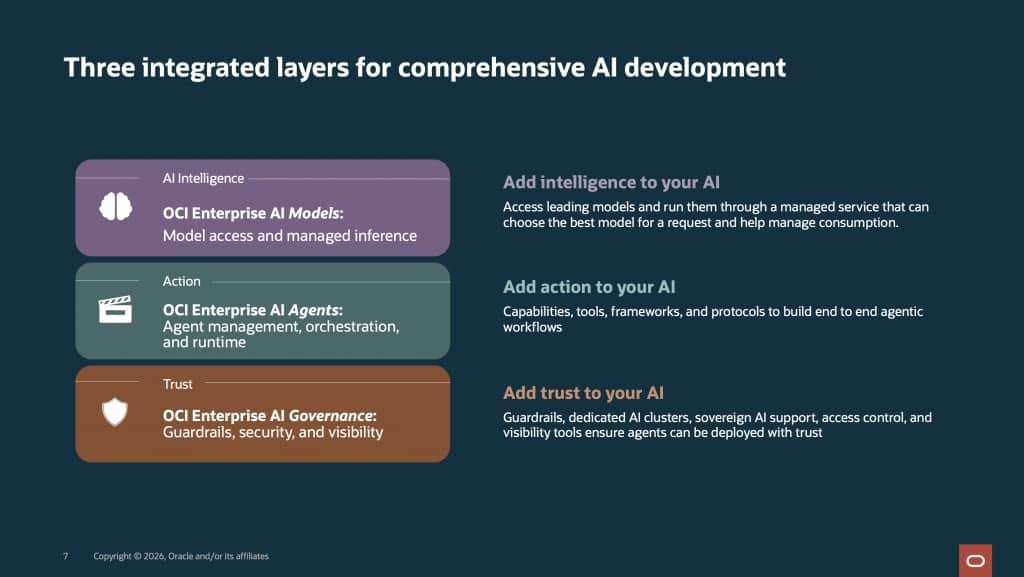
OCI Enterprise AI is designed to help solve these problems with three integrated layers:
- OCI Enterprise AI Models: Customers can access multiple frontier models in one interface, integrating them seamlessly for advanced use cases as their AI needs and expertise grow.
- OCI Enterprise AI Agents: Teams can quickly build, orchestrate, and launch agentic workloads using managed tools, standard protocols, and open-source frameworks.
- OCI Enterprise AI Governance: Enterprise-grade security, compliance, and access controls at every stage are designed to help address data protection and regulatory alignment without compromise.
Putting agentic AI to work across the enterprise:
Teams can use OCI Enterprise AI for a range of business and technical scenarios, such as:
- Develop a production-grade IT Operations Agent for incident triage and guided remediation across systems with custom tool integrations, multi-step orchestration, and open-source frameworks such as LangChain, LangGraph, and AutoGen.
- Build an enterprise knowledge assistant that gives employees a chat interface where they can choose the best model for their task, connect to approved knowledge sources and tools, and leverage centralized security, governance, and auditability .
- Create a Finance Operations Agent using the OpenAI Agent SDK for accounts payable and exception handling that ingests invoices, extracts and validates fields, obtains needed human approvals, and updates ERP systems.
Why OCI Enterprise AI?
Build production-ready AI solutions faster. Designed with different developers in mind, OCI Enterprise AI brings agent building, model access, and governance together behind a consistent approach—helping reduce operational overhead as deployments grow. By consolidating core capabilities in one service, teams can spend less time on repetitive setup work (such as tool connections, context and memory handling, and deployment mechanics) and more time building and iterating on agent behavior as they move from prototypes to production.
Open, extensible by design—plug in your tools, your way. OCI Enterprise AI supports open standards and interfaces so teams can integrate existing systems and evolve over time. This includes MCP for tools, A2A for agent-to-agent communications, and compatibility with the OpenAI Responses API—helping customers build on existing skills and integrations while keeping options open as models and tooling change.
Observe, govern, and secure more confidently. OCI Enterprise AI includes built-in controls, IAM integration, auditability, and observability to support both every day and regulated workloads. Teams get clearer visibility into how agents behave, what tools they use, and how data moves through interactions—supporting monitoring, earlier issue detection, and audit needs as deployments scale across teams and environments.
In addition to these OCI Enterprise AI benefits, Oracle offers three key differentiators that help enterprises adopt and scale AI with greater confidence. First, Oracle brings an enterprise first approach by combining performant, cost-effective infrastructure with sovereign, distributed, and multicloud deployment options, backed by a broad global footprint and a commitment to security and privacy. Second, Oracle’s full-stack AI approach gives customers flexibility to build solutions that fit their needs while working cohesively across the technology stack. Finally, an open ecosystem of partners further expands customer choice and long-term flexibility, including access to multicloud options, top frontier models, and high-performance infrastructure capacity.
Join us April 15 and April 23 for the upcoming webinar, Build, deploy, govern: Accelerate AI agents with OCI Enterprise AI, where our AI experts will officially introduce customers to the new service, its capabilities, and answer live questions.
Learn more about OCI Enterprise AI: