


In our previous blog, “Agentic AI in the Enterprise: How Oracle Is Powering the Next Wave of Autonomous Business,” we introduced Agentic AI as a shift beyond traditional automation, that is enabling systems that reason, plan, and act across complex workflows, not just generate insights. This blog moves from concept to practice.
Let’s explore a high-value manufacturing use case “inventory replenishment and supplier coordination” and show how a hierarchical agent architecture (Supervisor, Inventory, Supplier, and Logistics Agents) transforms replenishment from a reactive process into a continuous, self-optimizing capability using Oracle Cloud Infrastructure and Autonomous AI Database 26ai.
What is the Problem statement:
Global supply chains operate under constant disruption. Inventory must remain lean while absorbing variability in demand, production, and supplier performance. Traditional ERP-driven replenishment is based on static reorder points, batch MRP runs, and manual coordination and was built for stability. Today’s environment requires systems that can continuously adapt and act autonomously.
The Solution:
This solution uses Autonomous AI Database 26ai, Select AI, native AI Agents, and a Managed Model Context Protocol (MCP) Server on OCI. At its core is a Supervisor Agent that governs orchestration, risk, and enterprise objectives. This is not task automation; it is continuous optimization.
Why Agentic AI Orchestration is relevant here?
Inventory replenishment is not just a rule-based workflow, but it is a continuous, multi-variable, multi-objective optimization problem. Manufacturers must simultaneously balance resources like working capital, downtime risk, supplier reliability, logistics constraints, and financial governance. Traditional AI can forecast or alert—but cannot coordinate decisions or execute actions across systems.
Agentic AI is well-suited for this use case because it combines forecasting, contextual reasoning, orchestration, and secure execution within a governed framework. A Supervisor Agent evaluates enterprise risk and financial thresholds, while specialized agents manage inventory levels, supplier coordination, and logistics execution. Continuous feedback updates supplier reliability models and forecasting accuracy, enabling adaptive optimization rather than static recalculation over time.
The Agent Hierarchy
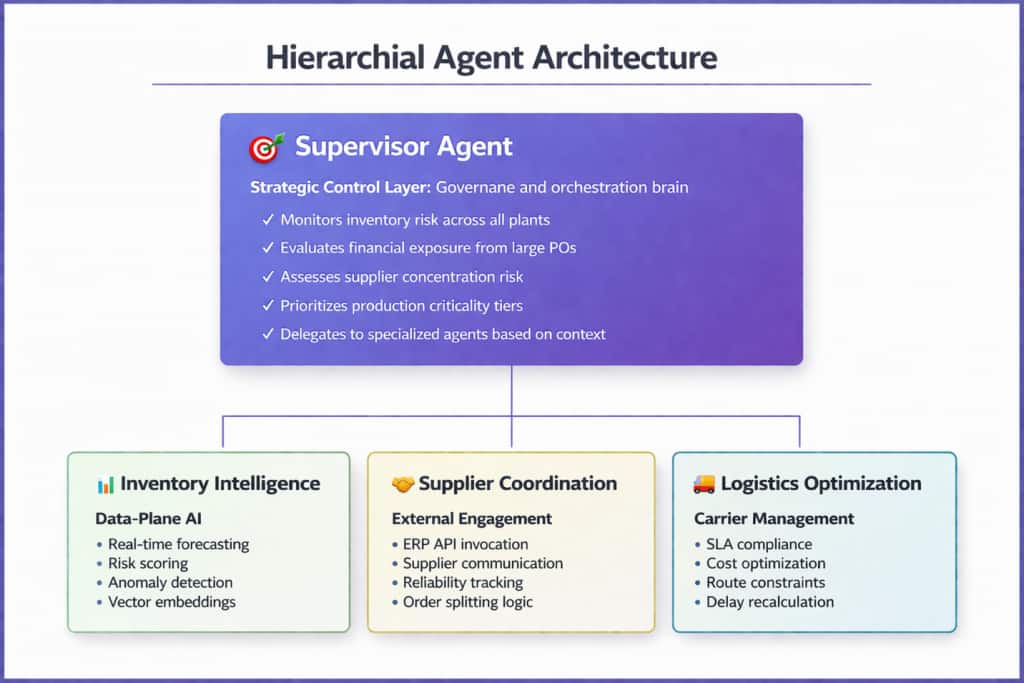
The Supervisor Agent: Strategic Control Layer
The Supervisor Agent is the governance and orchestration brain within the agentic flow. It does not execute operational actions itself; instead, it evaluates enterprise-wide objectives and delegates to specialized agents for further analysis and action
It monitors:
- Inventory risk across all plants
- Financial exposure from large purchasing commitments
- Supplier concentration risk
- Production criticality tiers
When a shortage is predicted, the Supervisor Agent decides whether to authorize replenishment autonomously or escalate to human oversight based on defined financial thresholds and risk profiles.
This layered architecture mirrors how high-performing organizations operate: with strategy at the top and operations beneath.
Inventory Intelligence Agent: Data-Plane AI
Running inside Autonomous AI Database 26ai, the Inventory Intelligence Agent, continuously evaluates inventory against demand, consumption rates, lead times, and supply chain anomalies. Because forecasting models and vector search operate natively within the database engine, there is no need for data movement, offers lower latency, and simplifies architecture.
Vector embeddings capture supplier reliability patterns, such as:
- Average delay distribution
- Partial shipment frequency
- Contract deviation history
With Select AI, which allows natural language interrogation of structured and vector data. A supply chain manager can ask: “Which SKUs are at risk within two weeks, and what is the confidence level?”
The system translates that request into optimized SQL and Machine Learning scoring logic internally.
Supplier Coordination Agent: Autonomous External Engagement
This agent triggers procurement via ERP APIs using the Managed MCP, ensuring secure, governed execution. It can interpret unstructured supplier responses (e.g., delay signals), update reliability models, and evaluate alternatives using vector similarity.
If risk increases, it can:
- Recommend alternate suppliers
- Split orders
- Adjust sourcing strategy
Logistics Optimization Agent
Upon confirmation, this agent selects carriers based on cost, SLA, and constraints. If delays occur, it recalculates production risk and feeds updates back to the Supervisor Agent—closing the loop.
End-to-End Flow Explanation
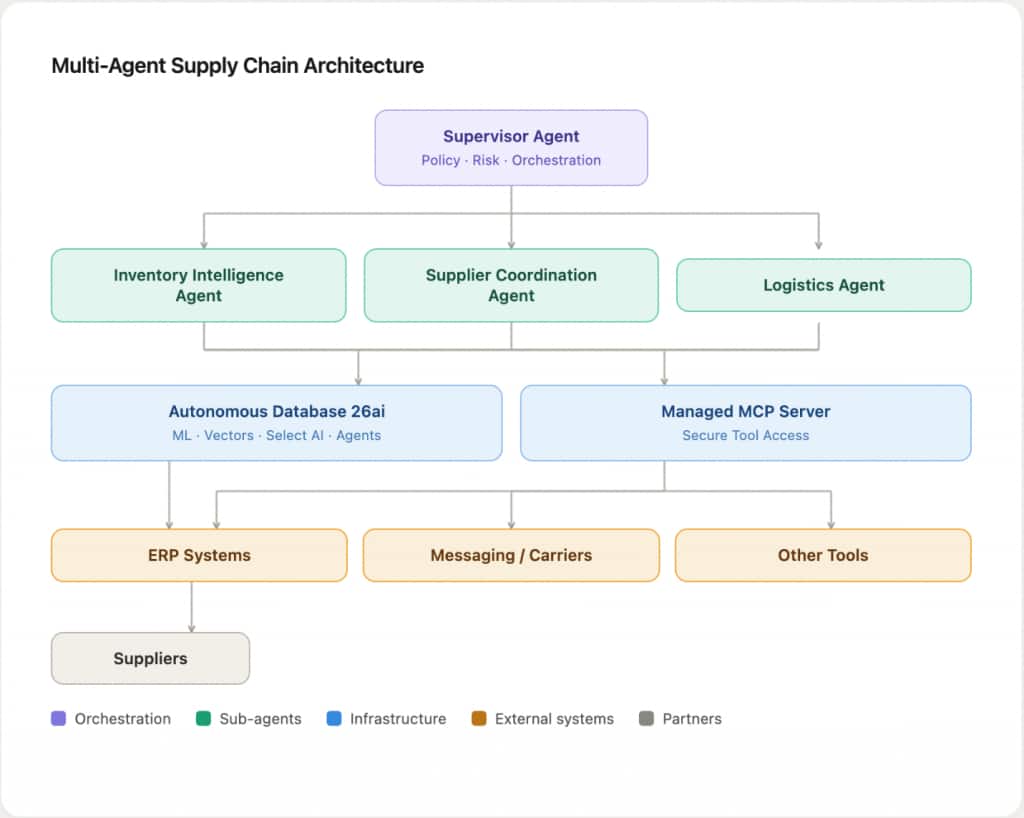
The solution operates as a continuous closed loop:
- ERP inventory and transactional data are ingested into the Autonomous AI Database 26ai.
- The Inventory Intelligence Agent performs real-time forecasting and risk scoring.
- If projected stockout risk exceeds defined tolerance, the Supervisor Agent evaluates enterprise context.
- Upon approval, the Supplier Coordination Agent generates procurement actions through specialized agents.
- Supplier responses are parsed, interpreted, and embedded for future risk modeling.
- The Logistics Agent executes shipment scheduling.
- Delivery outcomes update supplier reliability vectors.
- The Supervisor Agent recalibrates thresholds based on performance outcomes.
This is not batch replenishment, but a continuous, adaptive and well-orchestrated process.
Solution Flow Architecture Diagram
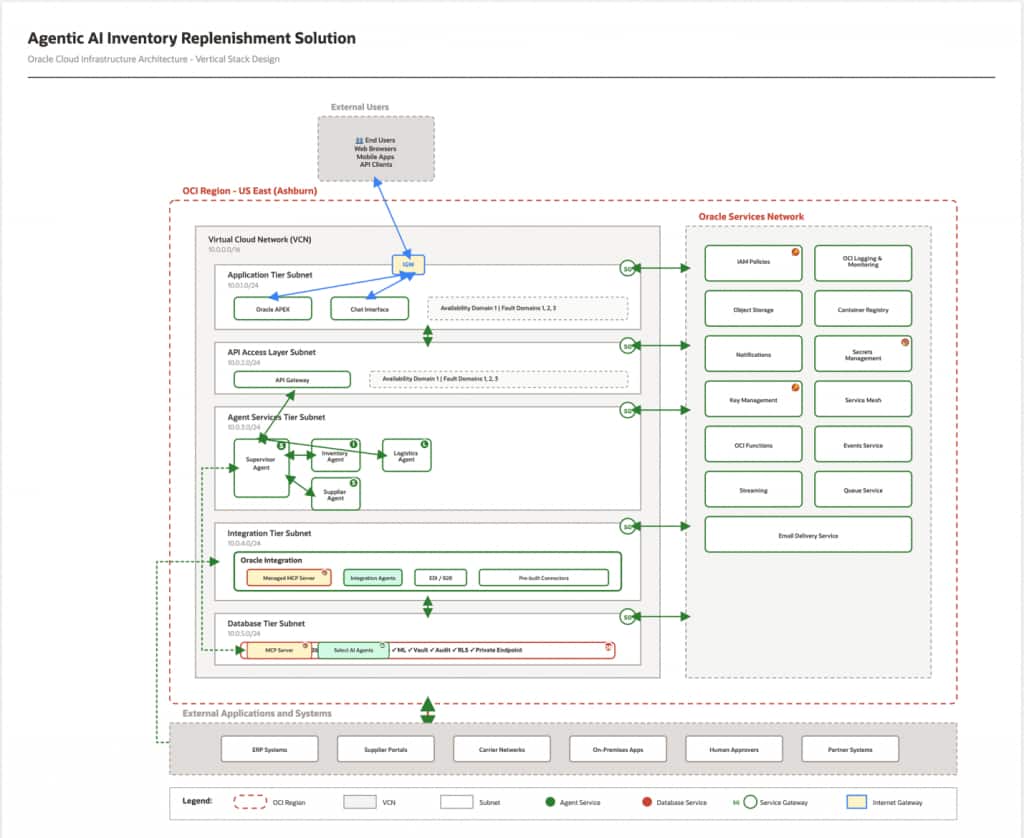
Technical Deployment Blueprint on OCI
A secure enterprise deployment on OCI includes a dedicated Virtual Cloud Network (VCN) with private subnets for Autonomous Database and agent services. Private endpoints ensure no public database exposure. A Service Gateway enables secure access to OCI-managed services without internet traversal.
IAM policies restrict MCP tool invocation to approved agents. Database Vault and row-level security enforce data segmentation across plants. Unified audit captures every AI decision, including reasoning traceability. Autonomous AI Database 26ai hosts relational inventory data, vector embeddings for supplier reliability, and in-database ML models. Logging and Monitoring services capture performance telemetry and forecast accuracy metrics.
This architecture ensures scalability, compliance, security and controlled autonomy.
Why Agentic AI Adds Value for Inventory Replenishment Compared to Traditional AI
Inventory management in manufacturing is more than forecasting demand—it’s about ensuring the right materials are in the right place at the right time and right quantity, while minimizing cost and risk. Traditional AI (forecasting models or RPA) provides insights or automates isolated tasks, but it cannot reason across the supply chain, coordinate systems, or adapt dynamically.
Agentic AI, as implemented with Autonomous Database 26ai, Select AI, Managed MCP Server, and a Supervisor Agent, transforms this process by combining forecasting, reasoning, orchestration, and execution into a single, intelligent workflow.
Technical Advantages for this Use Case
- End-to-End Decision Orchestration
- Traditional AI may predict stockouts or suggest reorders, but someone must generate purchase orders, contact suppliers, and schedule logistics.
- Agentic AI’s Supervisor Agent coordinates all steps: it validates risk thresholds, assigns tasks to the Inventory, Supplier, and Logistics Agents, and ensures the system acts autonomously while staying within policy limits.
- Dynamic Supplier and Risk Management
- Traditional AI models treat suppliers as static entities.
- In this solution, Supplier Agent embeddings continuously capture reliability patterns, partial shipment frequency, and response delays. The Supervisor Agent uses this context to reroute orders or split shipments proactively, avoiding production halts.
- In-Database Forecasting with Context Awareness
- Inventory Agent runs forecasts and anomaly detection directly inside Autonomous Database 26ai, avoiding data movement and reducing latency.
- Unlike traditional models, forecasts incorporate plant-level consumption, supplier constraints, and upcoming production events, producing contextualized and actionable recommendations.
- Closed-Loop Continuous Learning
- As deliveries are completed, delay or fulfillment outcomes automatically update supplier reliability embeddings and inventory forecasts.
- Traditional AI would require manual retraining cycles, often leaving the system reactive rather than adaptive.
Business Advantages for this Use Case
- Faster, More Reliable Replenishment
- Orders are triggered and executed automatically when inventory thresholds are breached or shortages are predicted, ensuring that the plants rarely run out of critical materials.
- Traditional AI may only alert procurement teams, causing further delays.
- Reduced Operational Risk and Downtime
- The system continuously evaluates supplier reliability and production criticality. Alternative suppliers or split shipments are recommended automatically, reducing downtime.
- Traditional AI lacks this reasoning layer, often requiring human intervention during disruptions.
- Significant Cost and Effort Reduction
- Automated coordination across multiple plants, suppliers, and logistics channels reduces manual procurement effort by 60–80% and avoids costly emergency shipments.
- Safety stock can be optimized using accurate, real-time forecasts, reducing inventory carrying costs by 15–30%.
- Enhanced Agility and Responsiveness
- The Supervisor Agent ensures that the system can react immediately to unexpected supplier delays, production changes, or demand spikes, adjusting orders and logistics dynamically.
- Traditional AI typically operates in batch cycles and cannot dynamically reroute or reprioritize orders across multiple plants.
Why Oracle Cloud Infrastructure (OCI) Provides Structural Advantages over other Cloud Platforms
Many cloud-native AI architectures require assembling:
- A relational database
- A separate vector or graph database
- A standalone ML platform
- A custom orchestration framework
- Third-party agent tooling
This fragmentation increases integration complexity, operational overhead, and latency.
OCI provides structural integration advantages:
- Converged relational + vector + ML capabilities inside Autonomous AI Database 26ai
- Native Select AI for natural language interaction
- Managed MCP Server for standardized tool invocation
- Enterprise-grade database security embedded at the data layer
Other providers often require combining multiple services to achieve comparable functionality. OCI’s consolidation reduces data movement, simplifies governance, and lowers total cost of ownership.
The Strategic Outcome
This architecture transforms replenishment into an adaptive intelligence system that continuously balances cost, risk, and service levels.
- AI is embedded in the data layer—not added externally.
- Governance is enforced without limiting autonomy.
- Inventory management becomes self-optimizing.
More Enterprise Use Cases where Agentic AI can add value in Manufacturing & Transportation
- Automated Service Contract Renewal
Industry: Transportation
Example workflow:
- Agent reviews expiring contracts
- Compares service history, fleet usage, costs
- Drafts renewal terms
- Submits for approval
- Triggers OIC workflow to issue updated contract
Impact: Faster renewals, fewer human errors, better customer satisfaction.
- Work Order Creation & Dispatch
Industry: Transportation (Fleet Maintenance)
Workflow:
- Detects vehicle or machinery issue
- Creates work order in Enterprise Resource Planning (ERP)
- Assigns technician
- Generates parts list
- Sends notifications
Impact: Faster maintenance cycles; reduced equipment idle time.
- Intelligent Quality Assurance
Industry: Manufacturing
Workflow:
- Agent analyzes sensor data and camera feeds
- Flags anomalies
- Suggests corrective steps
- Updates Quality Assurance (QA) logs and initiates re-inspection
Impact: Higher quality output, fewer recalls, lower scrap rate.
- Freight Exception Handling
Industry: Transportation & Logistics
Workflow:
- Detects shipment exceptions
- Gathers data across Transportation Management System (TMS), Warehouse Management Systems (WMS), and ERP
- Identifies root cause
- Proposes corrective actions
- Logs case & alerts stakeholders
Impact: Faster resolution, less manual triage, fewer Service Level Agreement (SLA) violations.
Conclusion
Manufacturing supply chains demand resilience and speed. With Autonomous AI Database 26ai, Select AI, Managed MCP Server, and agent-based orchestration on OCI, organizations can build systems that reason, act, learn, and improve continuously.
This is not incremental modernization. It is the architectural foundation for an autonomous and real-time supply chain.
Take the Next Step Toward Autonomous Supply Chains
The future of manufacturing is not just automated—it’s intelligent, adaptive, and agent-driven.
Ready to unlock the power of agentic AI in your supply chain?
- Request a personalized demo of the agentic inventory replenishment solution.
- Explore OCI AI Agents and Autonomous Database 26ai to see how reasoning-driven systems can transform your operations.
- Contact our Oracle Cloud experts to design a deployment blueprint tailored to your manufacturing environment.