

A New Era of AI-Driven Work Has Begun
For years, companies have automated tasks—but only the tasks they could explicitly script. Today, a new class of AI is redefining what’s possible. Agentic AI doesn’t just answer questions. It plans, reasons, takes actions, and orchestrates complex business workflows across ERP, supply chain, finance, and operations.
Manufacturers, logistics providers, and service organizations are already seeing transformational gains—faster cycle times, fewer errors, and smarter decision-making.
This blog breaks down what Agentic AI really is, Oracle’s strategy in this space, where Oracle is embedding it across the platform, and the real enterprise use cases delivering value today.
What Is Agentic AI?
Traditional AI predicts outcomes.
Agentic AI acts on them.
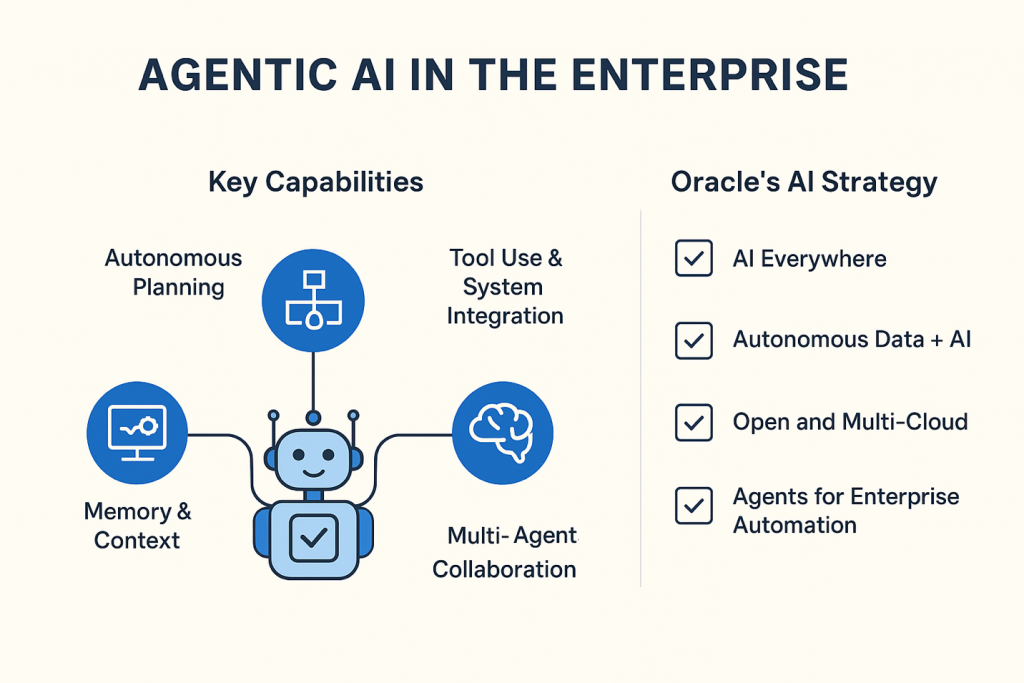
It is an evolution of Large Language Models (LLM) where the model becomes an autonomous worker capable of:
- Understanding defined objectives
- Creating multi-step plans
- Choosing and using the tools
- Taking actions autonomously
- Learning from outcomes
- Coordinating with humans
Instead of being “ask and answer,” Agentic AI becomes a co-worker that automates business processes end-to-end.
Core Components of Agentic AI
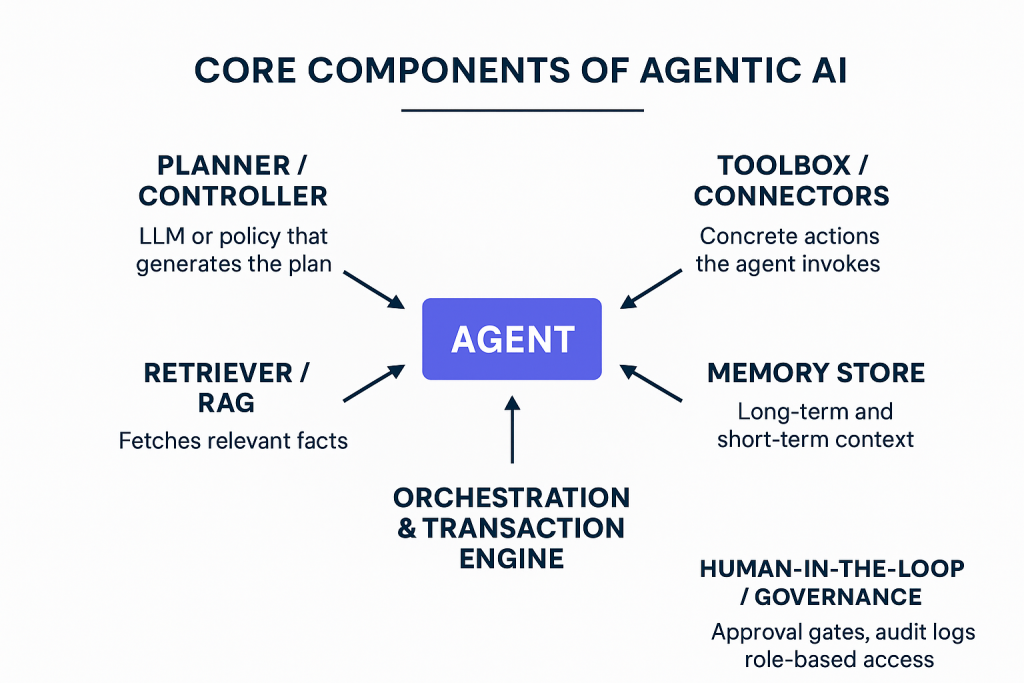
Agentic AI systems are built from coordinated layers that let them plan, act, and adapt in real business workflows:
- Planner / Controller: LLM that reviews the defined objectives and generates the plan (e.g., “renew service contract,” “update supplier record”).
- Toolbox / Connectors: Concrete actions—APIs, Enterprise Resource Planning (ERP) functions, SQL, Customer relationship management (CRM) calls, email, Robotic process Automation (RPA), or integrations.
- Retriever / Retrieval Augmented Generation (RAG): Gathers real-time facts from a vector store or database.
- Memory Store: Maintains long-term and short-term context for personalization and continuity.
- Orchestration Engine: Handles multi-step flows, state, retries, and rollback to accomplish the task.
- Human-in-the-Loop / Governance: Uses human approval gates, role-based access controls, logs, and policy checks to promote trustworthiness.
These components come together to create agents that are enterprise-grade, production-ready, and traceable.
Why Agentic AI Matters Now
Enterprises struggle with process complexity, siloed systems, and manual handoffs.
Agentic AI directly addresses these challenges:
- Removes repetitive manual work
- Bridges workflows across applications
- Reduces errors from human data entry
- Supports decision-making with real-time context
- Shows actions with traceability
Industries like manufacturing and transportation—where workflows span numerous systems—see some of the biggest benefits.
Oracle’s Agentic AI Strategy
Oracle’s AI strategy focuses on responsible, enterprise-grade , deeply integrated AI agents built directly into the databases, applications, and workflows customers already use.
Oracle’s differentiated approach:
Unified Data + Unified Apps + Unified AI
- AI connected directly to ERP, Supply Chain Management (SCM), Human Capital Management (HCM), Customer Experience
- AI embedded at the Oracle Cloud Infrastructure (OCI) layer, Database layer, and SaaS layer
- Full-stack optimization for performance and security
- Built-in RAG, vector search, semantic models, and transaction-safe orchestration
Oracle isn’t just adding AI features—we are embedding AI across the entire stack to create autonomous business workflows.
Where Oracle Is Embedding Agentic AI
Oracle’s Agentic AI strategy is differentiated because the entire stack—from data to applications—is designed for goal-driven agents that plan, decide, act, and learn. Unlike bolt-on AI tools, Oracle provides a native, end-to-end agentic platform anchored in secure enterprise data, leading AI services, and deeply embedded application intelligence.
Oracle is integrating agents across all layers:
- OCI Layer
- OCI Generative AI Service
Provides secure, high-quality models with:
- Tool use
- Task decomposition
- Long-context reasoning
- Guardrail & policy enforcement
Ideal for building enterprise-safe autonomous agents.
- OCI AI Agents
Purpose-built for agentic workloads:
- Multi-agent orchestration
- Memory management
- Dynamic tool invocation
- Ecosystem connectors
This is the digital workforce layer, where specialized agents coordinate like teams of domain experts.
- Oracle Digital Assistant (ODA) (Enhanced with GenAI)
ODA evolves from chatbots to conversational agents:
- Natural-language automation
- Task-driven intent recognition
- Integrated enterprise tool calling
- Multi-channel support
ODA provides the front-end interface for interacting with enterprise agents.
- Oracle Integration Cloud (OIC) & API Platform (for tool invocation)
OIC transforms into an AI-driven orchestration engine:
- Self-healing integration flows
- Intelligent exception resolution
- Automated mapping & process generation
- Seamless tool invocation for agents
This allows agents to perform real business actions end-to-end.
- Oracle Analytics Cloud (OAC)
OAC adds a “sense-and-respond” layer through:
- Natural language analytics agents
- Proactive KPI monitoring
- Autonomous data prep & joining
- Cross-system collaboration with DB, Fusion Apps, OIC, and OCI AI Agents
OAC converts enterprise analytics into real-time, autonomous decision pipelines.
- OCI Generative AI Service
- Database Layer
- Oracle APEX
Simplify Application development using:
- AI-assisted development: Generate, explain, and optimize APEX applications using natural language.
- Natural-language capabilities: Create app components and logic from prompts instead of code.
- Embedded GenAI features: Add AI-driven text generation and summarization to applications.
- Semantic search & RAG: Enable vector-based search and conversational access to enterprise data.
- OCI GenAI integration: Invoke OCI Generative AI directly from APEX.
- Database-native AI: Run AI capabilities close to the data using Oracle Database 26ai.
- Oracle Database 26ai (Native AI, Vector-native, Agentic Orchestration)
The database becomes an AI engine with:
- In-database vector search
- Native RAG pipelines
- Machine learning + SQL-based agents
- Document intelligence
This turns your operational database into the brain powering contextual reasoning and decision automation.
Built for large-scale agent workloads with: - High-performance vector stores
- Multi-agent orchestration
- AI-driven indexing and auto-tuning
- Memory-aware task routing
Perfect for enterprises adopting memory-rich, multi-step agents.
- AI Vector Search
Oracle’s vector search enables:
- Low-latency semantic search
- Large-scale RAG systems
- Unified structured + unstructured retrieval
Agents gain accurate, real-time context across documents, ERP data, supply chain events, and logs.
- Autonomous Database with built-in agent features
Autonomous Database adds:
- Autonomous indexing
- Auto-patching, self-repair
- Agent-assisted anomaly detection
- Integrated vector search
It provides the foundation for secure, self-optimizing agent workflows.
- Oracle APEX
- SaaS Layer (ERP, SCM, HCM, CX)
Embedded GenAI + Agentic workflows for:
- Contract management
- Procurement
- Financial close
- Project resource planning
- Order orchestration
- Maintenance and asset management, etc.
Oracle’s architecture supports autonomous, auditable agents—a requirement for mission-critical enterprise work.
Summary
Agentic AI is redefining the way enterprises operate—moving from manual, linear processes to autonomous, intelligent workflows.
Oracle’s full-stack approach makes it possible to deploy enterprise-grade, production-ready agents directly inside ERP, SCM, and industry workflows.
Manufacturing and transportation leaders are already adopting these capabilities to help speed up operations, reduce manual errors, and transform decision-making.
In the next part of this blog series, we will talk about common agentic ai usecases and subsequently dive deep into one usecase and discuss about the solution architecture in detail.
Call to Action
Interested in building Agentic AI workflows on Oracle?
Please reach out to us if you would like to have a conversation or evaluate how agentic ai can be applicable to your business.
Other Resources :
- Explore OCI Generative AI
- Try Oracle Database 26ai with vector search
- Experiment with OCI AI Agents
- Modernize workflows using Oracle Integration Cloud
- Hands-on self-guided workshops: