
Last week, leaders from business, government, finance, technology, and civil society convened in New York City for Climate Week to address both established and emerging challenges in climate action. Across sectors, conversations centered on the need to accelerate clean-energy investment and strengthen resilience while navigating economic uncertainty, supply-chain pressures, and the growing impacts of extreme weather.
For data centers in particular, the rapid growth of AI is raising dialogue related to electricity availability, grid capacity, affordability, cooling, and the environmental footprint of digital infrastructure. The discussions centered on how to build and operate it in ways that support cleaner electricity and a more resilient grid, while benefiting local communities and natural systems.
At Oracle, that work starts with setting clear, science-based targets. Oracle has committed to achieve net-zero emissions across its global value chain by 2050. Our targets are recognized by the Exponential Roadmap Initiative, an accredited partner of the UN Race to Zero campaign, and Oracle reports validated progress through annual, externally assured sustainability disclosures.
Progress we can build from
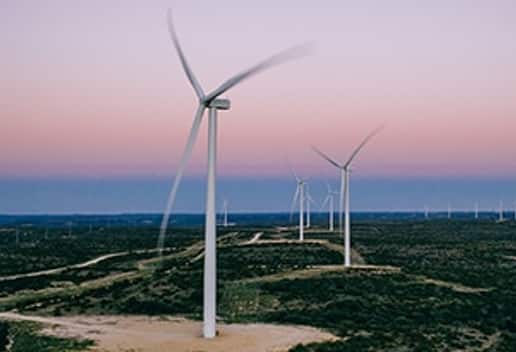
We are proud of the progress already made. Oracle has achieved 100% carbon-free electricity for its offices and public cloud data centers on an ongoing annual basis. We have also reached important milestones in supplier engagement, with 100% of key suppliers representing more than 80% of spend having environmental programs in place and more than 80% having set emissions-reduction targets. Additionally, through 2025, Oracle has reduced employee air travel emissions by 68% compared to a 2019 baseline.
Those milestones matter because they show progress, not just ambition. We have already demonstrated that clean energy, supplier engagement, and business change can be embedded into how Oracle works. But the next phase of the challenge is different.
AI creates a new infrastructure challenge

There were over 100 sessions at New York Climate Week discussing how AI is changing the scale, density, and electricity needs of digital infrastructure. Responsible AI growth requires data center innovation: specialized hardware, greater water efficiency, and new approaches to electricity procurement, resilience, cooling, and grid coordination.
That is why Oracle is distinguishing between its public cloud and office operations — where we have already achieved 100% carbon-free electricity — and Custom AI Data Centers, which include large, dedicated AI clusters and purpose-built environments for high-performance AI workloads.
Oracle has set a goal to match electricity used by Oracle Custom AI Data Centers with 100% carbon-free electricity by 2035. Oracle has also set a goal to reduce carbon emissions per megawatt of IT capacity by 20% by 2030, relative to a 2020 baseline, so we can track efficiency and emissions performance during a period of growth.
The point is simple: as AI infrastructure scales, climate strategy has to scale with it. That means reducing emissions, sourcing cleaner electricity, and planning for resilience in the systems our customers depend on.
Scaling carbon-free electricity where AI is growing
That strategy is already underway. Across the U.S., Oracle is investing in grid solutions that include carbon free electricity and energy storage in the communities where cloud and AI infrastructure is growing.
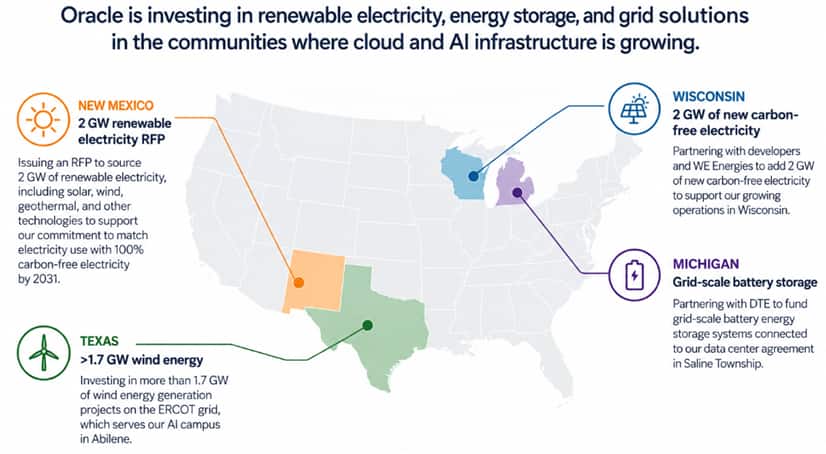
These projects reflect different regional constraints and solutions. In Texas and New Mexico, Oracle is supporting large-scale renewable electricity procurement on the grids serving new AI Data Centers, including more than 1.7 GW of wind energy in Texas and an RFP to source 2 GW of carbon free electricity in New Mexico. In Michigan and Wisconsin, Oracle is working with utilities, developers, and partners on grid-scale energy solutions, including battery energy storage systems with DTE and new carbon free electricity for Wisconsin’s grid.
Together, these efforts reflect the next phase of Oracle’s climate strategy: pairing AI growth with cleaner electricity, grid infrastructure, and regional energy solutions that support a more resilient system over time.
Reducing emissions while the transition is underway
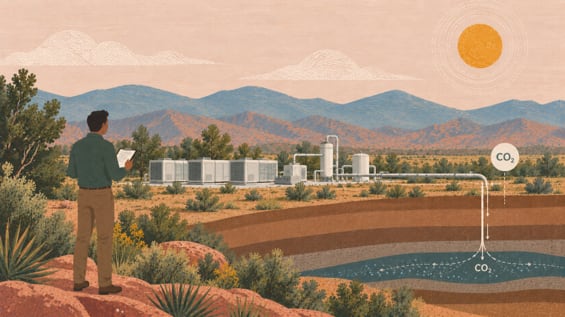
A recurring theme from New York Climate Week is that climate action has to move on multiple timelines at once: scaling cleaner electricity and long-term decarbonization while incrementally reducing high-impact emissions from systems that cannot yet fully transition.
Oracle has also announced $1 million in funding to support research into carbon capture and sequestration in New Mexico. This research will examine whether CO₂ emissions associated with Bloom Energy fuel cells can be captured efficiently and stored permanently, while exploring complementary decarbonization pathways.
Managing climate risk and resilience
Another key theme running through New York Climate week was resilience. Climate action also means planning for climate-related changes that could affect communities and infrastructure over time, including extreme heat, wildfire, water stress, and severe weather. Resiliency is key to cloud operations, where customers rely on Oracle to provide secure, reliable infrastructure for critical workloads. As Oracle scales cloud and AI infrastructure, we evaluate environmental impacts, risks, and opportunities as part of site selection, electricity procurement, water stewardship, supplier engagement, business continuity, and enterprise risk management so climate risk is more understandable, measurable, and actionable in how we build.
Oracle technology helps customers reduce energy demand and manage emissions
Across all topics at Climate Week, it was clear that climate action is empowered by data. At Oracle, climate strategy also means providing customers with data, tools, and software that help them operate sustainably.

Oracle Utilities Opower software platform combines behavioral science, AI, and personalized communications to help customers understand and manage their energy use. The OCI Carbon Emissions Analysis tool helps cloud customers estimate emissions associated with their OCI workloads. Oracle Fusion Cloud Sustainability and Oracle Cloud EPM provide integrated business applications that can capture business sustainability data, calculate emissions, analyze performance, plan against targets, and support emissions reporting and disclosure.
Together, these solutions show how Oracle technology can help customers take practical climate action: reducing energy demand, improving emissions visibility, supporting reporting, and using data to make more informed decisions for a more resilient energy system.
Supporting climate action beyond the value chain
Global climate progress depends on practical action beyond any one company’s operations. At Climate Week, super-pollutants like methane were a major focus because they can have a high near-term warming impact and action today can deliver faster climate, air-quality, and community benefits.
Oracle is collaborating with the Well Done Foundation to identify, prioritize, and cap orphaned oil and gas wells across New Mexico. Based on EPA estimates, plugging just one of the state’s orphaned wells can cut methane emissions equivalent to removing more than 3,000 gas-powered cars from the road.

Oracle has also partnered with Wild Bio, an innovative agricultural company using targeted genetics to improve the natural ability of plants and crops to capture and sequester atmospheric carbon in a safe and reliable manner. Through this work, Oracle Cloud and Oracle IoT technology are helping researchers bring together vast amounts of agricultural data to better assess crop performance and carbon-removal potential. By capturing field-trial data and bringing it together in an integrated cloud environment, Wild Bio can use AI to analyze and inform the next generation of resilient crop designs. If successful and validated, this kind of work could help farmers improve productivity and resilience while supporting new pathways for carbon removal.
For Oracle, the collaboration illustrates how cloud infrastructure, AI, and connected sensing can support climate innovation beyond our own operations as part of a broader climate strategy that recognizes both the urgency of reducing emissions and the importance of healthy soils, productive agricultural systems, and thriving ecosystems.
Climate, water, and nature are connected

Climate work cannot be separated from agriculture, water, and nature. Energy choices affect water. Land decisions affect ecosystems. Healthy watersheds, soils, forests, and biodiversity are part of long-term climate resilience.
That is why Oracle’s climate strategy should be understood alongside our broader water stewardship work, including efforts to reduce water use in high-stress regions, deploy closed-loop cooling, and invest in local watershed projects. It also connects to Oracle’s long-running support for biodiversity protection, including more than three decades of support for the Dian Fossey Gorilla Fund through funding and technology.
Climate Week takeaway
Climate Week reinforced that there is no single solution to climate change. Progress requires a range of approaches from reducing demand and improving efficiency to expanding carbon-free electricity, strengthening grids and resilience, engaging suppliers, and measuring progress transparently.
For Oracle, responsible AI growth means making climate strategy part of how we design, power, measure, and improve the systems and infrastructure our customers depend on. It also means being thoughtful stewards of land, air, and water in the communities where we operate.