
As we reflect on World Water Week, where leaders convened in Stockholm, Sweden, we are reminded of a simple but imperative responsibility: business growth should support the communities and watersheds in which it takes place. This year’s World Water Week theme, “Water for People and Progress,” underscored that water stewardship is not only about reducing use. It is also about supporting the long-term resilience of the places where people live, work, and grow.
As demand for AI and cloud infrastructure grows, that responsibility is central to how Oracle thinks about water. Oracle has already made measurable progress. Since 2015, Oracle has reduced potable water use at owned facilities by 53% through investments in high-efficiency data center cooling, low-flow fixtures, water recycling systems, and drought-smart landscaping. Building on that progress, Oracle has set a goal to halve water use per megawatt of IT capacity in areas experiencing high water stress by 2035, against a 2025 baseline.
For this goal, high-water-stress areas are water basins facing a material challenge in water scarcity, water quality, or infrastructure reliability. The goal is focused on driving impact where water stewardship can matter most.
Water stewardship goes beyond a singular metric. For Oracle, it follows a deliberate sequence: first, make design choices that reduce water demand; then operate those systems as efficiently as possible; and, after addressing operational demand, invest in practical local solutions that can create lasting benefits for the local watershed and community.
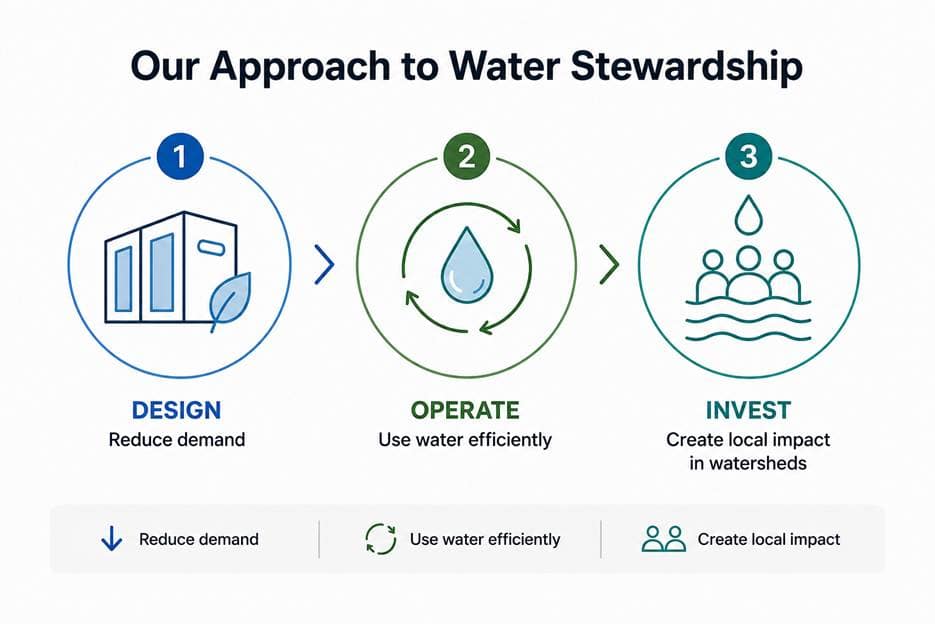
Design and operate efficiently
Data centers need reliable cooling to support computing equipment. Oracle uses reclaimed and/or non-potable water sources where feasible, while designing industrial systems to use water efficiently and minimize impacts on local public drinking water. One example is Oracle’s use of closed-loop, non-evaporative liquid cooling. These systems receive an initial fill and then continuously recirculate water through sealed pipes. This avoids the large volumes of water consumption associated with conventional evaporative cooling in data centers. Closed-loop cooling systems are being deployed at Oracle’s large AI data center campuses, significantly reducing water needed for cooling.
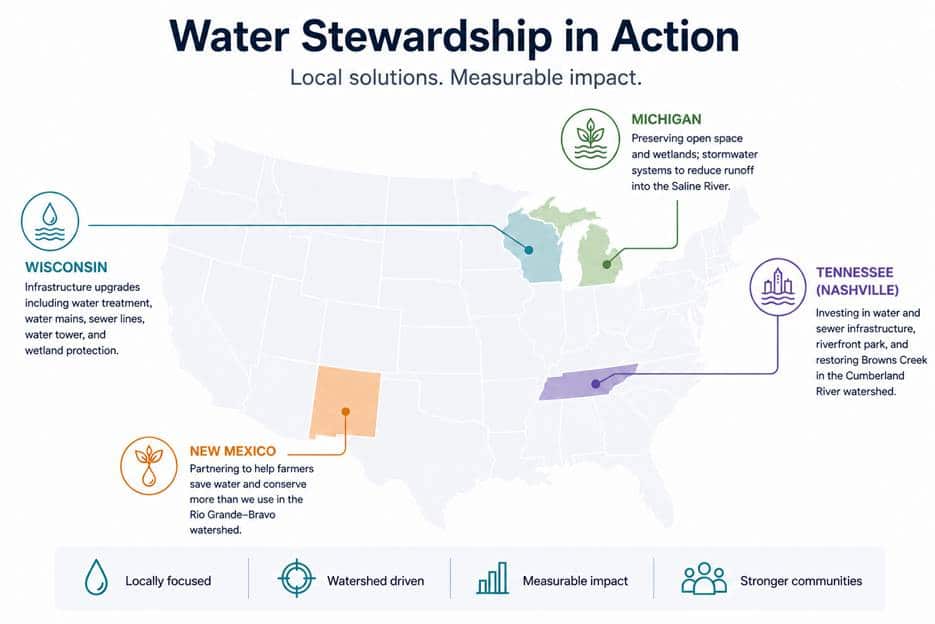
In Saline Township, Michigan, the campus is being designed with LEED-certified buildings, where closed-loop cooling systems are designed to limit water use to levels comparable to a standard office building.
Investing in local infrastructure and waterways
Water stewardship extends beyond business operations to address local site conditions and water constraints. The Michigan campus was designed to preserve more than 750 acres of adjacent open space, farmland, and wetlands, along with stormwater systems expected to reduce runoff into the Saline River.In Wisconsin, our Port Washington site plans to support infrastructure upgrades that include water and wastewater treatment capacity, upgraded water mains and sewer lines, a new water tower, wetland protection, and native landscaping.
In Nashville, Oracle is building its new headquarters along the Cumberland River’s East Bank and investing in sewer and water infrastructure, a riverfront park, greenways, utilities, stormwater infrastructure, and environmental remediation. Oracle has also partnered with the Cumberland River Compact to help restore Browns Creek, an urban waterway that flows into the Cumberland River, through efforts such as tree planting, rain gardens, vegetated infiltration strips, depaving, litter removal, and native plantings.
Local watershed replenishment and conservation
Oracle also extends impact to the local watershed through replenishment. Unlike operational efficiency, which reduces water demand within a facility, replenishment is verified action in the relevant watershed that increases water availability or reduces water losses. It can take many forms, such as more efficient irrigation, leak reduction, aquifer recharge, or restoration. The right approach depends on local conditions.
For Oracle, a replenishment project must be connected to the watershed where the need exists. It must also be measured. This helps keep conservation results distinct from a campus’s operational water use and makes the outcome clearer for communities and other stakeholders. At the Project Jupiter site in New Mexico, we’ve partnered with an agriculture technology company to fund IoT sensors that are designed to help farmers save water. This project is expected to conserve more water in the Rio Grande-Bravo watershed than Project Jupiter is expected to use for initial fill and annually across its cooling systems, power systems, and everyday domestic needs.
Transparent measurements and reporting
Water stewardship depends on trust. That means setting clear goals, measuring results, and reporting progress in a way that communities, customers, and other stakeholders can understand. Oracle tracks progress against its water goals and reports performance through its sustainability disclosures.
For watershed projects, measurement is especially important because conservation and replenishment are separate from a facility’s own operational water use. Results should be tied to a defined geography, a clear baseline, a recognized methodology, and transparent reporting. Where Oracle makes watershed conservation or replenishment claims, we aim to support those claims with appropriate measurement and independent review against recognized methodologies so stakeholders can understand what the project is expected to deliver and what it does not claim. World Water Week is a reminder that responsible growth depends on more than the capacity we build. It depends on how we build, where we listen, and whether we can demonstrate results. Oracle remains committed to bringing that discipline to water stewardship as we continue to grow.