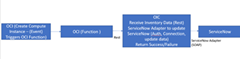
Oracle Integration Cloud (OIC) is often used to connect to SaaS apps such as Salesforce and ERP. In my case, that app is a ServiceNow developer instance. Common integration patterns involve sending data between SaaS apps, whether in a one-to-one or multi-pronged approach. However, it is also possible to set up integration with OCI services that emit events. This is commonly done through the use of Oracle Functions, a “serverless platform that lets developers create, run, and scale applications without managing any infrastructure.” The general structure of such an approach is the following:
Some OCI service emits an event
An OCI Event is configured to capture this event
This event is linked to a function, which is triggered
An OCI Function invokes an integration
Design Overview
Use case: manage cloud compute networks using ServiceNow tables. A customer wanted to manage the VMs that they created in various clouds using their ServiceNow account, which they were already familiar with. The idea here is that their ServiceNow tables would automatically sync with their cloud environments to reflect the state of all the VMs in their cloud networks. Here is an example: suppose I have three Oracle VMs and one GCP VM. One of the Oracle VMs is terminating, and another Oracle VM is stopped. On my ServiceNow table, called cmdb_ci_vm_instance_list, I will see four entries: one online Oracle VM, one offline Oracle VM, one terminated Oracle VM, and one online GCP VM. Now, suppose I provisioned a new GCP VM and restarted the offline Oracle VM. The ServiceNow table should automatically update to show two online Oracle VMs, one terminated Oracle VM, and two online GCP VMs. Finally, if I were to drill down into one of these entries, I would be able to view some basic information such as date of creation, VM shape/image, CPU count, etc. Read the complete article here.
Jürgen Kress is a recognized Oracle Cloud Platform expert and a member of Oracle's Product Management organization, where he leads global go-to-market initiatives for Oracle Integration. He is the founder of the Oracle Integration Community and the Oracle Partner Advisory Council, two flagship programs that connect customers, partners, and Oracle product teams around the world.
Under Jürgen's leadership, the Oracle Integration Community has grown to more than 10,000 members globally, making it one of Oracle's largest and most active technology communities. He drives customer engagement through newsletters, webcasts, hands-on training, certifications, conferences, and thought leadership programs that help organizations maximize the value of Oracle Integration.
Jürgen and his team are responsible for the positioning, adoption, and global go-to-market strategy for Oracle Integration. They lead customer engagement initiatives including product update sessions, roadmap briefings, customer success webcasts, hands-on workshops, certification programs, newsletters, and the annual Oracle Integration Customer Summit, enabling customers and partners to stay ahead of the latest innovations.
A sought-after speaker at Oracle conferences and industry events worldwide, Jürgen regularly presents on integration, cloud architecture, automation, AI-driven integration, and digital transformation. His sessions are consistently among the highest-rated integration presentations at Oracle events.
Jürgen holds degrees from Berufsakademie Stuttgart and the University of Brasília. He is also the author of several books, including Next Generation SOA, Best Practices for Knowledge Workers, and Thriving On Adaptability: Best Practices for Knowledge Workers. Through his work, writing, and active presence across professional communities and social media, he continues to help organizations accelerate their cloud transformation with Oracle technologies.


 Blog
Blog  Twitter
  LinkedIn
 ![image[7][2][2][2]](https://soacommunity.files.wordpress.com/2013/04/image7222.png?w=20&h=20 "image[7][2][2][2]") Facebook
Facebook ![clip_image002[8][4][2][2][2]](https://soacommunity.files.wordpress.com/2013/04/clip_image00284222.jpg?w=26&h=23 "clip_image002[8][4][2][2][2]") Wiki
Wiki