

A customer order starts in Siebel Communications, but fulfilling it and billing the customer require several systems to work together. How can communications service providers (CSPs) connect these processes through a common, standards-based approach? TM Forum (TMF) Open APIs provide a common framework for these exchanges.
TMF Open API integration for Siebel Communications replaces the existing RODOD AIA-based integrations between Siebel, Oracle Order and Service Management, and Oracle Billing and Revenue Management with a standards-based, event-driven model. It supports a more open, flexible, and maintainable approach to core order-to-bill and agent-assisted billing-care journeys.
An Integrated Journey From Order Capture to Billing
TMF Open APIs provide a common, standards-based model for exchanging business information across applications. For CSPs, this reduces dependency on highly customized integrations and supports a more maintainable approach to order, account, and product-inventory processes.
The journey begins in Siebel Communications, where agents manage customer accounts, configure products and promotions, associate billing and service accounts, and submit orders. For the order and account flows described here, Siebel Open Integration transforms business information into TMF-aligned payloads. Kafka provides the asynchronous messaging backbone for exchanges with OSM and BRM.
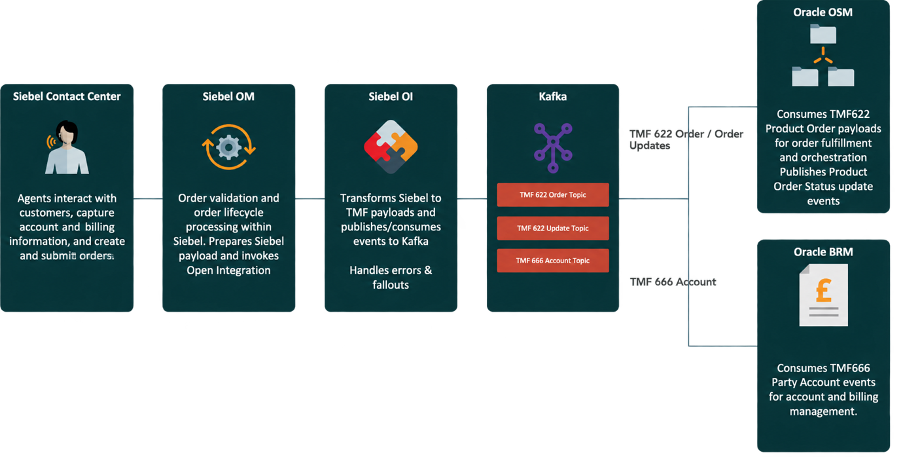
TMF622 order and TMF666 account integration flows across Siebel Communications, Kafka, OSM, and BRM
Each application has a distinct responsibility: Siebel manages customer interactions and order capture, OSM manages fulfillment and orchestration, and BRM manages account and billing processing.
Value For CSPs, Business and Technology teams
TMF Open API integration provides value across the telecommunications organization.
- ODA Alignment: Aligns Siebel Communications, OSM, and BRM through TM Forum Open API patterns.
- Simpler Integration: Reduces reliance on custom, product-specific integrations through standardized payloads and interactions.
- Improved Interoperability: Connects order, account, and inventory processes with fulfillment, billing, digital channels, and future ODA components.
- Greater Operational Visibility: Returns order and fulfillment updates to Siebel and supports trouble-ticket follow-up for failed processing.
- Event-Driven Scalability: Uses Kafka to support asynchronous processing, acknowledgements, callbacks, status updates, and fallout handling.
- Controlled Extensibility: Enables approved Siebel or customer-specific attributes to be added without changing the underlying TMF API contract.
TMF622 connects product orders with fulfillment
TMF622 Product Order Management supports the exchange of product-order information between Siebel and OSM. The integration is designed for common telecommunications order scenarios, including new orders, revisions, cancellations, follow-on orders, MACD scenarios like suspension, resumption, upgrades, and downgrades.
The value extends beyond sending an order downstream. As fulfillment progresses, OSM returns information so Siebel can reflect the latest order state. Header-level updates can include the order status, fulfillment status, and status context. Item-level updates allow the status of individual product-order items to be reflected as well.
For agents, this provides a more current view of an order and its components. For CSP operations teams, it supports a clearer handoff between order capture and fulfillment without making the customer interaction layer responsible for fulfillment orchestration.
TMF666 synchronizes account information with billing
Customer and billing relationships are central to telecommunications operations. TMF666 Party Account Management supports the exchange of account information from Siebel to BRM when an account is created, changed, or moves through a lifecycle-state transition.
When an account or a billing profile is created in Siebel—or when a new account-hierarchy relationship is established—the associated account information will be sent to BRM for corresponding account, hierarchy, and billing processing. Changes to account attributes can be synchronized separately from lifecycle-state changes, preserving the business distinction between an account update and an account-state transition.
For telecom product managers and business teams, this supports more consistent handling of customer-account and billing-account information across the systems involved in an order-to-bill journey. For developers, the use of distinct TMF666 event patterns provides a clearer, standards-based model for account-related integration.
TMF637 supports Friends & Family list synchronization
The integration also supports a specific telecommunications use case: special-rating products. TMF637 Product Inventory is used to synchronize Friends & Family list information from Siebel to BRM.
Friends & Family lists can be included in service bundles as special-rating products. During order capture, an agent can create a list, optionally add numbers to it, and associate the list with the relevant special-rating product. When the order is processed downstream, the associated information is available to support the corresponding rating configuration in BRM. Subsequent Friends & Family list updates follow a distinct path from the Kafka-based order and account flows. When a list changes, triggering the synchronization action in Siebel sends
Take the next step with TMF Open APIs
Ready to connect your Siebel Communications workflows with fulfillment and billing? Explore the Order Management Guide Addendum for Communications to understand the integration flows and assess how they fit your deployment.