

Siebel CRM continues to be a powerful operational backbone for enterprises with unrivalled configuration flexibility, empowering organizations with plenty of choices, including how to configure the perfect user experience. However, expectations for UX continue to evolve faster than most enterprise applications can keep up.
To help address modern UX expectations, with the Siebel CRM 26.1 Release Update we’re excited to announce that low-code web components for modern UI development are now available. This capability introduces a new approach to UI modernization, bringing modular architecture, declarative configuration, and Redwood-OJET user experiences to Siebel CRM.
In this blog, we explore how web components and a low-code framework help accelerate Siebel UI modernization, enabling faster innovation, simpler customization, and a future-ready user experience.
Understanding challenges in current Siebel UI development
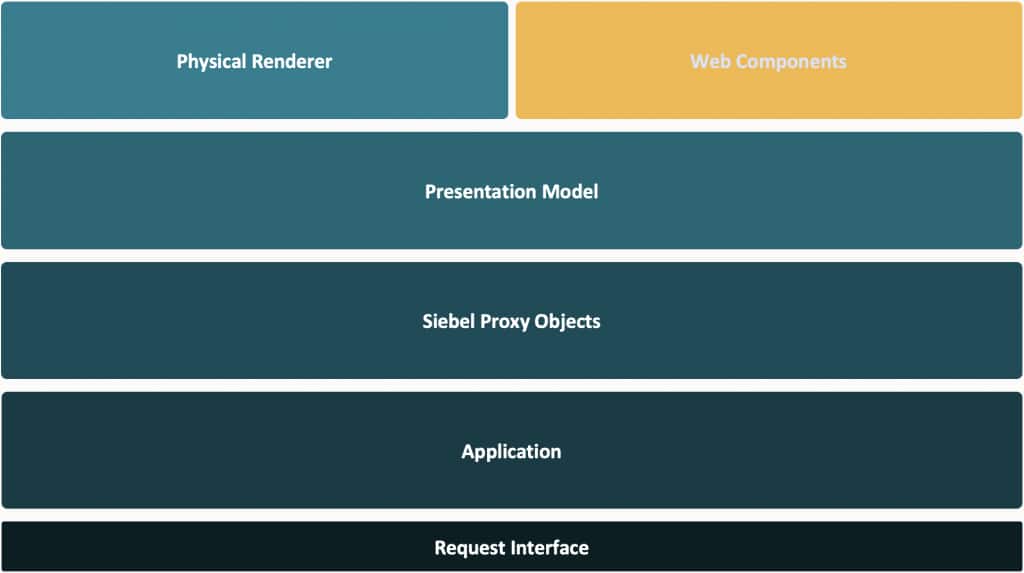
Traditional Siebel UI development relies on applet templates and Physical Renderers, which tightly couple UI logic with underlying structures. This can make even small changes complex and time-consuming.
As a result, organizations may face slower delivery cycles, higher maintenance costs, and limited flexibility when designing modern user experiences. Personalization and AI-driven enhancements often require significant rework, further slowing innovation.
- Slower rollout of new user journeys
- High maintenance and upgrade costs
- Limited flexibility in modern layouts
- Complex customization for AI and personalization
These challenges can make it difficult to meet evolving user expectations.
Enabling innovation with web components and low-code architecture
A different approach makes use of a low-code framework powered by web components. This allows UI rendering to be decoupled from traditional applet structures, making development more flexible and efficient.
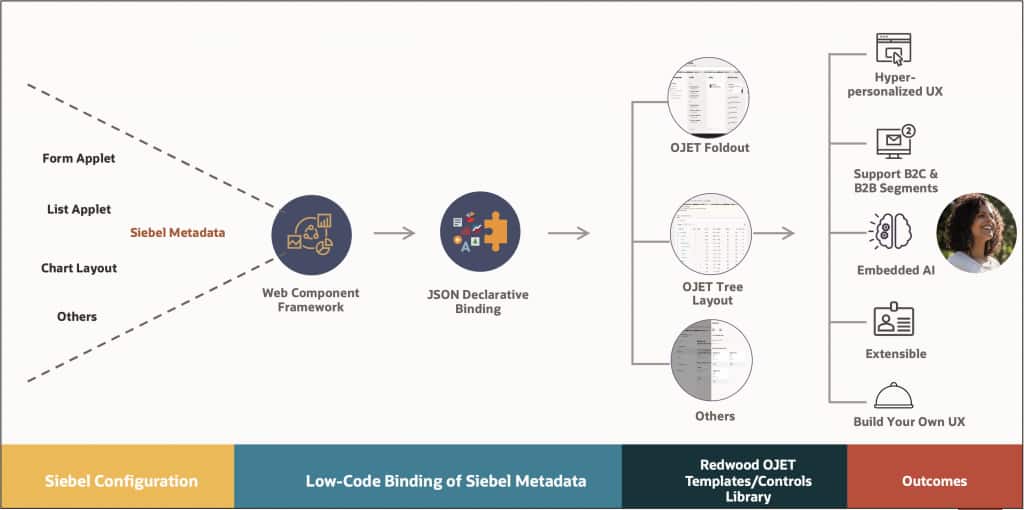
Instead of relying on heavy scripting, developers use declarative JSON to define UI behavior and layout. This simplifies customization and reduces dependency on complex JavaScript.
- Low-code development using declarative configuration
- Modular architecture with reusable web components
- Clear separation between UI and business logic
- Incremental modernization without disruption
This approach helps teams deliver new experiences faster while preserving existing investments.
Transforming Siebel metadata into modern user experiences
The Web Component Framework acts as a bridge between existing Siebel configurations and modern UI experiences. It transforms metadata into a flexible, component-driven interface.
Siebel metadata continues to define the structure, while web components handle rendering using modern design standards. The Presentation Model connects data and events seamlessly to the UI.
- Metadata-driven UI generation
- JSON-based layout and behavior control
- Redwood-aligned component rendering
- Clean separation of logic and presentation
This model enables faster iteration without impacting core functionality.
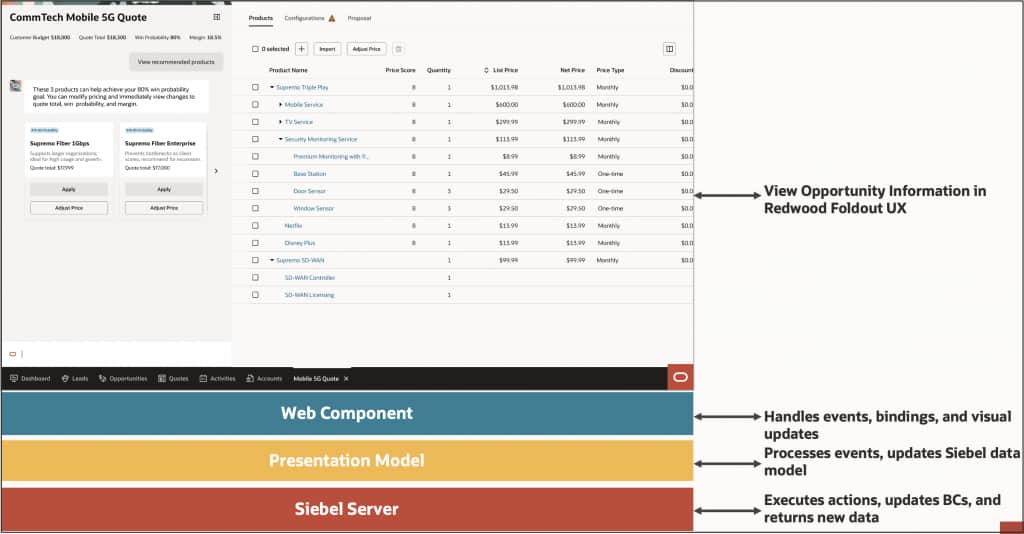
Delivering modern UX with reusable components and low-code features
A key advantage of this framework is the ability to reuse standardized UI components across applications. These components support a wide range of use cases, from simple forms to complex dashboards.
Developers can configure layouts and interactions using JSON, reducing the need for custom code and enabling rapid prototyping.
- Reusable Redwood-aligned UI components
- Low-code extensibility with declarative JSON
- Rapid UI development with minimal customization
- Flexible design for modern user journeys
This combination improves consistency while reducing development effort.
“Low-code and reusable components can significantly reduce development time while improving user experience consistency.”
Driving business impact with faster innovation and lower costs
Beyond technical improvements, the framework delivers clear business value. Organizations can accelerate delivery, reduce costs, and respond more quickly to changing needs.
By simplifying development and minimizing custom code, teams can focus more on innovation and less on maintenance.
- Faster innovation through shorter development cycles
- Lower total cost of ownership with reduced customization
- Improved agility to adapt to business changes
At the same time, the framework supports future-ready capabilities such as AI-driven interactions and personalized user experiences.
- Support for B2C and B2B use cases
- AI-enabled and context-aware interactions
- Ability to build new experiences on existing systems
Modernizing Siebel UX without disrupting existing systems
One of the biggest advantages of this approach is that modernization does not require a complete overhaul. Organizations can adopt web components incrementally while continuing to use existing Siebel CRM capabilities. This reduces risk while enabling steady progress toward a modern UX.
Conclusion: Build a cutting-edge user experience today
Modernizing user experience is no longer optional, it is essential for staying competitive. With web components and a low-code framework, you can evolve your Siebel CRM into a flexible, scalable, and experience-driven platform.
Organizations can innovate faster, reduce complexity, and deliver better user experiences, all while protecting their existing investments.
Want to explore how you can modernize your Siebel UI faster? Connect with our team to see how web components can transform your user experience.