


Run enterprise Kubernetes with your Oracle Database on an Oracle Database Appliance
Oracle, in collaboration with Red Hat, is pleased to announce that Oracle Database Appliance (ODA), an Oracle Engineered System, is now a partner validated platform for running Red Hat OpenShift, supporting both Single Node OpenShift and cluster extension configurations. This enables customers to run modern, containerized applications on ODA.
Red Hat OpenShift is already available on Oracle Cloud Infrastructure for public and sovereign cloud workloads. It is now also available on Oracle Database Appliance, bringing enterprise Kubernetes to on-premises Oracle Database environments. Whether the requirement is cloud-scale flexibility, a fully managed on-premises cloud service, or a purpose-built database appliance at the edge or in a branch office, Oracle and Red Hat offer a consistent, supported OpenShift deployment for each environment. Customers benefit from the same container images, tooling, and operational practices across all platforms.
What makes ODA different
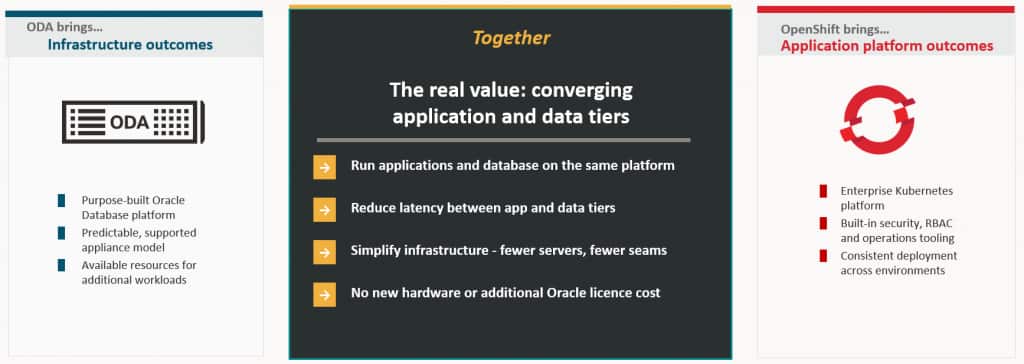
Most Oracle Database Appliance customers have invested in a platform specifically engineered for their most critical data. The hardware, firmware, and software are pre-integrated and optimized for Oracle Database from the ground up. OpenShift on ODA extends that investment by bringing enterprise Kubernetes to the same platform, without compromising what ODA was designed to do.
Most ODA environments today run application workloads on separate servers, connected to the database over a network. Every application-to-database call crosses that network. OpenShift on ODA changes this by deploying containerized applications in a dedicated ODA Application KVM (App KVM) on the same physical appliance as the database, reducing network traversal between tiers and consolidating what were previously separate procurement and operational responsibilities onto a single validated platform.
This allows customers to use a portion of their ODA capacity for containerized application workloads, aligning with common deployment patterns where the infrastructure supports both the database and application tiers.
How it works
Oracle Database Appliance uses KVM-based isolation to separate workloads at the hypervisor level. The database runs in one or more DB System KVMs. OpenShift runs in a second App KVM, on top of a RHEL hypervisor, with Red Hat managing the OpenShift platform end-to-end and Oracle managing the hardware, hypervisor, and database stack.
Oracle Linux runs across all physical cores as the base operating system, providing a consistent foundation across every workload on the appliance. The result is a validated architecture with clear ownership and support boundaries.
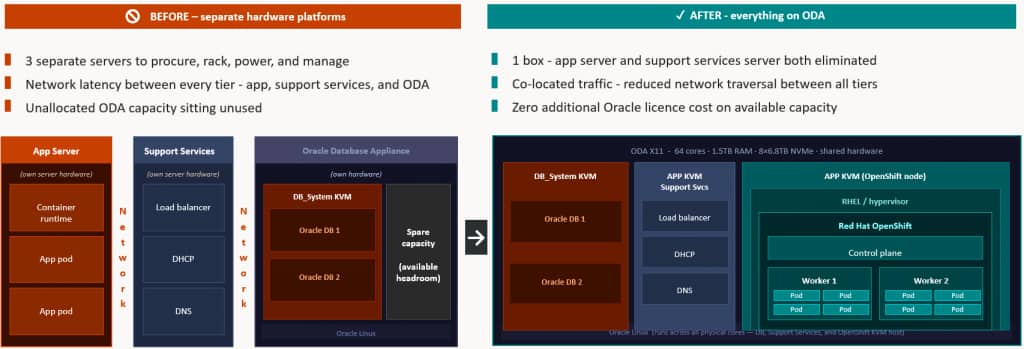
Figure 1: Before/after example with all services required for Kubernetes running on ODA
Two deployment models are supported:
In-a-box (Single Node OpenShift): A fully self-contained OpenShift instance running entirely within the ODA. No dependency on a central cluster. Suited to branch offices, factory floors, retail sites, and any environment where WAN reliability cannot be guaranteed.
Cluster extension: ODA capacity added as a worker node to an existing central OpenShift cluster. No migration of existing workloads required. Suited to data center environments looking to scale application capacity close to Oracle Database data.
Advantages of deploying OpenShift on ODA
No new hardware required: OpenShift uses available system capacity on the ODA, including compute, memory, and storage resources already present in the appliance.
Zero additional Oracle license cost: No additional Oracle Database licenses are required for application workloads: OpenShift runs in a dedicated ODA Application KVM (App KVM), allowing customers to deploy application workloads on the same appliance as their database.
Reduced network traversal: Application containers and Oracle Database run on the same physical box, reducing the network path between application and data tiers compared to separate-server architectures.
KVM isolation: Database and application workloads are fully isolated at the hypervisor level. The database has no visibility into what else is running on the appliance.
Edge and air-gapped ready: Single Node OpenShift runs fully autonomously with no WAN dependency. Remote sites keep running when the network goes down.
Clear support ownership: Red Hat supports the OpenShift stack end-to-end. Oracle supports the hardware, hypervisor, and database stack. Two vendors, two clear escalation paths, no ambiguity.
Simplified operations: Consolidating application infrastructure onto the ODA reduces the number of servers to procure, rack, power, and manage.
Reference architecture
Red Hat OpenShift is Partner Validated on Oracle Database Appliance. The Partner Validation reference is available at access.redhat.com/articles/7135321. OpenShift subscription licensing in a virtualized deployment depends on the cores allocated and the specific subscription model in place. Customers should confirm the exact licensing scope with their Red Hat account team before deployment. Verify Oracle licensing requirements with your Oracle account team.
Resources
The following resources are available to support your deployment:
- Red Hat blog article
- Red Hat OpenShift catalog
- Red Hat installation documentation
- Oracle.com ODA deployment guide
Getting started
To get started, contact your Oracle account team. As an optional first step, a 30-minute ODA capacity audit can help identify available cores, memory, and storage on your appliance and map them to your highest-priority application workload.
Summary
Red Hat OpenShift is partner validated on Oracle Database Appliance. Customers can run enterprise Kubernetes alongside Oracle Database on the same engineered hardware, reducing infrastructure complexity, reducing or eliminating network hops between application and data tiers depending on deployment, and allowing customers to run application workloads alongside their database without requiring additional Oracle Database licenses. Oracle supports the hardware and database. Red Hat supports OpenShift. One appliance. Two clear owners.