


2025 was a defining year for the Oracle Database Appliance (ODA) portfolio, characterized by the debut of the X11 series and a strategic pivot toward AI-driven data management. Following the release of the Oracle AI Database 26ai, ODA has evolved from a simple consolidation platform into a high-performance foundation for modern, intelligent applications.
This post summarizes the most significant ODA announcements of 2025 and what they mean for your infrastructure.
ODA X11 Series
The centerpiece of the year was the launch of the ODA X11 model family, designed to provide more power and efficiency for on-premises workloads. With the X11 generation, Oracle Database Appliance continues to provide:
- Appliance Simplicity: Unique end-to-end automation makes it simple to deploy, operate, and support the full database software and hardware stack
- Highest Reliability and Security: Unique integration with Oracle Database is designed for availability across all types of outages and updates and can improve security
- Lowest Cost: Unique automation, optimization, and software licensing can greatly reduce capital, labor, and maintenance costs
You can watch the ODA X11 launch video with Chris Craft here:
The next generation Oracle Database Appliance X11 offers a faster platform compared to the X10 generation, at the same price. The key highlights are:
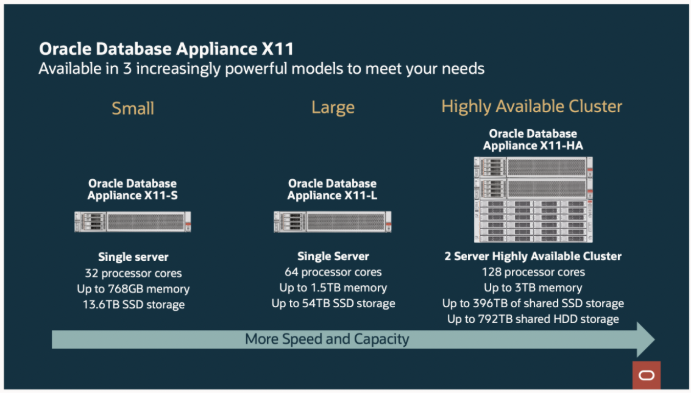
- Latest ultra-fast AMD EPYC x86 processors: Accelerate OLTP and Analytics up to 11% compared to X10
- Latest ultra-fast memory: Accelerate in-memory workloads up to 33% compared to X10
- Latest ultra-fast flash storage: Millions of OLTP IOs/sec, analyze a terabyte of data in seconds
- With the new capabilities, ODA X11 can run existing workloads faster, or run more workloads for no additional cost: ODA X11 delivers higher real-world performance, up to 3.6X higher real-world database TPS than ODA X7
- ODA is the only platform that allows Standard Edition 2 (SE2) to run on servers that use CPU chips that are based on multi-chip modules: Run SE2 on bare-metal or virtualized systems. Oracle Database release 26ai databases are supported on DB systems (VM)
- ODA with KVM hard partitioning allows Oracle Databases to be licensed in a virtual machine, enabling the remaining ODA hardware to run applications: this eliminates the need for dedicated application servers, reducing costs and enhancing latency
The “AI for Data” Revolution: Oracle AI Database 26ai
ODA officially joined the AI era in 2025 with support for the Oracle AI Database 26ai, offering:
- Integrated AI Vector Search: ODA users can now run semantic searches directly within the database, processing “meaning” rather than just exact keywords to build advanced AI applications.
- Simplified Adoption: Delivered as a Release Update (RU), the transition to 26ai is a straightforward application of an update, allowing existing customers to adopt AI features without a disruptive full-version upgrade.
- Converged Platform: Support for 26ai ensures that ODA remains a versatile foundation for JSON, graph, and spatial data alongside new AI-driven workflows.
2025 Software Milestones: four impactful software releases
The ODA software stack saw continuous refinement throughout 2025, with four major quarterly releases focusing on security, automation, and modernization. These updates represent more than just bug fixes; they are the result of thousands of hours of rigorous engineering and validation.
Below is a summary of the transformative features delivered across the ODA SW 19.26–19.29 release cycle in 2025:
- 26ai AI/ML features: ODA now supports Oracle AI Database 26ai, enabling organizations to adopt AI-aware database capabilities without re-architecting their environments. ODA supports both Oracle AI Database 26ai and Oracle Database 19c databases.
- Security that’s on by default: Security remains a core strength of ODA, and this year brought meaningful improvements with less manual effort. Security has been further strengthened with the implementation of STIG-aligned SCAP controls, delivering a Security Content Automation Protocol (SCAP) score of over 90% out-of-the-box, while SELinux is enabled in permissive mode by default, to ensure that access monitoring is active out-of-the-box, benefiting ODA Bare metal, DB Systems and application KVMs.
- A More predictable updating experience: To help customers stay current, ODA now supports a monthly OS update model, providing faster access to security fixes. Separate updates for server and grid infrastructure allow for flexible scheduling. Faster database updating prechecks cuts the precheck time significantly and there are now fewer updating steps.
- Optimized Performance and Storage: New updates significantly reduce the time required for critical infrastructure tasks. Optimized storage setup operations are now up to 2.4x faster and storage expansion operations have been accelerated by up to 3x. Furthermore, customer can now flexibly extend /u01 and /opt file systems via ODACLI or the Browser User Interface (BUI) to accommodate logs and software.
- Enhanced high availability: ODA now allows for up to two integrated standby databases, enabling one for DR and another for reporting or testing.
- Performance and Scalability with Oracle AI Database 26ai True Cache: This year also introduced True Cache support on ODA, unlocking newer database capabilities. True Cache allows applications to scale read performance while maintaining data consistency, making it well suited for high-demand and read-intensive workloads.
- Virtualizing and Solution-in-a-box: ODA continues to integrate more naturally into modern IT environments. ODA KVM virtualization has been validated with the following Oracle applications: Oracle Key Vault (OKV), Oracle Utilities Network Management Systems (NMS), Oracle TimesTen In-Memory Database. In addition, the Red Hat OpenShift Container Platform is now supported with ODA.
Conclusion
In 2025, the Oracle Database Appliance reaffirmed its position as the most cost-effective and simplified solution for small and medium enterprises to power their database needs. Between the raw performance of the X11 series, the integrated intelligence of Oracle AI Database 26ai, and continued software innovations through the ODA software stack, ODA provides a future-proof foundation for the next generation of data-driven innovation.
As we build on this momentum, we invite you to explore our latest technical announcements and connect with your Oracle team to begin your upgrade journey into 2026.