
After a cyber event, recovering data is only one part of the problem. There also needs to be a controlled way to validate restored data, limit access to the recovery environment, and decide how to resume service without reintroducing compromised state.
That is where Zero Data Loss Autonomous Recovery Service and a cloud clean room work together. By restoring to a specific point in time in a separate cloud compartment, data can be placed into an isolated environment where it can be inspected before applications or users are reconnected.
Recovery Service supports this approach with real-time protection of database changes and predictably fast point-in-time recovery.
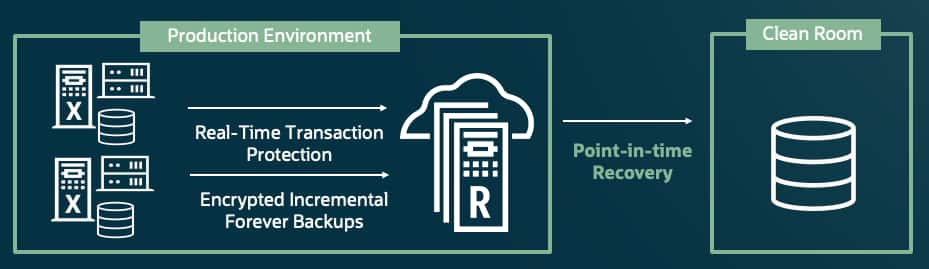
Why point-in-time recovery is important after a cyber event
In a cyber recovery scenario, the latest available copy may not be the safest recovery point.
If ransomware, malicious updates, or logical corruption entered the system before detection, the most recent state may already contain the problem. The ability to restore to a point before compromise or corruption spread further becomes critical.
That is why point-in-time recovery matters. Because Recovery Service continuously protects database changes, recovery can be performed to a more precise point in time rather than relying on a much broader backup interval. That precision can reduce data loss and provide a cleaner starting point for validation and rebuild activities.
Why recover into a separate compartment
The recovery target matters as much as the recovery point.
Restoring into the same broadly accessible compartment used for day-to-day operations increases risk. Existing administrators, automation, network paths, and integrated services may all interact with the restored environment before validation is complete and become exposed to potentially compromised data.
Recovering into a separate compartment creates an isolated recovery boundary. In practice, that restricted compartment can serve as a cloud clean room where:
- IAM access is limited to a small recovery group
- Recovery duties are separated from normal operations
- Connectivity is restricted while inspection is underway
- Restored data is validated before dependent systems are reconnected
- The environment is preserved for comparison, investigation, or extraction
This model provides tighter control over how the restored environment is handled and reduces the chance of prematurely reconnecting compromised or unverified data.
How Recovery Service fits the clean room model
Recovery Service enables recovery into a new, isolated environment.
That makes it possible to recover to a selected point in time using backups that Recovery Service has protected and validated for recoverability, then place the restored environment into a compartment where access can be tightly limited. Fast, predictable recovery using the latest virtualized full backup makes this operationally practical, without introducing unnecessary overhead into day-to-day protection.
In a clean room workflow, the goal is not just to restore data, but to evaluate what was restored before reconnecting it to broader operations.
This approach supports the ability to:
- Recover data from before the incident
- Validate restored data in isolation
- Compare recovered state to production state
- Investigate signs of compromise before reconnecting systems
- Make deliberate decisions about how to resume operations
A practical workflow
A technical workflow for this model typically looks like this:
- Identify the recovery point that best aligns to the incident timeline.
- Recover into a separate cloud compartment designated as a clean room.
- Restrict access to the recovery and security teams.
- Validate that the restored environment is usable and uncompromised.
- Reconnect, promote, extract, or rebuild from this new restored environment only after review is complete.
The restored environment should be treated as untrusted until validation is complete. That reduces the chance of reintroducing compromised data into production and provides a more defensible recovery process.
Why this improves cyber resilience
Cyber resilience depends on more than retaining backups. It depends on whether the recovery architecture supports isolation, validation, and controlled reintroduction when compromise is suspected.
A cloud clean room improves that architecture by creating a separate operational boundary for recovery work. Features such as immutable backups and end-to-end space-efficient encryption further strengthen the posture by helping protect recovery data and support a more controlled rebuild path.
For database recovery, incident response, and operational resilience, this approach provides a more practical way to rebuild after a cyber event without treating recovery as a simple restore-and-reconnect exercise.
Final thought
After a cyber event, the technical objective is not only to bring systems back online. It is to restore to the right point, validate in isolation, and reconnect only when the recovered environment is trusted.
Recovery Service supports that process by helping recovery happen into a cloud clean room where access can be limited and validation can happen before broader use. That makes recovery more controlled, more defensible, and better aligned with a real cyber recovery workflow.
This is the introduction to a multi-part series where the implementation details will be explored in future blogs.
More resources
OCI tenancy cyber resilience architecture
https://docs.oracle.com/en/solutions/oci-tenancy-cyber-resilience-architecture/index.html
Explore all OCI cyber resilience capabilities
https://docs.oracle.com/en/solutions/oci-tenancy-cyber-resilience-architecture/explore-more.html
Oracle Recovery Service documentation
https://docs.oracle.com/en-us/iaas/recovery-service/index.html
Oracle Cloud Infrastructure compartments
https://docs.oracle.com/en-us/iaas/Content/Identity/compartments/managingcompartments.htm
Managing Access to Resources
https://docs.oracle.com/en-us/iaas/Content/Identity/access/manage-accessresources.htm