
We recently released Verrazzano 1.4, which is a significant milestone release for the open source container platform project. There are a few very important points to make with this release:
- Oracle Verrazzano Enterprise Container Platform is now available as a support subscription, known as Oracle Verrazzano Premier, as part of the Oracle Linux family of support offerings. Verrazzano dovetails nicely with its companion product – Oracle Cloud Native Environment (OCNE) – to form a Kubernetes + container platform stack that can be used across on-premises and cloud environments.
- As customers are rolling out Verrazzano in production, we are adding more production-centric capabilities to the platform, including built-in backup and restore, as well as more flexible and highly available observability components.
- We continue to update the community-driven components embedded in Verrazzano.
Over the past several months, the OCNE and Verrazzano teams have melded to become a single team with a single purpose: deliver an open source, best-of-breed combination of container orchestration with a container platform. The Verrazzano 1.4 and Oracle Cloud Native Environment 1.5.7 releases are the first steps in achieving this unified solution, including:
- Shared Istio and Prometheus components, and aligned Kubernetes version 1.24 support.
- Simplified installation of Oracle Cloud Native Environment – the base layer of the combined products.
- Added installation validation for Verrazzano on top of Oracle Cloud Native Environment to verify that the components are installed uniformly.
- Enabled Oracle Cloud Native Environment cluster registration in Rancher.
All of this means easier, more resilient system provisioning, which leads to reduced overhead, and more resources to focus on your business.
Expect to see more alignment and integration between Oracle Cloud Native Environment and Verrazzano in upcoming releases. Our plans include combining tools, release schedules, and product lifecycles as part of a solution that addresses hybrid cloud challenges.
For Verrazzano itself, the 1.4 release was a significant milestone. We added tooling and features that make the platform easier to configure and manage, and even more highly available.
First up, we added a command line interface to enable interactive installation, upgrade, and configuration, and to make it easier to analyze your clusters and report issues to Oracle Support. We love the Kubernetes-native design of Verrazzano, with its custom resources and operators, and interacting through kubectl is thorough and detailed, but using the CLI can be much simpler and intuitive.
Next up is backup and restore. In Verrazzano 1.4, we included and integrated both Velero and rancher-backup so that you can effectively and efficiently create backups of your Verrazzano instances and the clusters where they run. You can then restore from backup in the event of a failure. For more details, see Backup and Recovery in the Verrazzano documentation.
Verrazzano 1.4 also includes improvements in the observability stack. We previously bundled the Prometheus operator, mainly for customer use, but Verrazzano was not using it internally. In this release, the Prometheus operator is fully integrated into Verrazzano. When Verrazzano sets up a Prometheus instance, it uses the operator to do so. You can modify the Prometheus configuration by modifying the Verrazzano custom resource. Options are listed at Prometheus Operator Component. Application metrics are now captured using Service Monitors rather than an update to the Prometheus scrape ConfigMap. This means more flexibility and resiliency for the observability infrastructure. Lastly for the observability stack, we added more metrics sources for the Verrazzano system and for the underlying Kubernetes clusters, which means more visibility without having to change the system configuration.
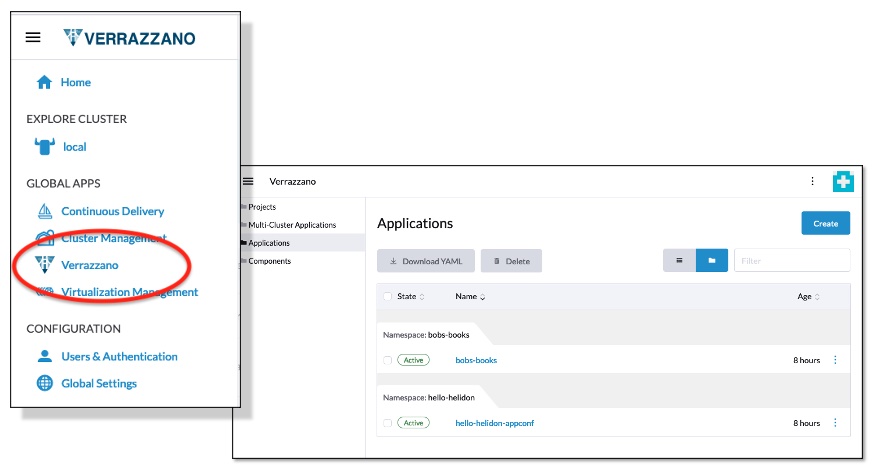
We have also started to enhance the Rancher user interface with Verrazzano-specific features. For example, we include the ability to deploy and undeploy applications across the clusters in your environment, and to drill down into details about deployed applications.
Lastly, besides adding Velero v1.8.1, we updated the latest version of Kubernetes that we support – 1.24 – and we updated the versions of some of the embedded components from community-led open-source projects, most notably:
- Istio v1.14.3
- Jaeger v1.34.1
- Rancher v2.6.8
- Coherence Operator v3.2.6
As with all releases of Verrazzano, we provide a simple and reliable upgrade process. See the Verrazzano Upgrade documentation for more details.
It’s easy to try out Verrazzano. See our latest hands-on lab: Install Verrazzano on Oracle Cloud Native Environment.
Feel free to connect with the Verrazzano team and me at https://bit.ly/verrazzano-slack.
Happy coding!