
We are excited to announce the availability of Oracle GoldenGate Veridata 26c as a container image on the Oracle Container Registry (OCR).
This release brings a faster, more flexible way to deploy enterprise-grade data validation, making it easier than ever to ensure data consistency across heterogeneous environments. Whether running on premises, in the cloud, or on Kubernetes, Veridata 26c enables teams to validate data with confidence while embracing modern, cloud-native architectures.
What is GoldenGate Veridata?
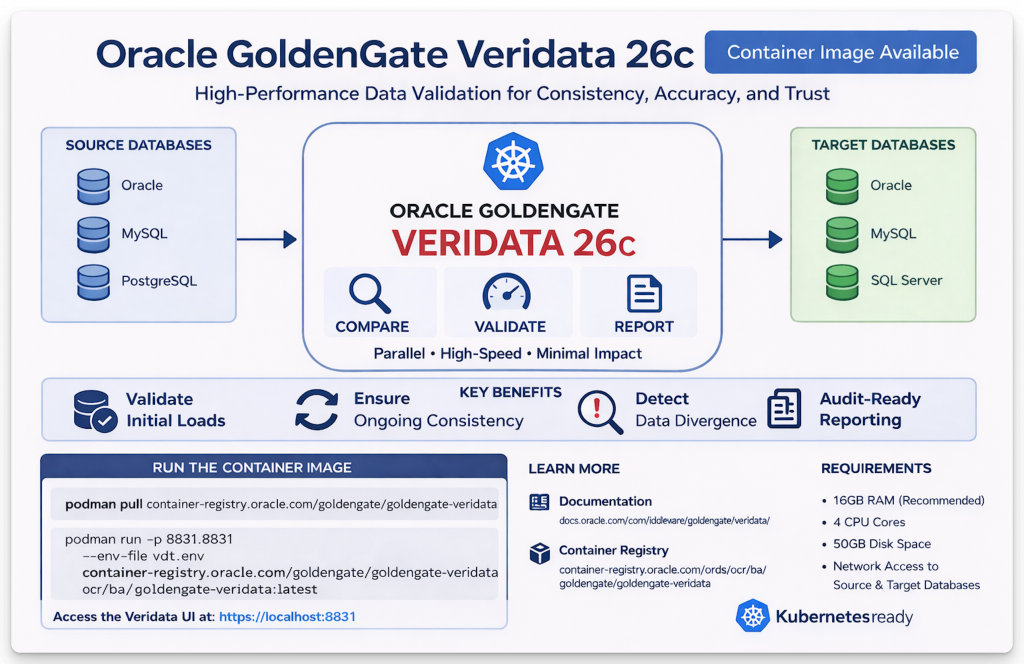
Oracle GoldenGate Veridata is a high-performance data validation solution designed to ensure consistency between heterogeneous databases.
It plays a critical role in data integration architectures by:
- Comparing source and target datasets with minimal impact on production systems
- Performing parallel, high-speed data validation
- Providing detailed discrepancy reporting
- Enabling audit-ready verification of data movement
Why Containers?
With the introduction of the Veridata 26c container image, teams can:
- Deploy Veridata quickly and consistently
- Integrate with CI/CD pipelines
- Run in cloud-native environments such as Oracle Cloud Infrastructure and Kubernetes
- Simplify testing and evaluation setups
- Train team members quickly and isolated
The Oracle GoldenGate Veridata 26c container image is designed for modern deployment environments and can be run using container runtimes such as Podman. It is also fully compatible with Kubernetes, enabling scalable and orchestrated deployments in cloud-native architectures.
Where Veridata Adds Value
Oracle GoldenGate Veridata delivers value across key stages of data integration and replication by ensuring accuracy, reliability, and trust in your data.
- Ensuring accuracy during initial data loads
- Maintaining trust in ongoing replication processes
- Identifying and resolving data discrepancies early
- Supporting audit and compliance requirements with verifiable results
Getting Started
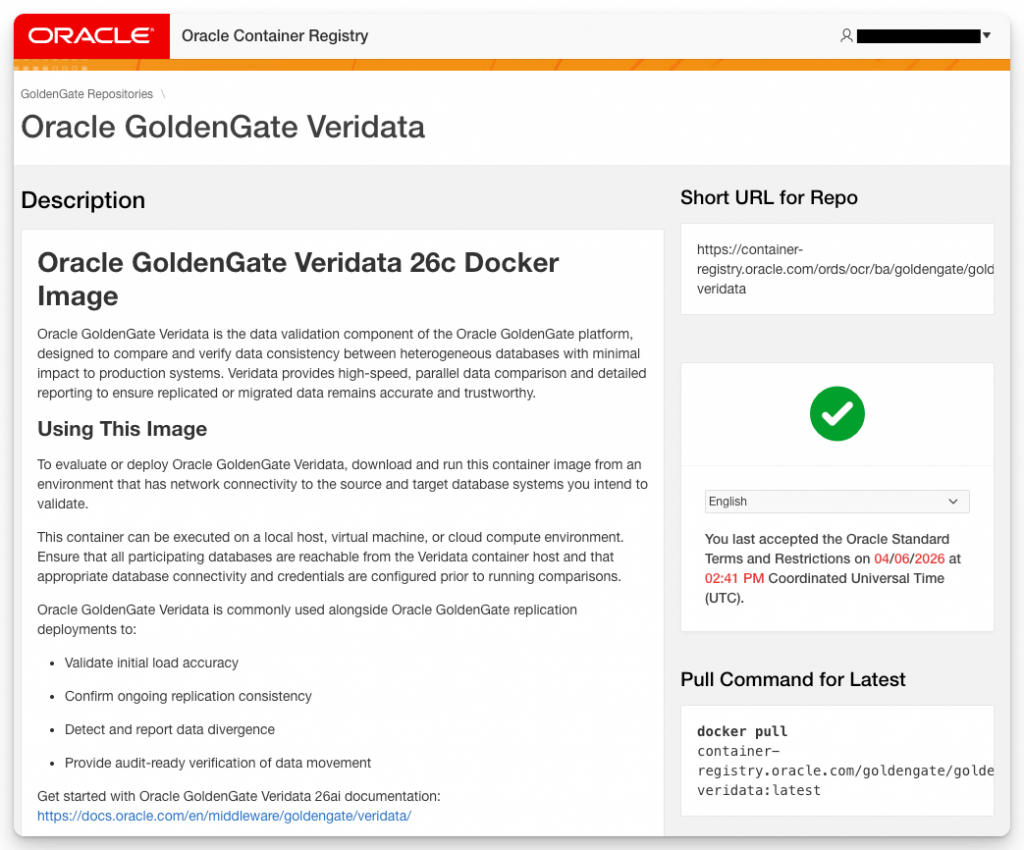
Pull the latest image:
podman pull container-registry.oracle.com/goldengate/goldengate-veridata:latestRun the container:
podman run -p 8831:8831 \
 --env-file vdt.env \
 container-registry.oracle.com/goldengate/goldengate-veridata:latest
Once the container is running, access the Veridata web interface at:
Example of the vdt.env file:
# Copyright (c) 2026 Oracle and/or its affiliates.

# Veridata admin user login username
VDT_ADMINISTRATOR_USER=veridata

# Veridata admin user login password. Must be at least 8 characters which contain at least 1 uppercase, 1 lowercase,1 numeric and 1 special character.
VDT_ADMINISTRATOR_PASSWORD=<your password>

# The jdbc database URL used by the Veidata agent to connect a database instance. If the entry is not given a value, then you need to enter the Veridata container and manually configure and start a Veriadta agent.
VDT_AGENT_JDBC_DATABASE_URL=jdbc:oracle:thin:@<database host>:<port>/<service name>

# The jdbc driver type. If the entry is not given a value, then it defaults to the value, ojdbc11. Other available options are mysql, postgresql, db2, sqlserver, and sybase
VDT_AGENT_JDBCDRIVER=ojdbc11
Deployment Requirements
For optimal performance, ensure the following:
- 16 GB RAM recommended
- 4 CPU cores
- 50 GB disk space
- Network connectivity to source and target databases
Learn More
Documentation:
https://docs.oracle.com/en/middleware/goldengate/veridata/
Container Registry:
https://container-registry.oracle.com/ords/ocr/ba/goldengate/goldengate-veridata
Final Thoughts
The availability of GoldenGate Veridata 26c as a container image marks an important step forward in modernizing data validation.
By combining the proven reliability of Veridata with the flexibility of containerized deployment, organizations can accelerate data initiatives, reduce operational complexity, and confidently validate data across distributed systems.
With support for container runtimes and Kubernetes-based deployments, Veridata 26c is well positioned to support today’s cloud-native data platforms and the evolving needs of modern enterprises.