
Once again, Oracle is named a Leader in the 2025 Gartner® Magic Quadrant™ for Data Integration Tools which analyzes offerings from 20 vendors. Organizations use these tools to combine data from multiple sources through data access, transformation, enrichment, and delivery. Gartner report’s strategic planning assumption is that “by 2027, AI assistants and AI-enhanced workflows within data integration tools will reduce manual effort by 60% and enable self-service data management.”
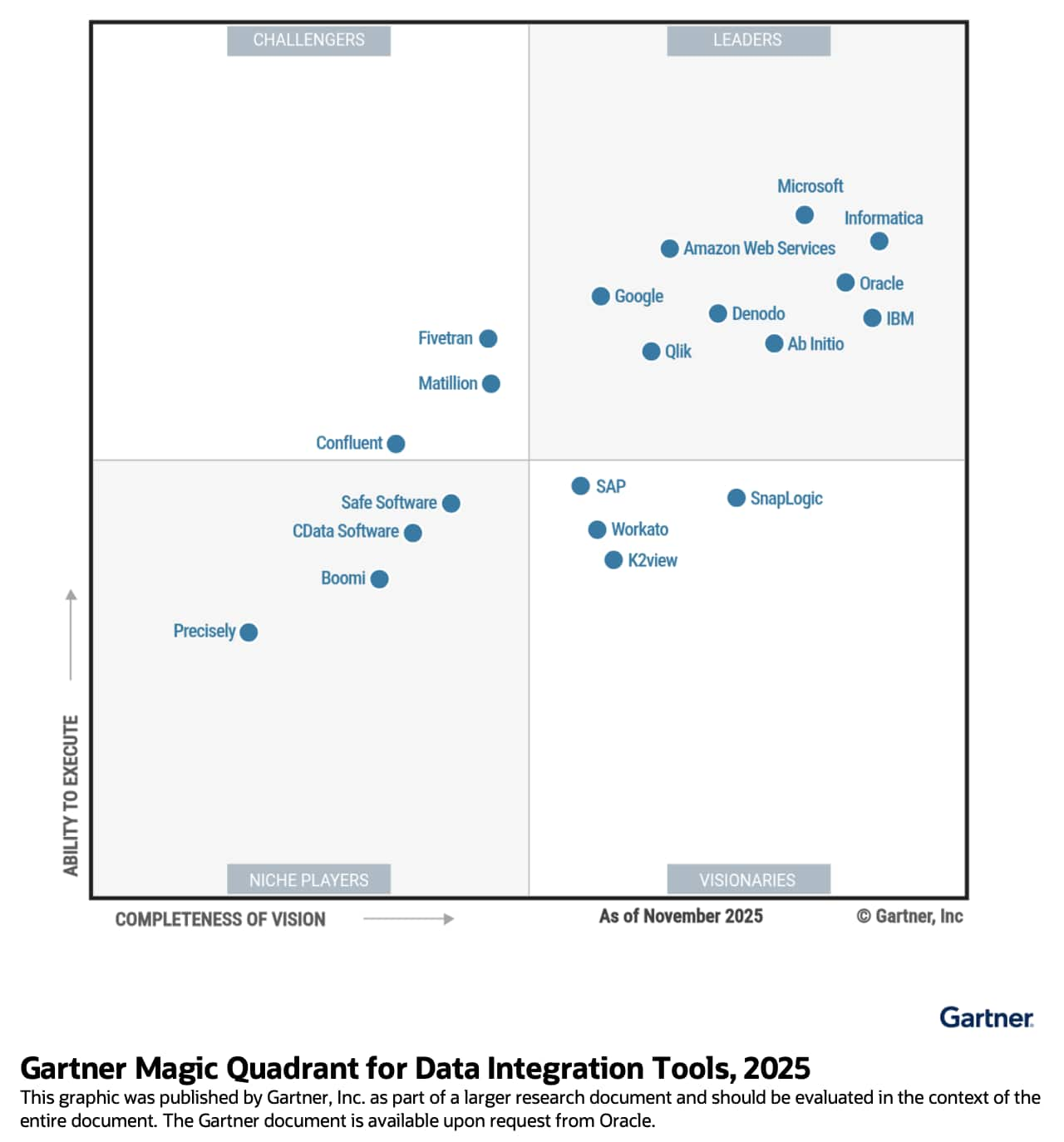
Gartner complements their Magic Quadrant with a detailed analysis of the critical capabilities of each vendor’s solution in their 2025 Gartner® Critical Capabilities for Data Integration Tools. Again, this year, Gartner ranks Oracle first in Operational Data Integration Use Case.
“We are honored to once again be named a Leader in the 2025 Gartner Magic Quadrant for Data Integration Tools. Oracle has been positioned as a Leader for seventeen consecutive years,” said Jeff Pollock, vice president, Product Management, Oracle. “Over the past two decades, Oracle has continuously enhanced our comprehensive portfolio of data integration solutions enabling customers to connect data and automate data delivery across their multicloud, hybrid, and on-premises data fabrics dynamically and cost-effectively. Our unified development, operations, and support strategy is the secret sauce to our success with engineering teams spanning Oracle Cloud Infrastructure (OCI), Oracle AI Database 26ai, Oracle GoldenGate 26ai, Oracle Autonomous AI Database, Oracle Autonomous AI Lakehouse, Oracle Analytics Cloud, and Oracle AI Data Platform.”
Oracle provides organizations with a choice of efficient services, consumption models, and deployment options to address diverse business needs and budgets—wherever their data resides.
While organizations use data integration tools for a variety of business needs, Gartner characterizes five common operational and analytical use cases:
- “Data engineering — Data integration by technical user personas to develop, manage and optimize data pipelines, mostly for analytical use cases
- Delivering modern data management architectures — Data integration to deliver modern data management design patterns, such as lakehouse, data fabric and data mesh, and deliverables, such as data products
- Self-service data integration — Data integration activities by less-technical user personas for various analytical demands of data, such as analytics and business intelligence (ABI), and data science use cases
- Operational data integration — Data integration to implement various operational data integration use cases, such as consolidation of master data, delivery and use of data hubs, interenterprise and partner data sharing, and application integration
- Supporting AI projects — Data integration to support AI projects with complex requirements, such as building chatbots or recommendation systems, and to support delivery of AI-ready data”
For over thirty years, Oracle’s data integration solutions have been trusted by enterprises to provide a real-time data fabric connecting applications and data sources for heterogenous mission-critical systems. With thousands of deployments, Oracle delivers an enterprise-proven data management solution giving organizations AI-ready data in real-time for smarter, faster, and more secure data-driven insights and innovation. The Oracle Integration portfolio of products and services is a comprehensive and integrated collection of data and application integration capabilities across all five Use Cases.
Oracle’s integration portfolio delivers the depth and breadth of technologies and automation to address diverse business requirements across an enterprise’s heterogenous data ecosystem –in OCI, multicloud, and on-premises environments. To find out more, visit: Oracle GoldenGate, OCI GoldenGate, Oracle Autonomous AI Lakehouse, Oracle Autonomous AI Database Data Studio, Oracle AI Data Platform, Oracle Data Integrator, and OCI Data Integration.
Get the details by reading Gartner Magic Quadrant for Data Integration Tools, 2025.
Gartner and Magic Quadrant are trademarks of Gartner, Inc. and/or its affiliates.
Gartner, Magic Quadrant for Data Integration Tools, by Michele Launi, Nina Showell, Robert Thanaraj, Sharat Menon, 8 December 2025.
Gartner does not endorse any company, vendor, product or service depicted in its publications, and does not advise technology users to select only those vendors with the highest ratings or other designation. Gartner publications consist of the opinions of Gartner’s business and technology insights organization and should not be construed as statements of fact. Gartner disclaims all warranties, expressed or implied, with respect to this publication, including any warranties of merchantability or fitness for a particular purpose.
Gartner, Critical Capabilities for Data Integration Tools, by Nina Showell, Michele Launi, Robert Thanaraj, Sharat Menon, 10 December 2025.