
Regional disruptions should not stall data movement. Cross-region disaster recovery in OCI GoldenGate preserves replication and event-driven integrations during outages by keeping GoldenGate configurations protected and ready to run in a paired region alongside your databases, including Oracle AI Databases. The result: lower recovery time objectives (RTO), tighter recovery point objectives (RPO), and lower operational risk for mission‑critical analytics, AI, and operational workloads.
What is disaster recovery and why it matters
Disaster recovery (DR) is the set of policies, architectures, and runbooks that restore services after a regional or site‑level disruption. A sound strategy aims to:
- Minimize downtime (RTO) with a pre-provisioned, tested standby environment.
- Minimize data loss (RPO) by continuously protecting state and checkpoints.
- Improve resiliency by removing single points of failure across regions.
- Meet compliance and Service Level Agreements (SLAs) through documented objectives and regular testing.
The new cross-region DR functionality in OCI GoldenGate helps enterprises satisfy all these requirements. This matters as GoldenGate often sits in the critical path for analytics, operational reporting, AI/ML, and event-driven integrations. If replication halts:
- Downstream analytics become stale and decisions degrade.
- Operational applications that rely on near‑real‑time replication drift out of consistency.
- AI/ML feature stores and model‑serving pipelines receive stale data, degrading inference quality and RAG accuracy.
- CDC‑driven microservices and event pipelines stall.
Cross-region DR keeps replication running with minimal intervention, avoiding extended outages and manual pipeline rebuilds.
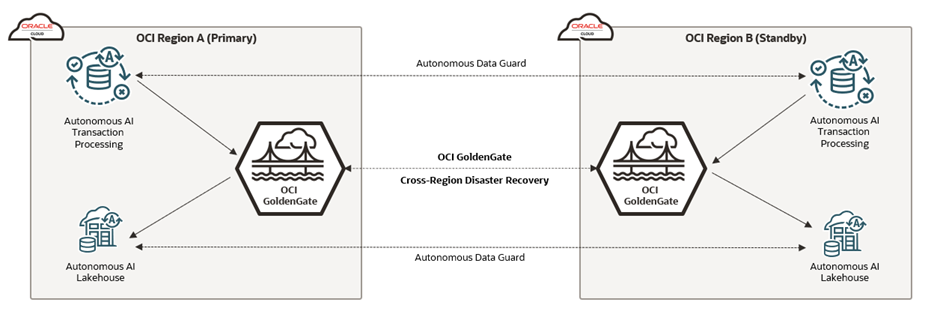
What the new cross‑region disaster recovery feature in OCI GoldenGate enables
At a high level, the new disaster recovery feature allows you to:
- Pair deployments across regions: Run primary replication in one OCI region and keep a paired DR deployment synchronized for rapid activation.
- Protect GoldenGate state: Preserve configuration, metadata, credentials (via OCI Vault), and replication checkpoints so you can promote the DR deployment without reauthoring processes.
- Switchover to paired region: Guided workflows validate prerequisites and promote the DR deployment in the standby region.
OCI GoldenGate cross-region disaster recovery keeps replication and integrations available during regional events by pairing deployments across OCI regions and protecting state, credentials, and checkpoints. With guided promotion and monitoring, you can reduce RTO and RPO with minimal disruption.
Getting started: step-by-step
- Plan regions and topology
- Select paired OCI regions that satisfy latency, compliance, and data residency requirements.
- Decide scope: protect a single OCI GoldenGate deployment or multiple. Map them to the corresponding database DR strategy (for example, Autonomous Data Guard regions).
- Prepare networking and security
- Mirror VCNs, subnets, route tables, and network security groups (NSG) rules across regions.
- Configure private endpoints and required routes to source/target databases in both regions.
- Validate the primary GoldenGate deployment
- Verify Extract and Replicat health, parameter baselines, credential stores, and storage configuration.
- Standardize naming and tagging, these help orchestration and cost tracking.
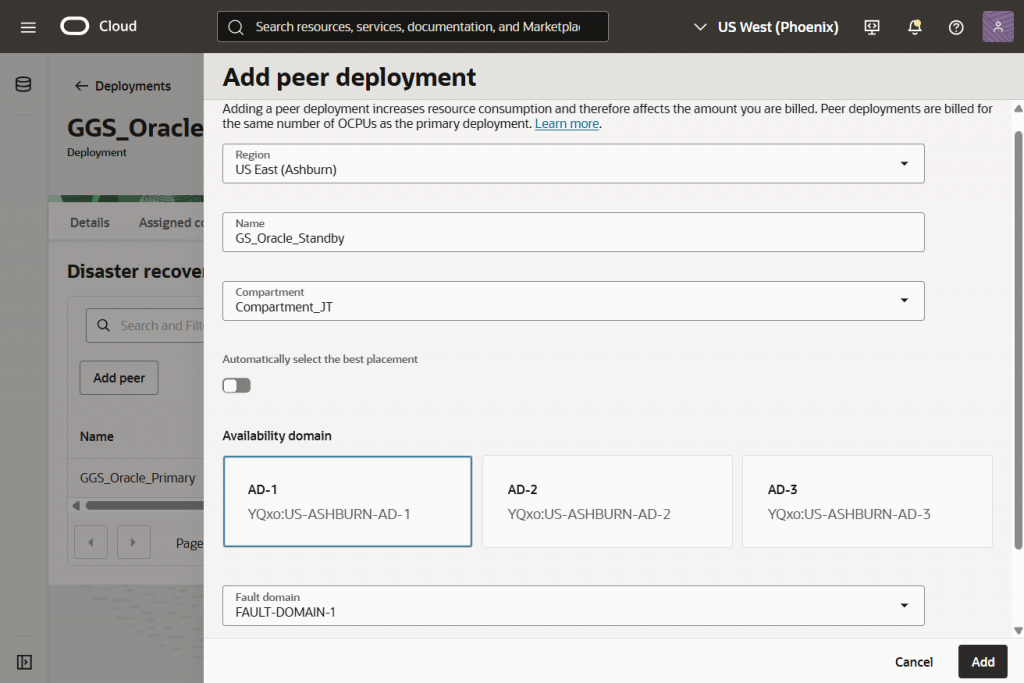
- Add a cross-region standby peer to your GoldenGate deployment
- Create and pair a DR deployment to your primary deployment. Ensure it has identical network reachability and access to DR databases or alternate endpoints.
- (optional) Align GoldenGate DR with Oracle AI Databases DR
- Enable and synchronize Autonomous Data Guard or Active Data Guard across the same region pair.
- Define the order of operations: typically fail over the database first, then promote GoldenGate.
- Run readiness checks
- Run prechecks to validate network reachability, secrets, IAM, and storage access.
- Dry-run a switchover in a non-production environment to measure RTO and update runbooks.
- Execute planned switchover test to standby region
- Initiate a controlled switchover to the DR region during a maintenance window.
- Verify that Extracts/Replicats start correctly, that checkpoints are consistent, and that downstream systems receive data without duplicates or gaps.
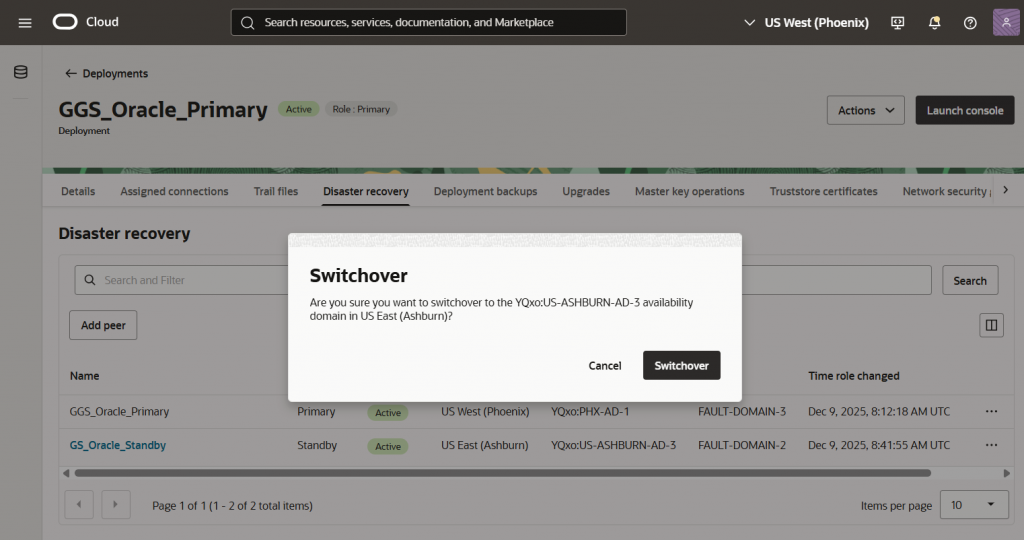
- Switchover back or keep the new primary
- Reverse pairing to restore the original topology or designate the DR region as the new primary.
- Operate and optimize
- Set up alarms, metrics, and logs in both regions.
- Monitor lag, throughput, errors, and checkpoint age.
- Periodically re-validate IAM policies, network rules, and encryption posture.
Conclusion
Cross-region disaster recovery in OCI GoldenGate keeps your data movement online when regions go offline. By pairing deployments across regions and protecting configuration, credentials, and checkpoints, you can reduce RTO and RPO without reauthoring processes, so analytics, integrations, and AI workloads stay current and reliable.
Take the next step:
- Watch the OCI GoldenGate Disaster Recovery feature demo
- Explore the documentation: OCI GoldenGate disaster recovery and high availability
- Check What’s New in OCI GoldenGate
- Review the OCI GoldenGate Documentation