
Why AI Is Forcing Enterprises to Reevaluate Database Strategy
For years, FinOps discussions focused primarily on infrastructure consumption: compute utilization, storage growth, idle resources, and cloud optimization. Those priorities remain important, but AI is changing the economics of enterprise technology.
As organizations invest in generative AI, predictive analytics, autonomous operations, and agentic workflows, a broader question is emerging: Is the current data and database strategy prepared for AI at enterprise scale?
The answer affects more than infrastructure cost. AI success depends on the quality, accessibility, governance, performance, and economics of the underlying data architecture. As a result, the database is returning to the center of the FinOps conversation.
The FinOps Foundation’s 2026 State of FinOps report highlights how FinOps is expanding beyond public cloud optimization into broader technology value management, with AI spend becoming a major area of focus. That shift requires organizations to evaluate not only what AI costs, but also whether their data platforms are structured to deliver sustainable business value.
AI Has Exposed the Cost of Fragmented Data Strategies
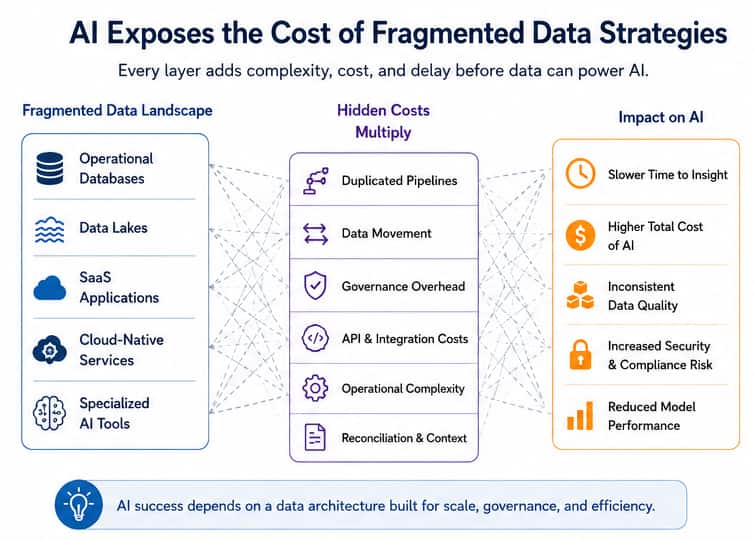
AI initiatives often reveal architectural decisions that were manageable in traditional environments but become expensive at AI scale. Enterprise data is frequently distributed across operational databases, data lakes, SaaS platforms, cloud-native services, and specialized AI tools. Every additional layer can introduce duplicated pipelines, repeated data movement, additional governance requirements, API overhead, and operational complexity.
The issue is not necessarily a lack of AI tools. In many organizations, the underlying data architecture simply was not designed for AI-era operating requirements. If teams must continuously copy, reconcile, secure, and contextualize data before it can be used, then the true cost of AI extends far beyond GPUs, tokens, or model subscriptions.
For FinOps teams, this changes the analysis. AI cost management is not only about measuring AI services after they are consumed. It also involves understanding whether fragmented data architectures are increasing the cost and reducing the value of every AI initiative built on top of them.
The Database Is No Longer Just Infrastructure
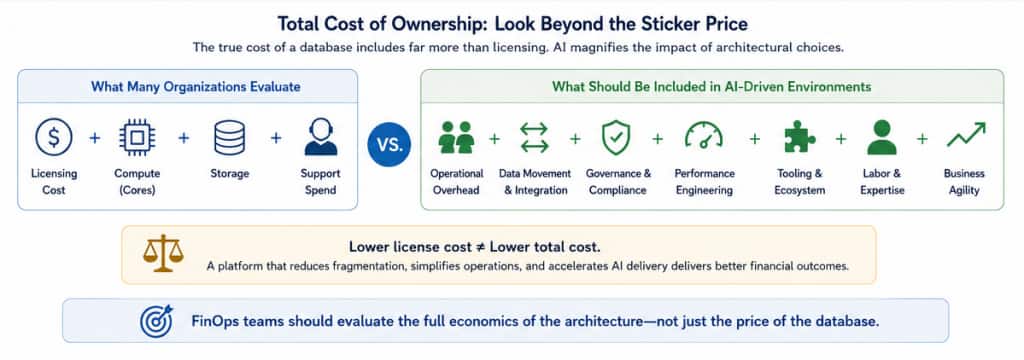
Historically, many enterprises evaluated databases through a procurement or licensing lens: What does the platform cost? How many cores are required? Can support spend be reduced?
Those questions still matter, but AI broadens the scope of the discussion.
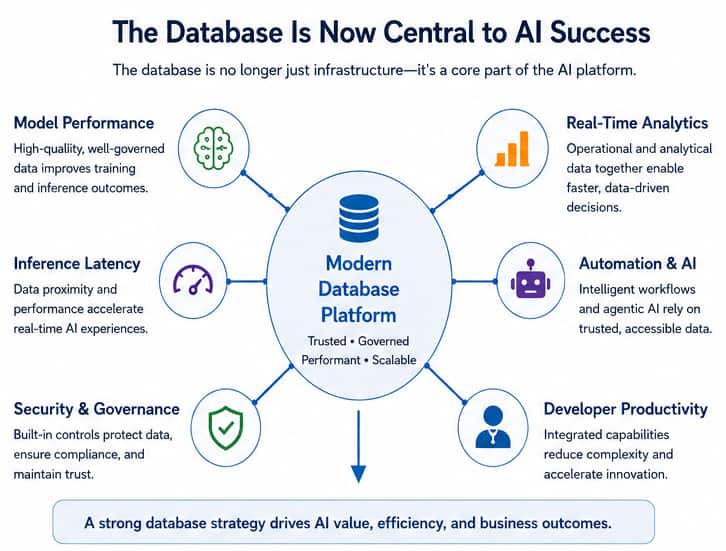
Database strategy now influences model performance, inference latency, governance, security, real-time analytics, automation, and developer productivity. The database is increasingly part of the AI platform decision rather than simply a back-office infrastructure component.
This is especially relevant for organizations with large Oracle Database estates. Oracle Database has long supported mission-critical workloads where resilience, transaction consistency, performance, security, and operational maturity matter at scale. AI does not eliminate those requirements. In many cases, it reinforces them.
Rethinking the “Oracle Is Too Expensive” Narrative
Many organizations still evaluate Oracle Database using assumptions formed years ago. Some diversified database platforms to reduce concentration risk, standardized on open source for selected workloads, or moved noncritical systems to lower-cost alternatives.
The question now is whether those decisions still deliver the best financial outcome in an AI-driven operating model.
A lower-cost database may be appropriate for some workloads, but the financial analysis should include operational overhead, data fragmentation, governance complexity, performance engineering, integration costs, and labor. As AI scales, these secondary costs can become increasingly material.
A platform that appears inexpensive in isolation may not reduce total cost if it increases data movement, duplicates tooling, slows AI deployment, or fragments governance. For organizations with existing Oracle investments, the analysis should also consider whether underused database entitlements could support modernization, consolidation, cloud mobility, or AI-ready services before being retired.
AI-Ready Databases Require More Than Storage and Transactions
Modern AI architectures increasingly rely on capabilities such as vector search, retrieval-augmented generation (RAG), semantic retrieval, and governed access to operational data. These requirements are pushing organizations to evaluate whether AI systems should remain distributed across many platforms or operate closer to governed enterprise data.
Oracle AI Database 26ai reflects this broader industry direction. Oracle documentation describes AI Vector Search as a capability that enables semantic search and retrieval-augmented generation patterns directly within the database environment.
That matters because architecture choices shape cost and operational complexity. If AI requires a separate database, separate vector store, separate governance layer, and repeated data movement for every use case, flexibility may come at the expense of efficiency.
Specialized AI tools and databases will still have an important role. The goal is not one-size-fits-all standardization. Instead, FinOps teams should evaluate the full economics of architecture decisions based on workload requirements, governance needs, and business outcomes.
Autonomous Operations and the Economics of Database Management
Operational labor is another critical part of total technology cost.
AI initiatives increase pressure on platform teams, security teams, and engineering organizations. The cost of database management therefore includes more than software or infrastructure. It also includes the work required to patch, tune, secure, monitor, scale, back up, and govern those environments.
Oracle Autonomous Database is relevant in this context because it is designed to reduce manual administration through automated tuning, patching, backups, scaling, and security operations. Oracle also references IDC research describing operational-efficiency and productivity improvements associated with Autonomous Database.
From a FinOps perspective, this matters because labor, uptime, process consistency, and operational risk all influence technology economics. As AI environments scale, operational simplicity may become as important as raw infrastructure pricing.
A More Practical FinOps Framework
None of this suggests that every organization should consolidate onto a single database platform or reverse prior modernization efforts. In many cases, moving selected workloads to specialized or lower-cost platforms was rational and financially beneficial.
The more important question is whether historical optimization decisions still align with today’s AI, governance, and operational requirements.
This is where FinOps can provide a useful framework. Rather than framing the conversation as Oracle versus non-Oracle, or cloud versus on-premises, FinOps teams can evaluate workload placement, data movement, operational cost, governance, and business value together.
For organizations with existing Oracle Database investments, several questions are worth evaluating:
- What Oracle Database entitlements and support obligations exist today?
- Which licenses are actively used, underused, or unused?
- Can existing investments support modernization, consolidation, AI development, or cloud mobility?
- Where has database diversification reduced cost, and where has it increased complexity?
- Which data domains are most important for AI use cases?
- How much cost is tied to data movement, duplicated storage, security controls, and operational support?
These questions do not assume a predetermined answer. In some cases, the right decision may be to retire unused assets. In others, existing investments may provide a more efficient path to AI readiness than introducing additional fragmentation.
Why the Conversation Matters Now
As AI shifts enterprise priorities from infrastructure consumption to data-driven business value, database strategy deserves renewed attention within FinOps planning.
A support invoice is visible and easy to challenge. The costs of fragmented governance, operational complexity, delayed AI deployment, and excessive data movement are often harder to measure. FinOps can help organizations make those tradeoffs visible before decisions become difficult to reverse.
The practical question is no longer only, “What does the database cost?” It is also, “Does the database strategy help the organization deliver AI efficiently, securely, and sustainably over the next decade?”
Additional Resources
- Oracle GLAS Overview
https://www.oracle.com/corporate/global-licensing-advisory-services/ - Oracle GLAS Blog
https://blogs.oracle.com/global-licensing-advisory-services-glas/ - Oracle Autonomous Database
https://www.oracle.com/autonomous-database/ - Oracle Database 26ai Overview
https://www.oracle.com/database/ai-database/ - FinOps Foundation
https://www.finops.org/ - Oracle AI Vector Search and RAG Documentation
https://docs.oracle.com/en/database/oracle/oracle-database/26/vecse/