
The leading Swiss online bank is bringing cloud database agility into its own Swiss data centers to support growth, manage trading volatility, and standardize critical Oracle Database workloads.
For online banks, market activity can change in minutes. A quiet trading period can quickly become a surge in traffic, transaction volume, and database demand. Customers still expect every interaction to be fast, secure, and available.
That is the operating environment for Swissquote, a leading Swiss online bank based in Gland, Switzerland. Swissquote provides digital financial services for trading, investing, and banking. Its internally developed platforms rely heavily on Oracle Database and serve around one million active clients, with tens of thousands of users connected at peak periods.
For Swissquote, latency and availability are not abstract IT metrics. They directly shape the customer experience. As the bank continued to grow, it needed a database platform that could support more users, absorb periods of market volatility, and help its teams modernize a heterogeneous estate without compromising control over sensitive data.
Modernizing while keeping data in Switzerland
Before the project, Swissquote operated a mix of database infrastructure, including Oracle Database Appliance and commodity hardware. The environment had supported the business, but growth, hardware refresh cycles, licensing considerations, and the need for a more consistent architecture made modernization a priority.
As a Swiss financial institution, Swissquote also had strict requirements around data control and data residency. The company wanted to benefit from a cloud operating model, but its critical database workloads needed to remain in Swissquote-operated data centers in Switzerland, close to applications and users.
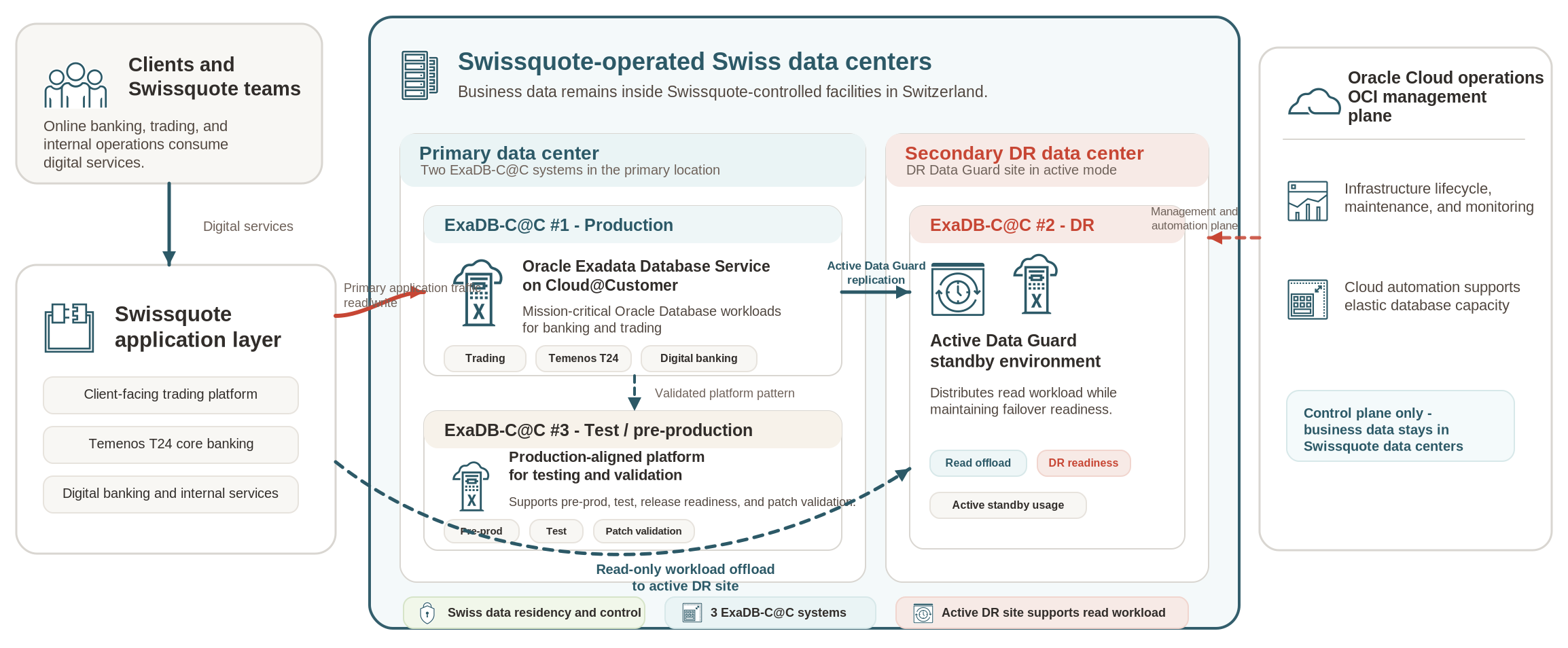
Oracle Exadata Database Service on Cloud@Customer gave Swissquote a way to meet both objectives. The service brings Oracle Cloud capabilities and Exadata performance into customer data centers, helping organizations run critical Oracle Database workloads with cloud agility while maintaining local control over where data resides.
“Ensuring that the data remains inside Swissquote data centers, which we operate ourselves, was strategic,” says Guillaume Hayoz, Head of Data Management at Swissquote. “The Cloud at Customer solution addressed those needs.”
One platform for trading, core banking, and disaster recovery
Swissquote deployed Oracle Exadata Cloud@Customer as a standardized foundation across key environments, including production, disaster recovery, and pre-production. That consistency helps simplify operations and gives teams a common platform for critical Oracle Database workloads.
Two workload patterns were especially important. The first was Swissquote’s client-facing trading environment. Trading demand can be highly unpredictable, with market events driving sudden spikes in activity. The second was core banking, including Temenos T24, where demand is more predictable but nightly batch processing can be intensive.
Oracle Exadata Cloud@Customer helps Swissquote address both patterns. For trading workloads, the bank can scale resources reactively as demand changes. For predictable workloads, teams can plan capacity in advance and allocate resources around known processing windows. This helps avoid permanently oversizing infrastructure for peak demand while still supporting high-volume periods when they happen.
Dynamic scaling for market volatility
Dynamic scaling has become a central capability for Swissquote because it allows database CPU resources to be adjusted without the operational disruption associated with traditional infrastructure changes.
“Dynamic scaling allows us to adjust, almost in real time, the number of CPUs assigned to a database,” says Guillaume Hayoz. “This allocation can be increased or decreased transparently. There is no restart, and there is no direct impact on database availability.”
Swissquote monitors server activity frequently and can adapt capacity within minutes based on observed load. For workloads with predictable patterns, such as core banking batch processing, the team can also plan resource increases ahead of time. The result is a more flexible model for aligning capacity with real business demand.
Standardization becomes the biggest win
After migration, Swissquote observed performance gains on selected workloads. But the bank sees standardization as one of the most important outcomes. Its database systems are now more consistent, current, patched, secured, and uniformly managed.
“With our new platform, we can now say that our systems are up to date, patched, secured, and managed in a uniform way,” says Guillaume Hayoz. “That is a major advantage.”
That standardization also changes how database teams spend their time. Instead of focusing as much on lower-level infrastructure administration, Swissquote DBAs can spend more time on activities that improve services for internal teams and customers. Guillaume Hayoz describes the move as a generational leap for the DBA team that has brought renewed energy and a stronger team spirit.
A new operating model for critical banking systems
Moving to Oracle Exadata Cloud@Customer also required an operating model shift. Swissquote historically controlled each infrastructure layer directly, from disk installation through patching. With Oracle Exadata Cloud@Customer, Oracle manages platform installation, hardening, maintenance, and lifecycle activities, while Swissquote retains control of its data and database environment.
For Swissquote, that shift means relying on specialists for the infrastructure layers beneath its critical Oracle Database workloads. It also gives the data management team a modern, resilient platform designed for the kinds of workloads the bank runs every day.
Oracle teams supported the migration program, helping Swissquote move critical workloads into production and establish the new platform as a strategic foundation for additional Oracle Database workloads where the business value is clear.
A foundation for continued growth
Swissquote’s modernization program shows how financial institutions can adopt cloud capabilities without moving every critical workload to a public cloud region. With Oracle Exadata Database Service on Cloud@Customer, Swissquote can keep data in its own Swiss data centers while gaining a more elastic, standardized, and cloud-enabled database platform.
For clients, that helps support responsive digital banking and trading services during normal operations and periods of volatility. For employees, it provides a more modern and consistent platform. For the business, it creates a foundation that can scale with continued growth while supporting the data-residency and operational requirements of a regulated banking environment.
As financial services organizations continue to modernize mission-critical systems, Swissquote’s experience highlights a practical path: bring the cloud operating model to the data center, standardize the database estate, and use elastic capacity where business demand is hardest to predict.