
Author: Arun Sathyamurthy, Oracle Database Engineering
Contributors: Suparna Gurunaga, Sharath Bhogappaveerabhadraswamy, Rabeen Ravindranathan, Pradeep S, Ravi Singh, Mayank Shah, Oracle Database Engineering
Oracle AI Database recently introduced the Private Agent Factory, a platform available with the Oracle Database to build, test, and deploy agents to enable Agentic AI in the enterprise. To get started with the Agent Factory you can access a hands-on-lab here.
A few of us started to use the Private Agent Factory to build the agents required for our day to day tasks of QA testing of software and automating the tasks of software testing pipelines. We share our experience of this agentic journey below.
From Vision to Velocity: How Oracle AI Database Private Agent Factory Rewires Enterprise Innovation
Our Requirement: Turning QA Ambitions into a Resilient Pipeline, Quality Analysis Reinvented
An AI-driven system generates cloud test cases and fully executable test scripts on the fly from diverse inputs—such as Development Handoff to QA (DHQA) documents, reported bugs, internal knowledge bases, and ongoing user prompts—then runs them using user-provided Oracle Cloud inputs to perform pre-checks, validate critical operations, and capture outputs in structured logs, while orchestrating asynchronous tool execution across multiple cloud services with JOBID/TASKID tracking and ensuring strict enterprise compliance, governance, maintainability, and extensibility.
Solution with the Oracle AI Database Private Agent Factory
We came up with an architecture with the Private Agent Factory below
- Visualize a hierarchy-Supervisor Agent –> Specialized Use-Case/Script Agents –> Cloud-Service Subagents.
- Wire MCP tools (hosted on a single MCP server) for data collection, code generation and validation.
- Track each user request with a JOBID, break work into TASKIDs, and persist status/logs in Database.
- Expose the entire flow through REST APIs so internal apps can trigger and monitor progress automatically.
This resulted in a resilient pipeline that turns heterogeneous inputs into validated, self-sustaining test scripts without manual orchestration.
Why the Agent Factory Fit
We believe the following features of the Agent Factory helped address our requirements rapidly. This would have taken much more work to integrate with a disparate set of tools – data, workflows, LLMs, containers, etc. to bring together in a platform.
- Speed without compromise: Accelerated time-to-value experience as we move from idea to active agents
- Enterprise guardrails baked in: Run agents entirely within tenancy, keep sensitive datasets in place, and align with existing governance policies — no “shadow AI” risk.
- Design first, wire later: Define goals, craft reasoning steps, and attach tools visually. The factory handles orchestration, context passing, and endpoint management behind the scenes.
- Interop by default: Connect to vLLM, OpenAI, Ollama, and OCI GenAI models; expose agents through REST for integration with apps, portals, or automation pipelines.
How We Composed the Agents
We now explain how the agent is built in the Agent Factory, but using a supervisor agent that works with specialized sub agents, all very easy to set up.
- TestAssist Agent –interacts with Agent Factory comprising of Supervisor/Sub agents as explained below.
- Supervisor Agent – understands each user request, classifies whether it’s for use case generation, script generation, or both, and delegates the work accordingly.
- Specialized Area Agents – expert agents for use cases and scripts. They reframed objectives, applied structured instructions, and invoked cloud-service specialists using curated CODEX skillbooks packed with rules, formatting expectations, and examples.
- Cloud-Service Specialist Agents – one per Oracle Cloud domain. They invoked MCP tools, triggered asynchronous commands, and consolidated outputs.
- MCP Tools & Governance – custom tools generated use cases and scripts, validated cloud commands, enforced pre-checks, produced logs, and orchestrated JOBID/TASKID management. All status tracking lived in Database, giving us full traceability. CODEX skillbooks are being used by some of the MCP tools to provide response to the user requests.
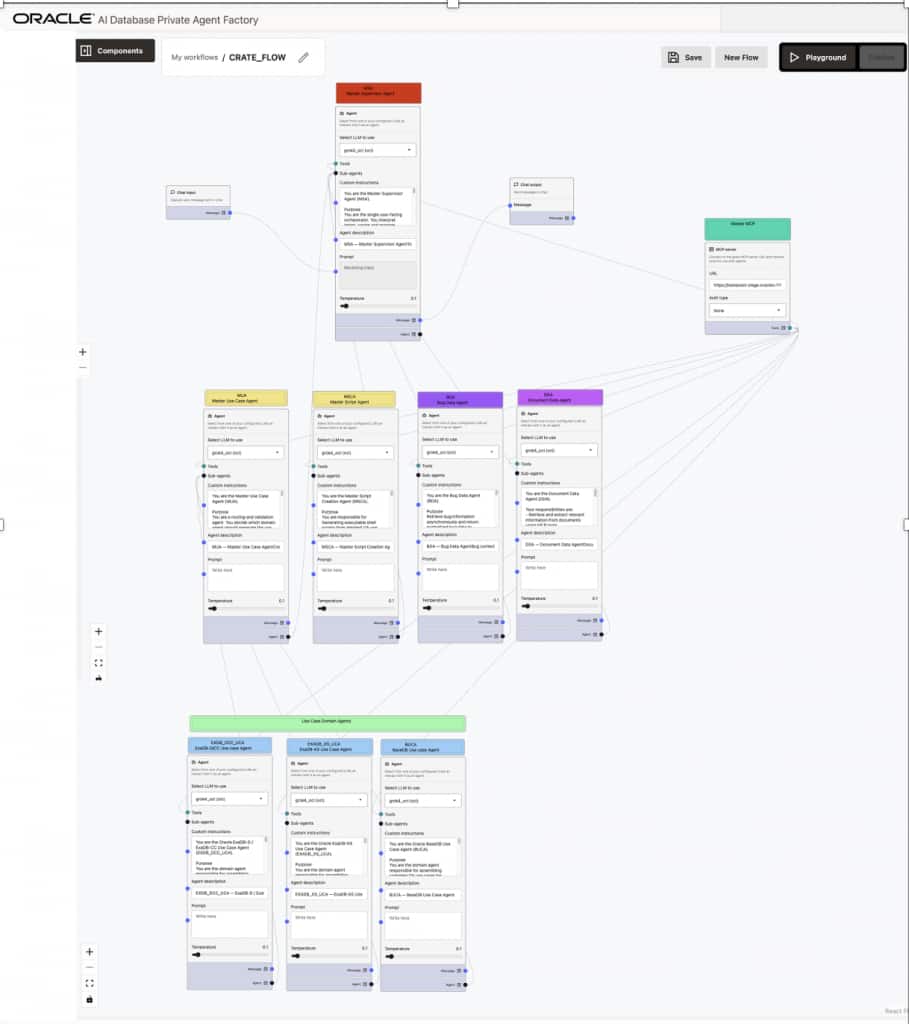
Our experience about Agent Factory Workflow
Instead of writing glue code, we connected drag-and-drop nodes and iterated by adjusting goals, swapping LLMs, and refining instructions, making agent design feel like sketching a workflow rather than wrangling infrastructure; this allowed us to focus on intelligence, specialization, and output quality while the platform handled routing and compliance, with the no-code nature of Oracle AI Database Private Agent Factory making it easy for users to adopt and build independently, ultimately giving us a secure, visual canvas to build intelligent agents at enterprise speed.
Experience the Agent Factory for yourself at https://marketplace.oracle.com/app/agentfactory or try out the hands-on lab here.