
Give enterprise applications a trusted natural-language front door with: optional LLM assistance, single sign-on, embeddable search, and tools for continuous improvement.
Enterprise applications often already contain the right reports, workflows, and pages. The problem is finding them.
Users may need to know an exact report name, navigation path, filter syntax, or internal business term. When they do not, they search through menus, ask an analyst for help, or open a support request. A simple question can become a slow and expensive exercise in application navigation.
Oracle Trusted Answer Search helps close that gap. It maps natural-language questions to curated application targets, including approved reports, URLs, and SQL-driven views. It can also resolve the validated inputs those targets require, such as a region, language, category, or time period.
The application remains in control of the destination and action. The user gets a faster, more natural way to reach it.
Oracle Trusted Answer Search 26.2 expands this approach with optional LLM-powered input extraction and re-ranking, single sign-on, an embeddable search widget, support for OCI-hosted LLM models, and richer tools for understanding and improving search behavior.
Curated actions, not improvised answers
Trusted Answer Search is designed for application experiences where predictable outcomes matter. Instead of generating a free-form response, it retrieves from a constrained set of curated search targets and returns structured metadata that the application can use to open the appropriate page, render an approved report, or run a governed view.
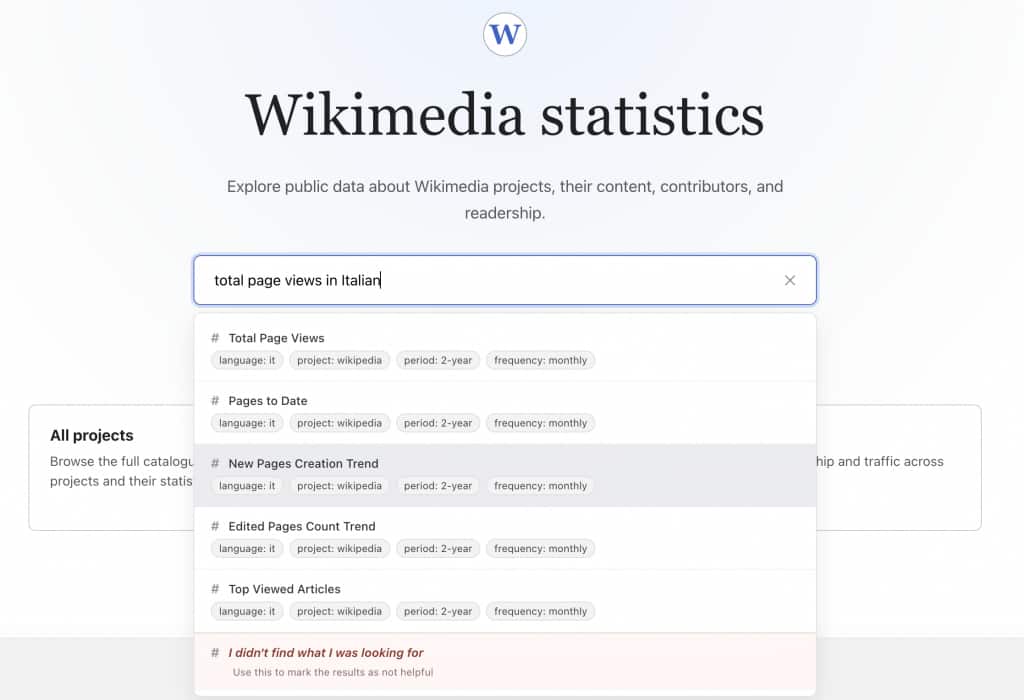
Consider a user asking a Wikimedia analytics application for “total page views in Italian.” Trusted Answer Search can identify the appropriate report and resolve controlled inputs such as language, project, period, and frequency. The application can then take the user directly to the relevant Wikimedia Statistics view.
The same pattern can apply to many enterprise domains. A finance employee could ask for quarterly operating-expense variance by cost center. A field-service manager could request open high-severity work orders for a territory. A banking user could look for a daily cash-position report for an approved account.
In each case, the application, not the language model, owns the final action and enforces the user’s existing permissions.
Turn existing application investments into easier self-service
For many enterprises, the strongest business case for natural-language search is not creating another source of answers. It is making existing, governed capabilities easier to use.
Trusted Answer Search gives applications a natural-language front door. Users can describe what they need in familiar language, and the application can route them to a curated destination with validated inputs. This can help organizations:
- Increase adoption of existing reports, workflows, and application capabilities
- Reduce “where do I find this?” support requests and routine analyst assistance
- Shorten the time between a business question and the appropriate action
- Improve self-service without requiring users to learn application-specific terminology
- Add a modern search experience without rebuilding the underlying application
- Preserve established permissions, business rules, and governance
This is especially valuable in complex, high-value systems where the correct action already exists but is difficult to discover. Rather than trading control for convenience, teams can improve usability while keeping results tied to approved application behavior.
What’s new in Oracle Trusted Answer Search 26.2
Authenticate through single sign-on
Trusted Answer Search 26.2 supports sign-in through the configured single sign-on identity provider. Organizations can provide a more seamless user experience while aligning access with their existing identity-management approach.
Use LLMs to extract target inputs
Enterprise actions frequently require specific inputs: a region, company, product category, date range, person, or another domain-specific value. In 26.2, teams can use a configured LLM to extract target-action input values from natural-language questions.
The extracted values are used within the application’s configured target-and-action model. This gives teams a flexible option for interpreting more complex inputs while keeping the resulting action grounded in a curated target.
Improve relevance with LLM-based re-ranking
Trusted Answer Search combines semantic and lexical retrieval to identify relevant curated targets. With 26.2, administrators can optionally use an LLM to re-rank retrieved candidates and improve relevance within a search space.
The system still returns curated search-target metadata rather than an unconstrained generated answer. Teams can apply LLM assistance where it adds value while retaining the predictability of controlled outcomes.
Configure supported OCI-hosted LLM models
26.2 adds support for configuring supported OCI-hosted LLM models for Trusted Answer Search-assisted workflows. Administrators can use configured models for capabilities such as target-input extraction and relevance re-ranking.
Embed search in an existing application
The Trusted Answer Search widget makes it easier to add natural-language search to an existing application. Teams can embed a ready-to-use search experience without building the complete interface from scratch.
Organizations can also use the packaged portal experience or integrate through APIs when they need greater control over the user experience.
Continuously improve search quality
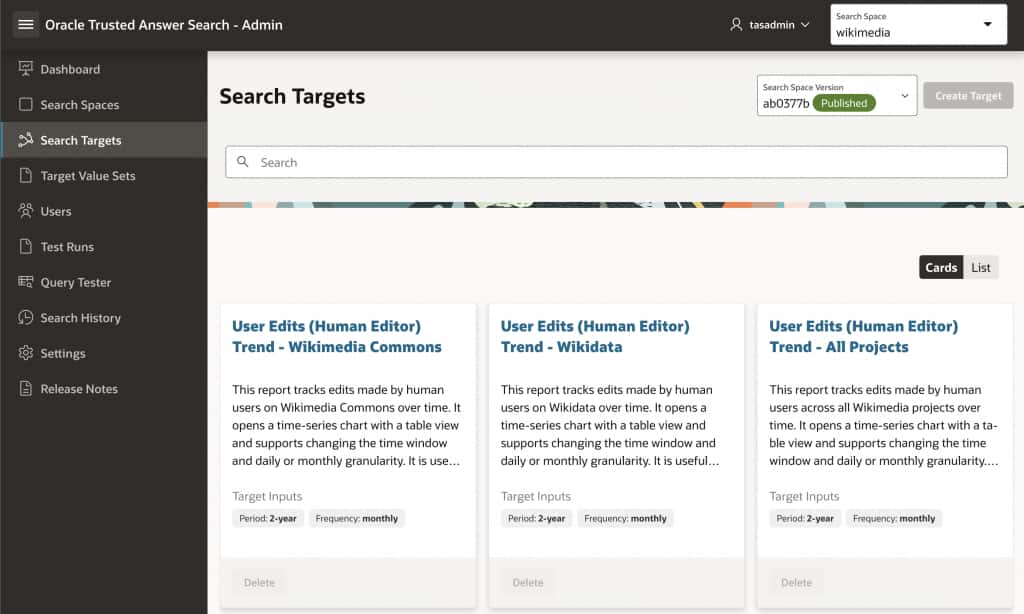
Search quality is an operational practice, not a one-time configuration task. Trusted Answer Search 26.2 helps teams validate behavior with repeatable question sets and use telemetry to understand real-world search activity.
Together with expert feedback, search-space versioning, regression analysis, and staged testing, these capabilities create a structured improvement loop:
- Observe how users search.
- Identify unsuccessful or incorrectly ranked results.
- Refine curated targets, descriptions, sample questions, or value sets.
- Test the changes against repeatable questions.
- Promote a validated search-space version.
This gives teams a measurable way to improve relevance while controlling how changes reach production.
Choose the right amount of AI for each workflow
Trusted Answer Search does not require every question to become a generative-AI task. Teams can use Oracle AI Vector Search and lexical retrieval for fast, controlled matching, then selectively apply an LLM for input extraction or candidate re-ranking.
That flexibility matters in enterprise environments. Some workflows benefit from additional language understanding. Others prioritize predictable behavior, low latency, or reduced model usage. Trusted Answer Search allows teams to choose the appropriate approach while keeping the final result connected to a curated application target.
Built for enterprise application teams
Trusted Answer Search supports the different roles involved in operating an enterprise search experience:
- End users search in natural language and provide feedback.
- Search-space experts curate targets, descriptions, sample questions, and controlled values.
- Administrators manage users, versions, models, tests, and rollout.
- Developers integrate search through the portal, widget, or API.
The result is a search experience designed to be accurate, controlled, adaptable, measurable, and easier to integrate into existing applications.
Get started with Trusted Answer Search 26.2
Oracle Trusted Answer Search 26.2 is available for teams building dependable natural-language access to enterprise reports, pages, and workflows.
Explore the product page: https://www.oracle.com/database/trusted-answer-search/
Read the documentation: https://docs.oracle.com/en/database/oracle/oracle-database/26/otasc/
Try the LiveLab: https://livelabs.oracle.com/ords/r/dbpm/livelabs/view-workshop?wid=4388