

Guest Author: Can Mingir, CEO, GreyCollar.ai
If you build event-driven systems, you know the usual tradeoff. Message brokers like Apache Kafka give you pub/sub, but are one more distributed system to own.
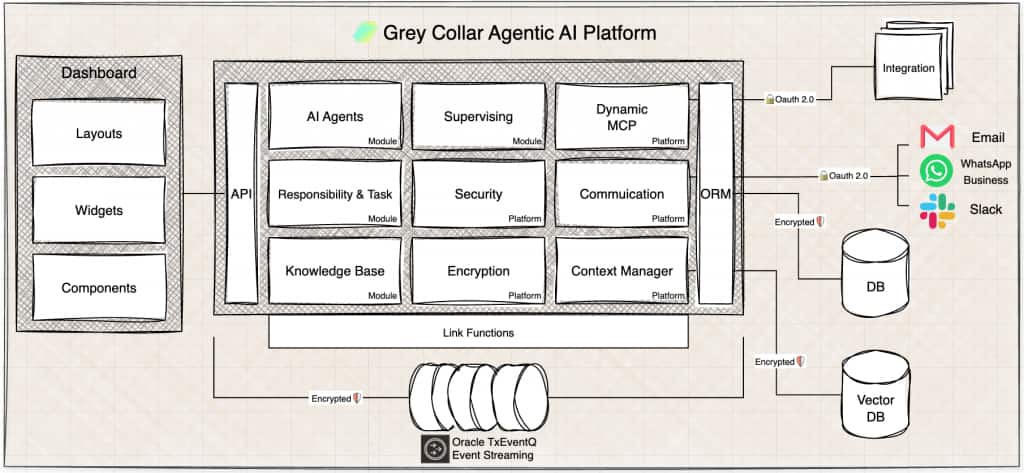
Many teams struggle with this operational overhead, which was the problem GreyCollar needed to solve. About GreyCollar.ai: GreyCollar is a supervised enterprise AI platform for internal business operations, enabling Human-AI collaboration. AI agents follow “Blueprints,” which are defined as business process flows with a knowledge base. Hallucination Control detects ambiguity or uncertainty during task execution. When identified, the supervised AI platform escalates the task to a human supervisor for guidance, allowing the system to continuously learn and expand its knowledge base for similar future workloads.
Apache Kafka works for this architecture, but it also meant GreyCollar needed to manage a separate streaming stack alongside their database which already held the system of record.
The extra moving parts impeded operations for the engineering team, especially when application logic needed to keep events and business state in transactional sync.
This is where Oracle AI Database Transactional Event Queues (TxEventQ) turned out to be a better fit.
The short version
GreyCollar replaced Apache Kafka with TxEventQ without rewriting the application architecture.
- it kept the event-driven model the team already liked
- it removed the need to run a separate Apache Kafka cluster
- it let messaging happen in the same transactional boundary as database inserts and updates
The key here is that this isn’t a “switch messaging vendors” story. It’s a story about collapsing unnecessary infrastructure while maintaining the existing programming model.
Apache Kafka APIs, but your database is the broker
One of the biggest reasons teams hesitate to move off Apache Kafka is simple: they do not want to throw away tooling, patterns, and code.
TxEventQ makes that conversation easier because it supports familiar Apache Kafka-style messaging patterns inside Oracle AI Database, including pub/sub workflows, multiple producers and consumers, partitioned queues, and JSON payloads. For GreyCollar, the Apache Kafka-compatible APIs reduced migration friction. The main difference is that the broker is in the database rather than in a separate cluster you have to provision, operationalize, and babysit.
Less operational overhead because there is no separate cluster to run
This is the part people tend to underestimate until they have to own it in production.
Apache Kafka is not just an API. It is also cluster management, networking, monitoring, scaling, security, upgrades, partition planning, and troubleshooting another system when something gets slow at 2AM.
GreyCollar had that same burden. Apache Kafka handled inter-agent messaging, but it also introduced duplicated infrastructure and a split architecture:
- streaming lived in one platform
- transactional data lived in another
- engineers had to keep both healthy and keep them aligned
TxEventQ simplified that model by moving event streaming into Oracle AI Database itself:
- no separate broker cluster to deploy
- no extra streaming layer to scale independently
- fewer components to monitor and secure
- fewer places where data and events can drift apart
For a team building an agentic platform, that is not just an efficiency gain. It is focus. Engineering time goes back into workflow logic, observability, and product behavior instead of broker operations.
Transactional messaging is the feature that changes the architecture
The strongest technical argument for TxEventQ is not just convenience: it’s transactional messaging.
With TxEventQ, you can publish a message in the same atomic operation as a database insert or update. In plain terms: if you write the business state, you can enqueue the event in the same transaction. They succeed together or fail together.
That solves a very real problem in event-driven systems.
If your application updates an order record and then publishes an event through a separate broker, you now have a coordination problem. What happens if the database write succeeds but the event publish fails? What happens if the event is published but the state change rolls back? Now you are building retries, outbox patterns, reconciliation jobs, and a bunch of extra logic just to restore consistency.
Greycollar’s platform is exactly the kind of system where this matters. Agents are coordinating real workflow state. If one agent says a task moved to the next stage, that event has to match what was committed in the system of record. Transactional messaging removes a whole category of dual-write failure modes.
That is the technical benefit in one line: the event is no longer adjacent to the transaction. The event is part of the transaction.
Why migration was low friction
GreyCollar had already made a great design decision before TxEventQ entered the picture: Its messaging layer was abstracted behind an adapter interface with dependency injection.
That meant Apache Kafka was not hardcoded into the business logic. It was just one implementation.
When the team evaluated TxEventQ, they were able to do it the right way:
- review the existing event topology
- validate topic and partition requirements
- confirm payload and throughput expectations
- implement a TypeScript TxEventQ adapter
- swap the backend without rewriting application code
This is the pattern other teams should notice. If messaging is isolated behind a stable contract, changing the backend becomes much less risky. GreyCollar did not need to rethink how its agents collaborate. It just replaced the plumbing with something that better matched the rest of its stack.
Why this matters for agentic systems
Agentic systems make messaging more important, not less.
Once you have multiple agents reasoning, calling tools, updating shared context, and handing work to each other, messaging becomes part of the execution model. How you implement it affects latency, retries, auditability, correctness, and cost.
That is what makes GreyCollar’s design choice interesting. In an agentic platform, the queue is not just a transport layer. It is part of how work gets coordinated and how application state stays trustworthy. TxEventQ gave GreyCollar a way to keep asynchronous coordination without introducing another system that had to be kept in sync with the database.
Takeaway
GreyCollar did not move to TxEventQ because “database messaging” sounded novel. It moved because the engineering tradeoff was better.
The team kept an event-driven architecture and a familiar developer model. It avoided the cost of operating a separate Apache Kafka cluster. And it gained something an external broker cannot naturally give you: the ability to publish messages as part of the same atomic operation as your data changes.
If your application already depends on Oracle AI Database as the system of record, TxEventQ is often a direct architectural simplification. GreyCollar’s experience shows what that looks like in practice.
- https://greycollar.ai/
- Learn more: https://www.oracle.com/database/advanced-queuing/
- Oracle Documentation: https://docs.oracle.com/en/database/oracle/oracle-database/26/adque/aq-introduction.html
- Developer Guide: https://oracle.github.io/microservices-datadriven/transactional-event-queues/
- Code Samples: https://github.com/oracle/spring-cloud-oracle/tree/main/database/starters/oracle-spring-boot-starter-samples
If you want to reach us, please contact support: https://support.oracle.com/ (Product – Oracle Database – Enterprise Edition, Problem Type>Information Integration>Advanced Queuing. (mention TxEventQ in the description).