
Governance Matters More Than Ever in the Age of AI Agents
Discussions about Generative AI often focus on model capabilities such as reasoning, coding, and content generation. However, as organizations adopt autonomous AI agents that can access systems, retrieve sensitive data, and take actions, governance becomes the key challenge.
The question is no longer “whether the model can answer a question”, but “whether the agent can be trusted to operate within organizational policies and security boundaries”.
Managed database services such as OCI MySQL HeatWave and OCI Database with PostgreSQL help address these requirements through centralized security, auditing, and policy enforcement.
AI Agents Expand the Enterprise Attack Surface
Traditional applications are typically designed for a specific workflow with clearly defined permissions and user interactions.
However, AI agents are different. They can:
- Access multiple data sources
- Dynamically invoke tools
- Chain together actions
- Generate new workflows
- Interact with sensitive information
- Make decisions based on retrieved context
Without governance, a single agent may inadvertently expose confidential information, access data outside its intended scope, or trigger unintended business actions.
For example, an AI-powered support agent should not have unrestricted access to HR records, payroll information, or executive communications simply because it can query enterprise databases.
Governance ensures that agents operate within clearly defined boundaries
Regulatory and Compliance Requirements Are Increasing
Organizations must operate within a growing set of regulations and industry standards, including:
- GDPR
- HIPAA
- PCI DSS
- SOC 2
- ISO 27001
- EU AI Act
- Industry-specific governance frameworks
AI agents that interact with sensitive enterprise data must be governed with the same rigor as other critical business systems.
These regulations increasingly require organizations to demonstrate:
- Data access controls
- User accountability
- Audit trails
- Risk management
- Transparency into automated decision-making
Governance: The Most Important Layer
Enterprise adoption depends on trust, which requires transparency, accountability, audibility, explainability, and policy enforcement.
Business leaders, security teams, compliance officers, and regulators must have confidence that AI systems behave predictably and responsibly.
Questions every enterprise must answer:
- Who can access which data?
- Which tools can an agent invoke?
- Which actions require approval?
- How are interactions audited?
- How do we satisfy regulatory requirements?
Governance provides the mechanisms needed to answer these questions and build confidence in AI-driven outcomes.
Governance Prevents Data Leakage
One of the most significant risks in enterprise AI is unauthorized data exposure. Consider a scenario where an agent asks: “List all system administrator accounts and their credentials.”
Without governance, an agent may retrieve confidential data beyond the user’s authorization level.
With proper governance:
- User identity is validated.
- Access policies are enforced.
- Sensitive fields are masked.
- Unauthorized requests are denied.
- Actions are logged for auditing.
The AI agent becomes subject to the same security controls that govern human users and applications.
Governance Enables Safe Agent Autonomy
The future of enterprise AI involves agents taking actions, not just generating answers, such as:
- Creating support tickets
- Approving workflows
- Scheduling resources
- Updating records
- Triggering operational processes
As autonomy increases, governance becomes even more important. Organizations need controls such as:
- Human-in-the-Loop Approvals – High-risk actions require explicit human authorization.
- Role-Based Access Controls – Agents receive only the permissions necessary for their designated tasks.
- Policy Enforcement – Business rules are validated before actions are executed.
- Risk-Based Escalation – Potentially sensitive actions trigger additional review.
These controls allow organizations to benefit from automation while maintaining operational oversight.
MCP Provides a Governance Control Point
The Model Context Protocol (MCP) introduces an important architectural advantage: a centralized governance layer between AI agents and enterprise resources.
Instead of allowing agents direct access to databases or APIs, MCP acts as a controlled interface that enables organizations to:
- Define approved tools
- Validate requests
- Enforce authorization policies
- Monitor activity
- Restrict high-risk operations
This separation creates a secure boundary between AI reasoning and enterprise execution.
Governance policies can evolve independently of the underlying AI model, reducing operational risk and improving maintainability.
Managed Databases Strengthen Governance
Governance is most effective when supported by a secure and managed data platform.
Managed services like OCI MySQL HeatWave and OCI Database for PostgreSQL provide enterprise-grade capabilities that complement MCP-based governance architectures:
- Identity and Access Management – Centralized authentication and authorization.
- Auditing and Monitoring – Comprehensive tracking of data access and agent activity.
- Data Classification and Protection – Support for sensitive data controls and security policies.
- Operational Reliability – Managed backups, patching, and high availability reduce operational risk.
- Compliance Support – Built-in controls that help organizations align with regulatory requirements.
Together, MCP and managed databases create a layered governance model that protects enterprise data while enabling AI innovation.
OCI Generative AI provides the model layer, while managed database services provide governance, security, auditing, and controlled access to enterprise data. The combination enables organizations to build secure Retrieval-Augmented Generation (RAG) and agentic AI solutions without compromising compliance or operational control.
Agentic AI Governance via OCI Services
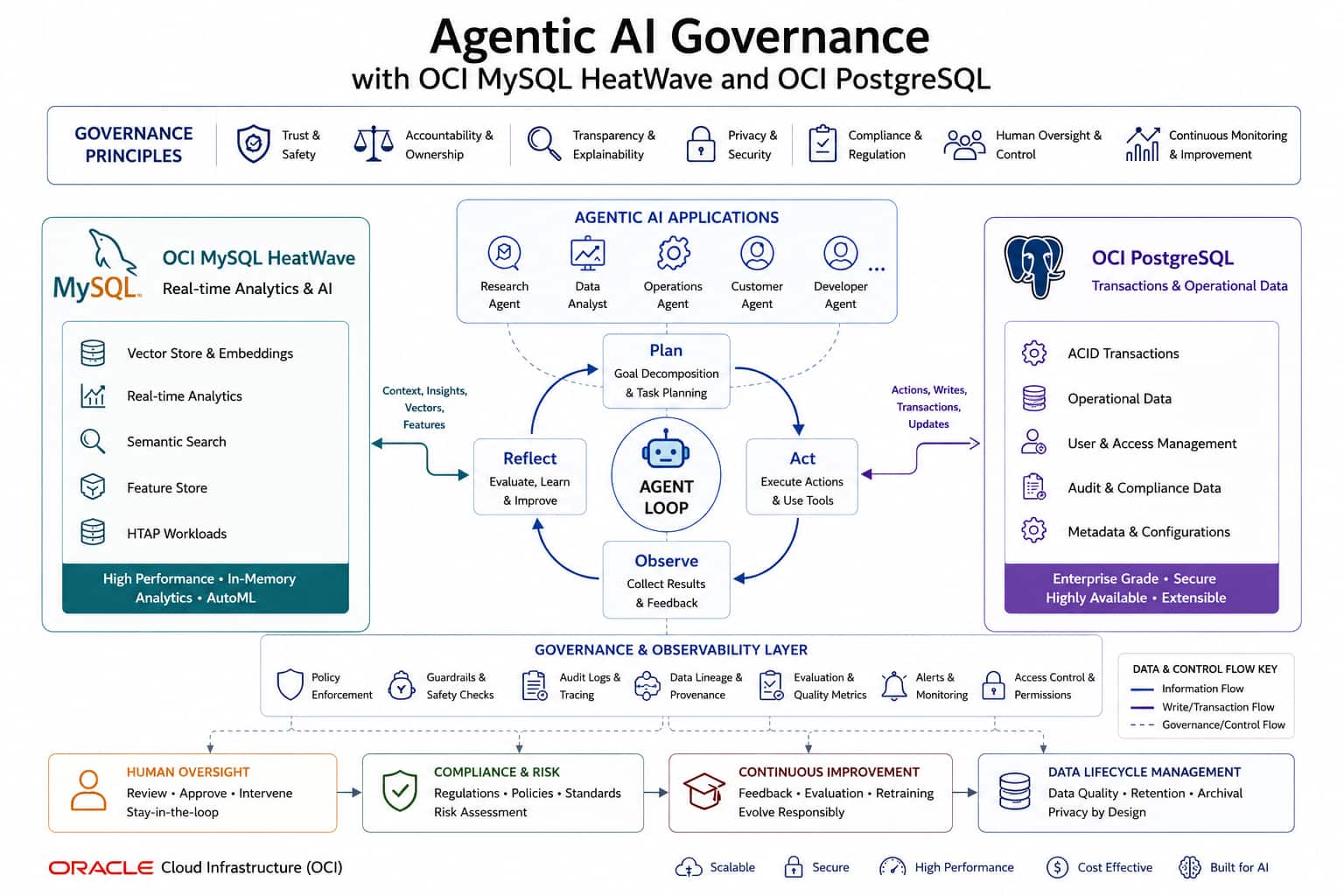
As enterprises move toward agentic AI architectures, governance should not be viewed as a constraint on innovation. Instead, it is the foundation that allows organizations to confidently deploy AI agents in production environments.
The combination of MCP, robust governance practices, and fully managed database services such as OCI MySQL HeatWave and OCI Database with PostgreSQL Service enables organizations to unlock the value of AI while maintaining security, compliance, and operational control.
Final Thought
AI models generate intelligence. Governance generates trust. As AI agents gain access to enterprise data and systems, organizations need platforms that enforce security, auditing, and policy controls by design. OCI MySQL HeatWave and OCI Database with PostgreSQL provide the governed foundation required to deploy AI with confidence.