

How Oracle Autonomous AI Lakehouse and Oracle Cloud Infrastructure make racing footage searchable by meaning
Oracle Red Bull Racing’s media and production teams need a way to quickly identify top video clips within their 10-year archive of Formula 1™ video using natural language. They don’t want to rely on folder structures, file names, and catalogue metadata to locate assets – and then review the asset to identify the exact clips they need. Instead, they want to be able to ask a simple question about people, moments in races or celebrations, and sponsorship impacts and be shown the top playable clips for each request – allowing them to become dramatically more productive and rapidly respond to request from sponsors and the media.
To address these needs, Oracle has used the built-in AI Vector Search available in Oracle AI Lakehouse to develop a solution that enables natural language querying of the 22 Tbytes of video assets archived from previous Formula 1™ seasons stored by the Oracle Red Bull Racing video archive on Oracle Cloud Infrastructure (OCI). The AI Lakehouse is the system of record for vectors, metadata, entitlements, and associated metadata for the archive, with every second of video having its own vector embedding that represents the semantic meaning of that clip.
Every season, Oracle Red Bull Racing captures an enormous amount of video. Across ten seasons, the Oracle Red Bull Racing archive has grown to an estimated 80–90 TB. Its value is not the raw footage; it’s the ability to find the right moment in seconds: a podium celebration, the fastest pit stop of the year, a driver in the garage, or a clear shot of a partner logo on the car. The Oracle AI Database foundation of Oracle AI Lakehouse makes this possible.
OCI provides the cloud foundation for the Oracle Red Bull Racing media manager, storing raw video in Object Storage, vector embeddings and associated metadata in Autonomous AI Lakehouse, and using NVIDIA GPUs to accelerate the video enrichment with NVIDIA VSS and vector index build stages of the process using NVIDIA cuVS. Retrieval, searching, and data governance are the responsibility of the AI Lakehouse.
See it in action
Oracle Red Bull Racing media search environment.
The business challenge: an archive you cannot search
Today, finding a moment in the archive takes a lot of manual work by the Oracle Red Bull Racing media team. The footage lives in OCI Object Storage and is reached through a media-collaboration file system that is fast to open but has no way to search by meaning. Teams browse filenames and folders or rely on tags applied by hand. You cannot ask for “a podium celebration”; you must already know the file or have labelled it in advance. With an estimated 80–90 TB of video spanning ten seasons, that approach no longer scales.
Four needs stand out:
- Find clips based on meaning, not by file name—for example, “mechanics changing tires at a pit stop,” rather than a catalogue card number (an internal asset identifier).
- Know who, what, and where—identify approved people, partner logos, actions, and locations or race moments where the evidence supports them.
- Answer questions with evidence—every result should lead back to a source clip that a person can play.
- Find results quickly and accurately—make relevant footage practical to discover during time-sensitive media and sponsor requests.
The technical goal: make natural language search available to everyone
Prior to the development of this system, tags had to be applied by hand in the media manager and searching for video clips was manual. People doing a search had to have a high level of knowledge about where data should be located, limiting the number of searches the team could complete per day. There was no way to automatically recognize what was in a frame or measure partner exposure.
In addition, search meant browsing filenames, folders, and hand-applied tags in the media file system. There was no natural-language query, no understanding of what was in a frame, and no way to identify people or measure partner exposure automatically.
The goal of the project is to have the Oracle Red Bull Racing media team describe what it needs in plain English, with Oracle AI Database’s AI Vector Search capabilities identifying the relevant clips, including people identification, partner screen-time analytics, and grounded questions and answers that link back to source footage. The solution should measure search latency, accuracy, capacity, and operational value against the current manual process.
The solution: enrich once, search live – with Autonomous AI Lakehouse at the center
The updated media management system employs a two-step process. First, a background media enrichment pipeline makes selected content machine-understandable. Second, a live, meaning-based natural language query experience uses Autonomous AI Lakehouse to retrieve relevant, authorized evidence. Separating enrichment from serving keeps the search experience available while new footage is processed.
During enrichment, NVIDIA GPUs on OCI accelerate vision-language processing, including frame descriptions, sponsor-logo detection, and key-moment tagging. Face recognition can identify approved people against an enrolled gallery. Oracle Private AI Services Container creates embeddings from the generated captions. The pipeline then stores captions, vectors, people information, sponsor evidence, and related metadata in Autonomous AI Lakehouse.
For a live search, a user submits a natural language query. Oracle AI Database manages the creation of the query embedding with the Private AI Services Container, and Oracle AI Vector Search finds, reranks, and de-duplicates relevant clips in the database. From one OCI-based console, the solution enables the production team to:
- Search the archive by meaning using natural language and jump straight to the timecode.
- Find people: searching for a driver returns clips where that person was recognized by face, not merely look-alikes.
- Measure partner exposure: on-screen minutes and share-of-voice per brand.
- Ask questions: grounded recaps and Q&A with citations to source clips.
- Analyze any clip on demand for an immediate description.
The architecture: Autonomous AI Lakehouse as the system of record
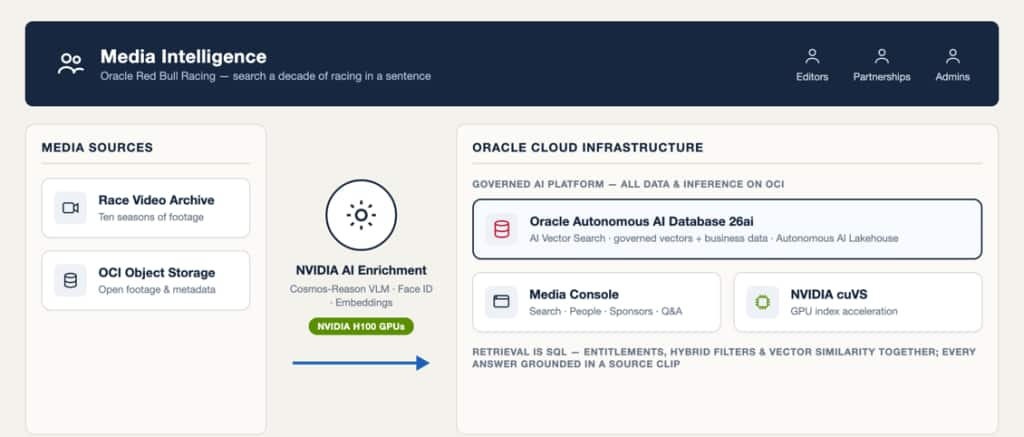
High-level solution architecture — media sources are enriched on NVIDIA GPUs, while AI Vector Search and metadata retrieval, and serving run in Autonomous AI Lakehouse on Oracle Cloud Infrastructure.
Many retrieval systems move embeddings into a separate vector database, fragmenting the system: vectors sit in one service while business records and access controls sit in another. This platform keeps retrieval database centric. In Autonomous AI Lakehouse, VECTOR data resides alongside relational rows, JSON, metadata, and governance, so retrieval is a single SQL operation that applies user entitlements, combines structured filters with vector similarity, and returns only authorized evidence for a grounded answer.
In Oracle Red Bull Racing’s enhanced media management system, the media assets remain in OCI Object Storage in open formats, while Autonomous AI Lakehouse manages vectors, structured metadata, entitlements, and AI Vector Search, becoming the system of record for retrieval, governance, and serving.
Why Oracle Autonomous AI Lakehouse and OCI
Keeping vectors, business data, and governance together in Autonomous AI Lakehouse rather than in a separate vector store gives Oracle Red Bull Racing a single, trusted control point. Answers respect row-level security, join against live records, and stay current, because retrieval is SQL over data the organization already governs. And because every component runs on OCI – Autonomous AI Lakehouse, the Private AI Services Container, and the GPU endpoints – acceleration happens without moving data out of the cloud of record: no cross-cloud egress, no second copy of sensitive content, and no separate trust boundary to manage.
Scaling to the full archive
Because Oracle AI Vector Search HNSW indexes are held in memory, index size grows with the number of vectors and the selected index configuration. Capacity planning to support current as well as future seasons is therefore a critical requirement.
Autonomous AI Lakehouse can scale up on a node and scale out with RAC. The Oracle Red Bull Racing configuration is using high-performance CPUs and Exadata optimizations for the in-database path,. As capacity and refresh requirements grow, the architecture can scale database resources, partition workloads, adjust sampling or quantization, and use GPU acceleration for index builds where it is shown to help.
Beyond Oracle Red Bull Racing: a reusable pattern
The Oracle Red Bull Racing solution makes the value tangible, but the pattern is general. Organizations with large, growing, high-value media or knowledge estates need to make content searchable by meaning, keep it current, and link answers to governed, playable, auditable sources. Oracle AI Database and Autonomous AI Lakehouse on OCI provide the foundation, with NVIDIA GPU acceleration applied in targeted supporting roles.
Conclusion
This Oracle Red Bull Racing is designed to evaluate whether a decade of racing footage can be searched by meaning and linked to real, playable clips. Autonomous AI Lakehouse keeps vectors, governance, SQL-aware hybrid retrieval, and serving together on OCI; NVIDIA GPUs provide targeted acceleration for enrichment and index builds.
Forward-looking statements: This document may describe features and timing that are under development and subject to change. It is intended to outline product direction and should not be relied upon in making a purchasing decision. The development, release, timing, and pricing of any features described remain at Oracle’s sole discretion.