

Every AI agent is only as capable as the data it can access. If it depends on stale exports, disconnected silos, or data that must leave its secure environment before it can be useful, its value is already compromised. The real breakthrough in agentic AI is not just the model. It is bringing AI to the data, not forcing the data to move to the AI.
That’s exactly what Oracle is enabling with Oracle AI Database Private Agent Factory and Exadata Database Service for Developers: a practical path for teams to build, test, and validate enterprise-grade agentic applications on Exadata infrastructure without Oracle Database license costs for development and testing.
Bring AI to Your Data, Not the Other Way Around
The standard playbook for building AI applications often involves too much data movement: exporting data, pushing it into a vector store, chunking and embedding it, then relying on retrieval to be accurate enough. Each handoff introduces security risk, freshness issues, operational complexity, and engineering overhead.
With Oracle’s approach, your Exadata Database Service becomes the intelligent core of your agentic system. Vectors, JSON, unstructured data, relational records, and real-time transactional data all coexist in one place and your agents query, reason, and act on them without data ever leaving the perimeter. We are not shipping your data to the model. We are bringing AI directly to your data.
Oracle Agent Factory: Build, Connect, and Deploy
Oracle AI Database Private Agent Factory helps teams accelerate the creation of data-centric agents that are designed to work with governed enterprise data. Instead of starting from a blank orchestration layer, developers can use pre-built agents and visual tooling to connect agents directly to trusted data sources and business workflows.
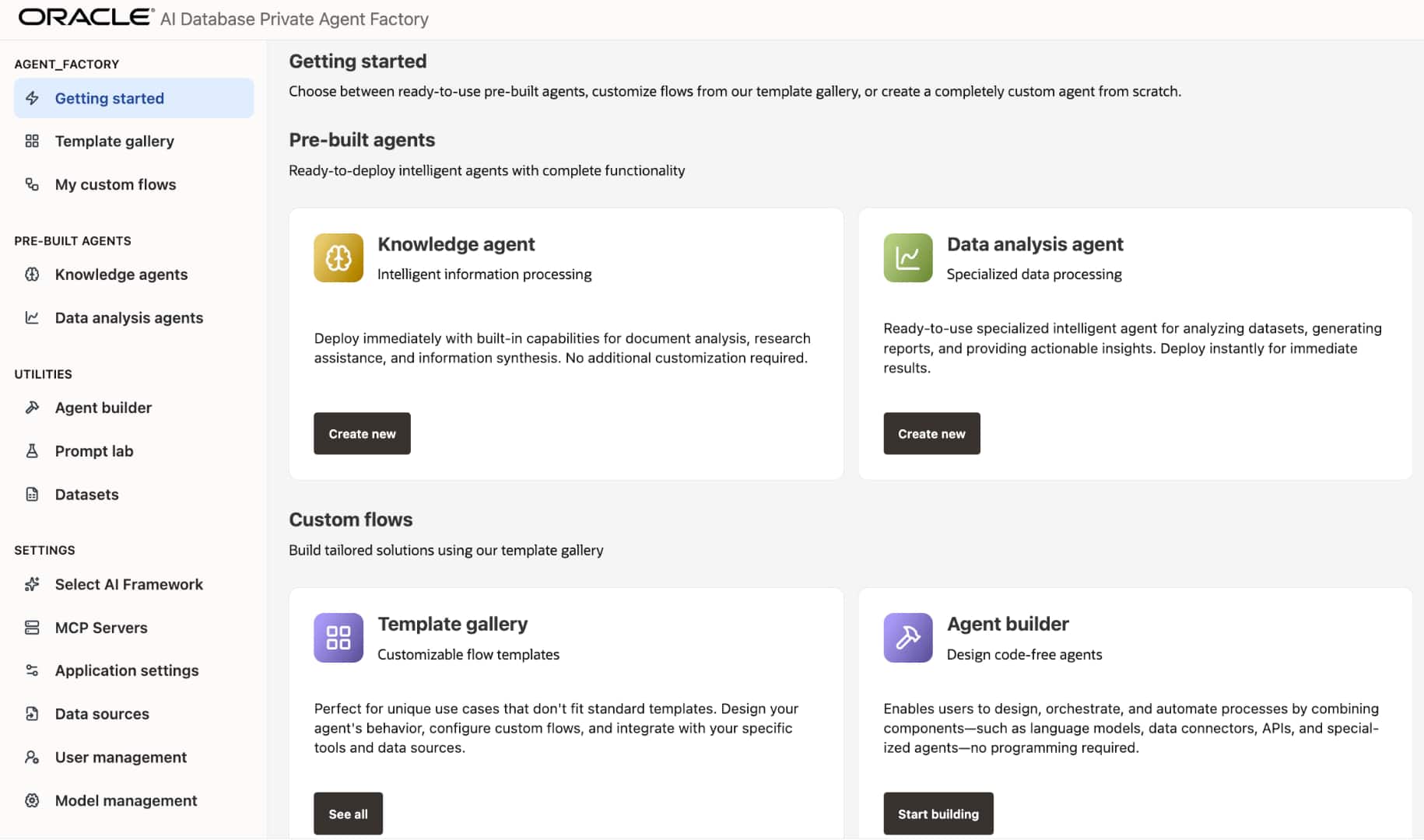
The Knowledge Agent turns your enterprise repositories and internal systems into an AI-powered assistant, delivering RAG in a box for the enterprise with access controls and auditability built in from day one and no external vector infrastructure required.
The Data Analysis Agent is designed for private, governed analytics over enterprise data. It connects directly to structured data in your Exadata Database Service instance, enabling users to ask complex analytical questions in natural language without moving, copying, or re-platforming the data. Because the agent works where the data already lives, organizations can preserve security, governance, and freshness while giving users faster access to trusted, conversational insight.
The Visual Agent Builder lets you design agent workflows by connecting components including tools, data sources, and reasoning steps without writing boilerplate orchestration code. Your enterprise data connects directly as a first-class input with no export, no transformation, and no migration required.
In-Database Vector Search at Exadata Speed
Oracle AI Vector Search is built directly into Oracle AI Database. Vector embeddings are stored alongside relational, JSON, and other enterprise data inside the database, enabling similarity search, hybrid SQL queries, and analytical workloads to run within a single converged data platform. This eliminates the need to copy data into a separate vector store, reduces cross-system round trips, and enables organizations combine semantic search with trusted business data using SQL .
That same converged foundation is what makes Oracle AI Database especially powerful for enterprise agents. It supports vectors, JSON, relational, graph, and spatial data in a single engine, whether deployed on-premises, on OCI, or across multicloud environments. Agents can access the full richness of the enterprise data model where it already lives, while Oracle’s security, governance, and performance controls help ensure consistent behavior across environments.
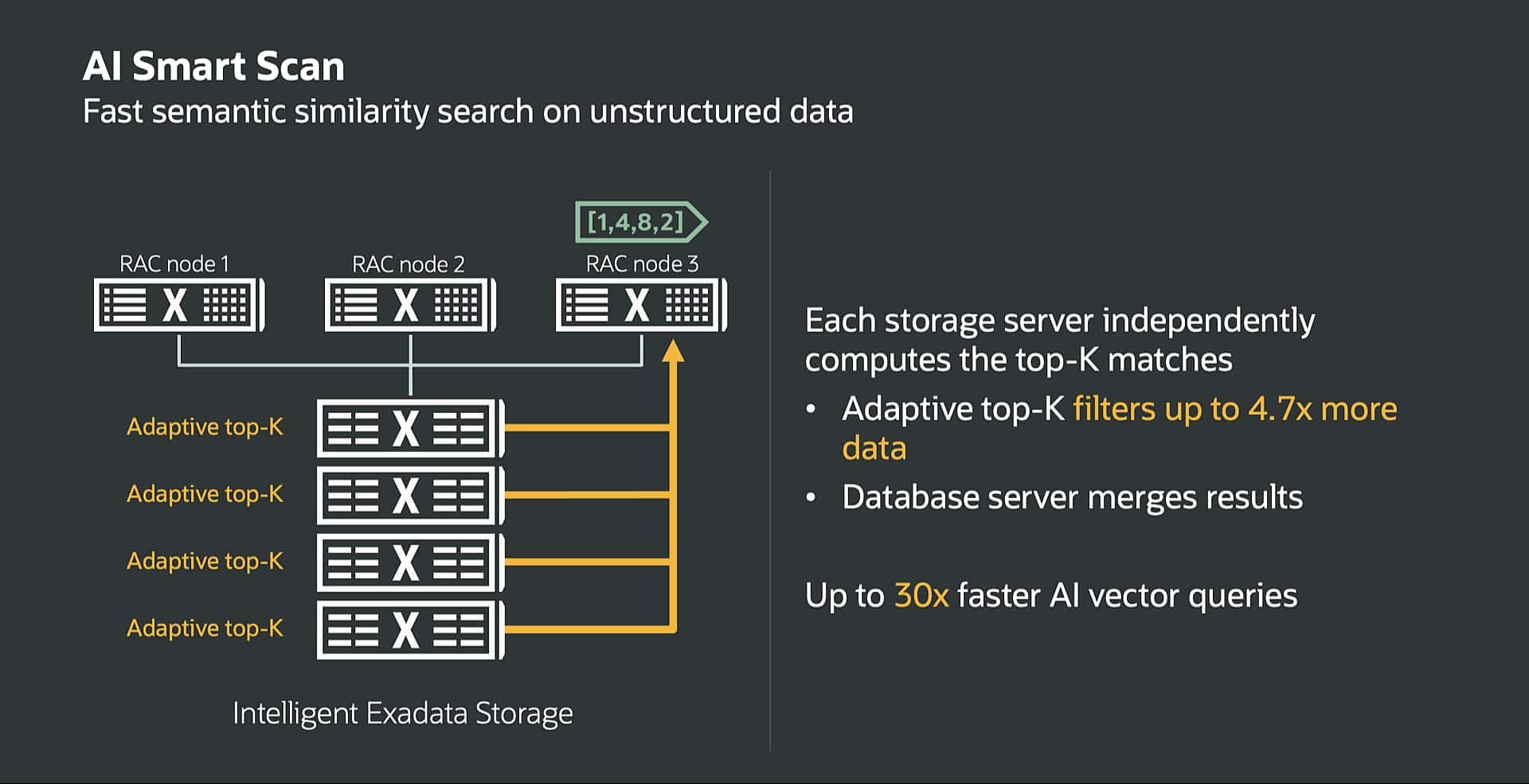
On Exadata, Oracle AI Vector Search runs even faster with AI Smart Scan, which pushes vector distance calculations and top-K search processing down to the storage tier. Offloading this work to Exadata storage servers cuts data movement, reduces query latency, and increases throughput for large-scale semantic search. Paired with Exadata RDMA Memory (XRMEM) and Smart Flash Cache, the architecture delivers high-speed parallel vector search across massive datasets while freeing database server resources for other workloads. The result is a faster, more scalable foundation for enterprise AI applications and RAG pipelines with retrieval happening right where the data lives.
Enterprise Exadata Now Free for Developers
The new Exadata Database Service for Developers gives teams a dedicated developer environment on Exadata Database Service on Dedicated Infrastructure, using the same Oracle Database and Exadata stack that powers enterprise production workloads. Developers can build and test with real Exadata capabilities, Oracle AI Vector Search, and Oracle’s converged database features with zero Oracle Database license cost. It is real Exadata for real development, without adding database licensing friction.
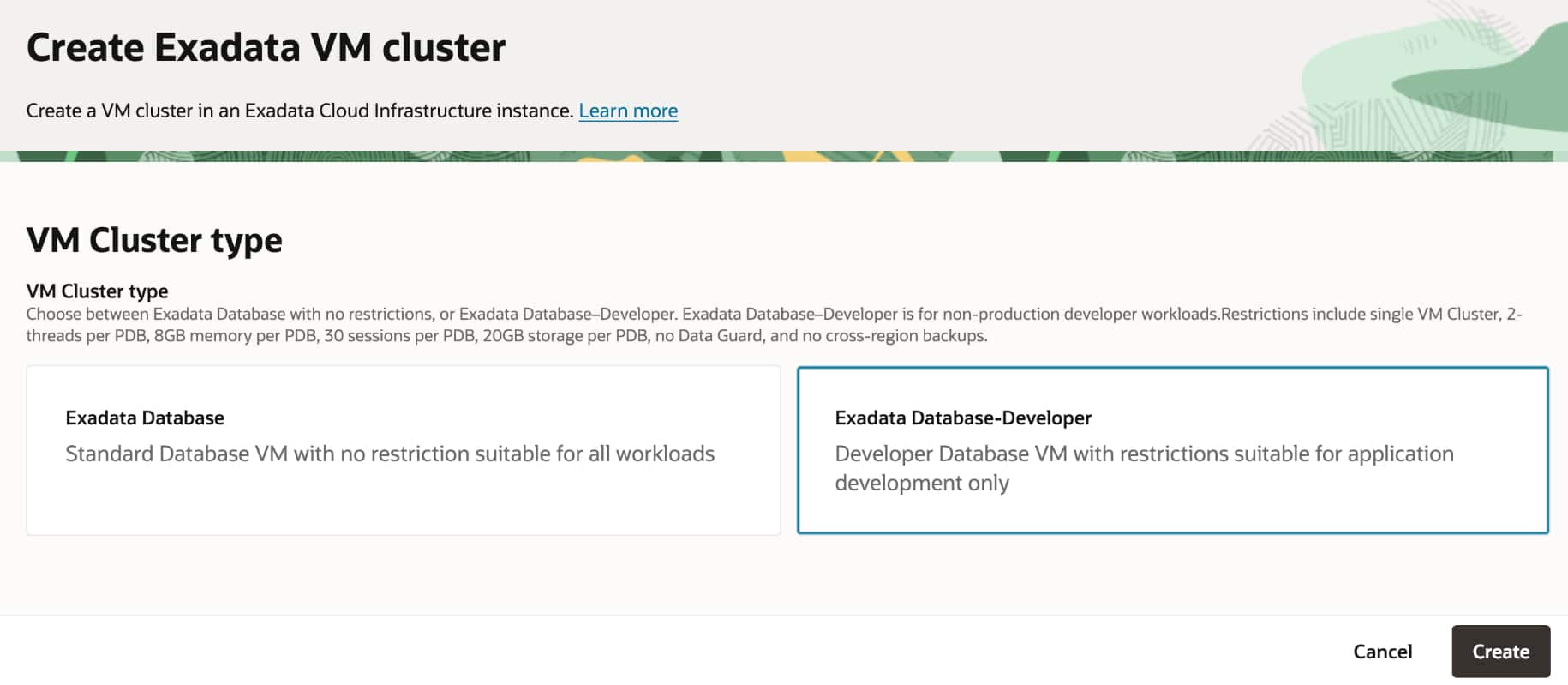
These zero-cost Oracle Database licenses are intended for development and testing only, not production workloads. Oracle applies per PDB resource limits on threads, memory, database size, and sessions to keep these environments scoped for developer use. Even within those limits, developers get access to most Oracle Database Enterprise Edition features and options, including Enterprise Manager Packs, Multitenant, and Advanced Security, so they can build, test, and validate applications on a stack that closely matches production.
The Data Advantage Is Now the Developer Advantage
Together, Oracle AI Database Private Agent Factory and Exadata Database Service for Developers make enterprise-grade agentic AI accessible from day one: pre-built agents, a visual builder, in-database vector search, and the full converged Oracle AI Database running on Exadata infrastructure. And for the first time, all of that starts at zero cost.
Get started with Oracle AI Database Private Agent Factory and provision your license-free Exadata Database Service for Developers instance to begin building agents where enterprise data already lives.
For more information
- Documentation: Exadata Database Service on Dedicated Infrastructure for Developers
- How-to Guide: Exadata Database Service for Developers
- Documentation: Oracle AI Database Private Agent Factory