
Deliver Fast, Accurate, and Secure Answers and take trusted actions using trusted data using natural language
Oracle today announced Trusted Answer Search, a platform that helps teams build natural-language interfaces for applications where answers must be accurate, secure, consistent, and fast. Many enterprise search problems on private enterprise data are application and domain specific and do not require the full generality of LLMs that traditional RAG-enabled chatbots use.
Introduction
Oracle Trusted Answer Search is a specialized LLM-free semantic search platform that helps applications reliably route questions to the right predefined target (a URL, a report, etc.)—continuously improved by human feedback and tracked using change management.
Trusted Answer Search maps end user questions in natural language (e.g., “Is the cash I added on Monday available now?” or “Show me the health of databases in the fleet” or “Set my Slack status to away”) to “match documents” (containing a target URL, a report, an action, etc. and any additional parameters) that applications can interpret—so the application can reliably render the right report or take the right action. The vision: enable end users (customers, the public, or the broader employee community) to get fast outcomes via natural language—without risking confidential data exposure or unpredictable responses.
The Problem
Traditional enterprise search approaches often create unacceptable tradeoffs:
Accuracy and predictability are non-negotiable for end-user experiences. Users need consistent, correct results, especially when the answer is tied to their identity – it would not be acceptable to have the possibility of leaking someone else’s data when a patient asks, “Show me my prescription medications”.
General-purpose LLM/RAG chat experiences can be costly and unreliable for bounded, application-specific questions. LLMs can hallucinate, introduce randomness, and may be slower and more compute-intensive than needed for many application interfaces.
Information is constantly being added. As teams add new information, refine match document descriptions, and respond to user feedback, the semantic mapping of questions to match documents can change—breaking previously good matches unless change is managed deliberately.
In short: organizations need a scalable way to give end-users natural-language access to trusted reports and actions—while maintaining correctness, safety, and operational control.
The Solution
Trusted Answer Search addresses these needs by combining Oracle AI vector search and information retrieval techniques with enterprise-grade workflows for correctness, security, and continuous improvement:
Maps natural language to a constrained set of curated descriptions using vector similarity and state of the art information retrieval. The curated descriptions are associated with a “match document”. The set of curated descriptions for a certain application is known as “Search Space”. Trusted Answer Search can manage many Search Spaces.
Returns an application-specific “match document” (JSON) rather than free-form text. The application then interprets the match document to take a deterministic next step—like opening a specific report, redirecting to a URL, or invoking an action with parameters. Since it is up to the application to interpret the match document, it makes Trusted Answer Search very flexible.
Supports value-specific answers to identify important values or value classes (e.g., dates, categories, names of entities) from the query and returns match documents that contain the extracted parameters. These can then be used by the application to direct the user to the page or report with the correct URL parameters.
Implements feedback and correction workflows so that Search Space experts can review incorrect matches, mark items as correct, propose new descriptions, or request new reports—creating a structured loop for improving quality over time.
Includes change management and versioning so teams can batch updates, trial changes with subsets of users, require approvals, and proactively detect match regressions caused by target description edits or new target additions.
Keeps data secure by design by relying on targets that are already built to honor end-user identity. Trusted Answer Search does not index or store the target documents themselves in any manner. It simply stores a URI to the targets.
Provides out of the box UIs for administrative users and end-users.
Provides an API for developers to build their own UI while leveraging the full capability of the Trusted Answer Search platform.
The result is a practical pattern for accurate, consistent, secure, and fast end-user experiences—where the app delivers trusted, data-driven outputs through reports and controlled actions, and the language layer improves continuously with human oversight.
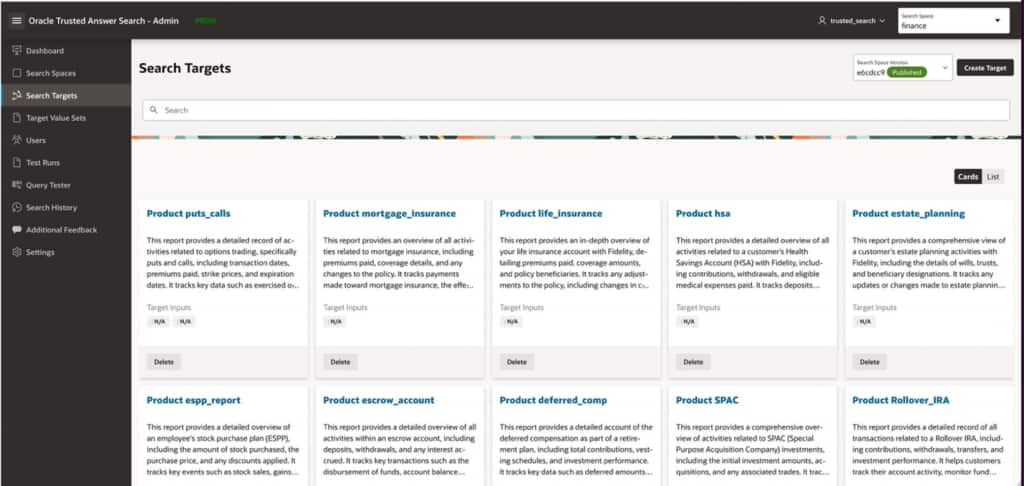
The setup includes a Search Space, that has several Search Targets (think of these as reports or data sources) that are made ready with information retrieval and context-driven techniques for the search to work deterministically. These are seen in the illustration below.
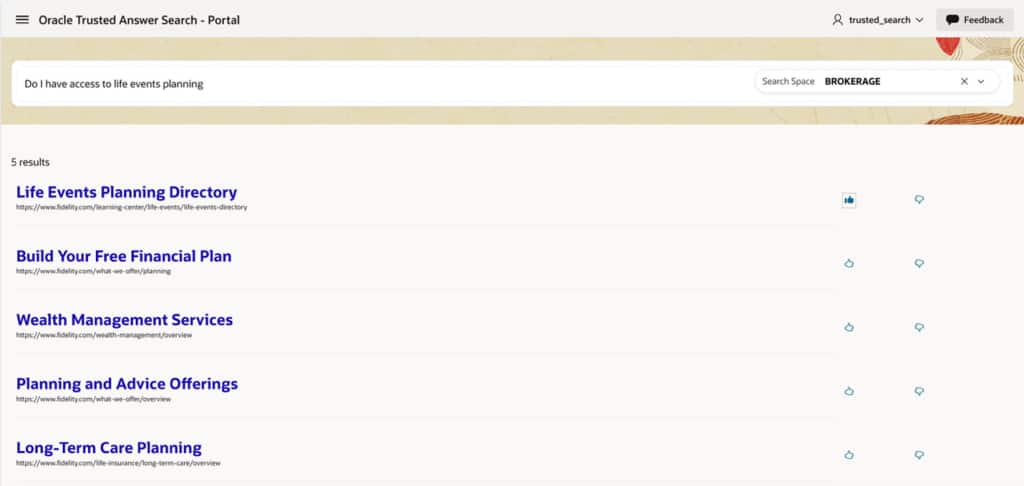
When asking a question, you can upvote or down vote a result, and the system will learn from that response, improving its search system. The illustration below captures this
Trusted Answer Search can be leveraged in different ways.
Using the GUI application:
Trusted Answer Search ships with 2 APEX applications: The Trusted Answer Search Administrator APEX application that is used by those administering the system, and the Trusted Answer Search Portal for end-users.
Using the API:
Developers who want to integrate Trusted Answer Search into their UIs or applications and who want more control of the look and feel will want to use the Trusted Answer Search API directly. This is a PL/SQL API.
Trusted Answer Search matches the provided natural language question to a set of curated natural-language descriptions. It returns the “match document” associated with the best matching description; the application then interprets that match document to open a report, navigate to a destination, or perform an action.
Trusted Answer Search returns the best-matched target document/resource
Trusted Answer Search returns a match document (JSON) that is specific to the application use case. The match document might include a report URL plus parameters, for actions, the action details and the action parameters. The application remains in control of what happens next.
Value Specific Answers
When configured correctly by the Search Space expert, Trusted Answer Search can identify parameters from the natural language question and include the parameters in the match document that is returned to the application. For example, in a question posed by a manager to a HCM application such as “What is my current PTO balance?”, the parameter might be the type of request. The following URL is an example of what might be returned by Trusted Answer Search to the application: https://hcm-app.enterprise.com/deeplink?objType=ABSENCE_BALANCE. Here ABSENCE_BALANCE is a parameter returned in the match document by Trusted Answer Search. The parameter is inferred by Trusted Answer Search based on the mention of “PTO” in the natural language query. Authorization is always enforced by the application (if the user does not have permission to view the PTO balance, the HCM app will prevent them from doing so).
Trusted Answer Search improves with user feedback
Trusted Answer Search records question history, match outcomes, and user feedback. Search Space experts can review incorrect matches and take structured actions: add descriptions to match documents, mark correct/ignored items or suggest new matches. Trusted Answer Search also scans historical questions when descriptions are changed to show the impact (good and bad) before rolling out a change.
Better than a generic RAG Chatbot
While LLMs/RAG are powerful for unbounded Q&A, they can be less suitable as an end-user interface when answers must be reliable, deterministic, and fast. LLMs can hallucinate, introduce randomness, and be slow. Trusted Answer Search focuses on reliably matching the user question to a constrained set of vetted descriptions and returning the corresponding match document to the application. The application can then reliably render the right report or take the right action based on the contents of the match document.
Benefits to Expect from Trusted Answer Search
- Faster access to the right page/report/action via natural language
- Consistent outcomes
- Better security posture because targets are vetted by the Search Space expert and the application is control of authorization.
- Lower operational risk via approvals, versioning, and regression visibility when language mappings change
Oracle Trusted Answer Search is a download package available with Oracle AI Database with instructions on how to install it with your Oracle AI Database 26ai. For more information visit the product documentation page or the product website.