
Last week our team attended DeveloperWeek 2026 to hear about some of the latest work across the AI landscape. One theme dominated nearly every conversation:
Security
Prior years focused on model performance and prompt engineering. This year the discussion shifted. Organizations are excited about agents, but they are asking a harder question:
Are agents using my data securely?
That question is more complex than it sounds. Security in the age of agents includes:
- Protection against data leakage
- Credential and API token management
- Securing the agent runtime
- Governing orchestration layers
- Controlling MCP servers and tool integrations
- Model governance (which models are allowed, and where)
- Auditability of deployments and changes
And the list keeps on growing.
Meanwhile, many early agent experiments are happening on laptops. A developer installs an agent framework, pastes in a personal API key, uploads corporate documents, and connects it to internal systems.
It works… Until it doesn’t.
Corporate data is sent to third-party tools. Tokens live in environment variables. Permissions are overly broad for convenience. No one tracks which agents are deployed, where they run, or what data they can access.
For large organizations running mission-critical systems on Oracle AI Database this model is a non-starter.
These are precisely the challenges Oracle AI Database Private Agent Factory was designed to address.
The Enterprise Gap in Today’s Agent Landscape
Agents are powerful because they reason across your data, call tools, and take action autonomously.
But autonomy without governance introduces risk.
Let’s make this concrete with a practical example: an AWR Analysis Agent.
The AWR Agent Use Case
Every Oracle database generates Automatic Workload Repository (AWR) reports — often 100+ pages of detailed performance diagnostics.
Traditionally, a DBA reviews reports manually, and only a subset get properly analyzed. This means that insights may arrive after performance degradation has already occurred, if at all.
In 2026, that approach is no longer sufficient.
An agent can:
- Generate the AWR report automatically
- Parse the entire document in seconds
- Compare it to historical baselines
- Identify anomalous wait events or SQL regressions
- Deliver a concise summary with recommended follow-up actions
This is true operational leverage, however it also increases the surface area for an attack.
Without enterprise tooling, a DBA might upload the report to some 3rd-party AI tool. If it’s pasted just once, that information is leaked forever.
AWR reports contain details about system configuration, workload patterns, and infrastructure design. All of the details a malicious 3rd party needs to bring down your systems.
That information should never leave your controlled environment.
What Private Agent Factory Changes (and How It Looks in Practice)
Oracle AI Database Private Agent Factory provides a governed environment to build, deploy, and manage agents directly within your Oracle ecosystem.
Instead of agents running on individual laptops with personal credentials, you can:
- Define approved models
- Define approved data sources
- Use Oracle IAM and database security controls
- Deploy agents into controlled environments
- Track agent definitions and deployments centrally
You move from ad hoc experimentation to managed automation. For organizations where Oracle Database is the system of record, that distinction matters.
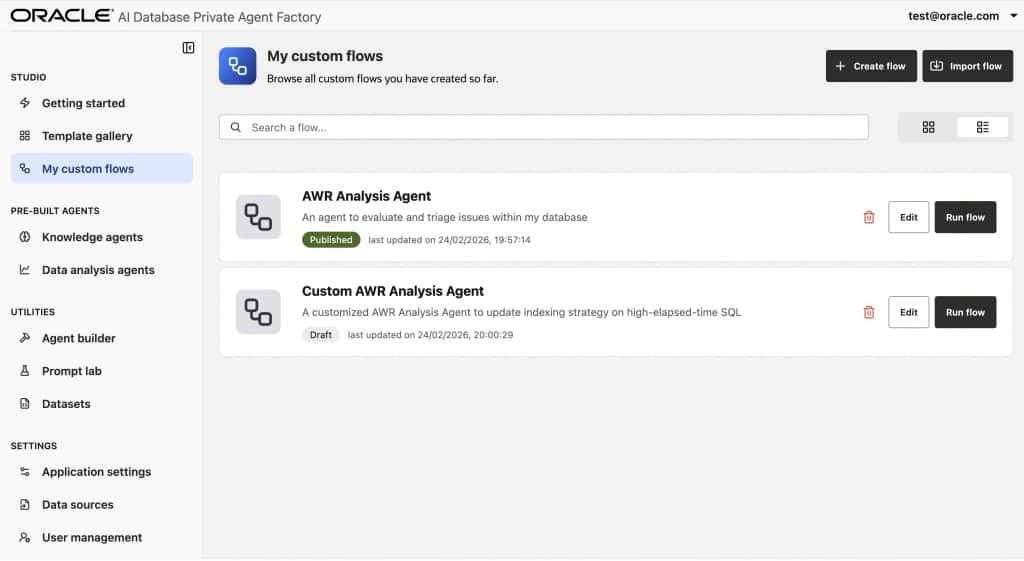
Secure Architecture: The AWR Agent Revisited (From Idea to Governed Flow)
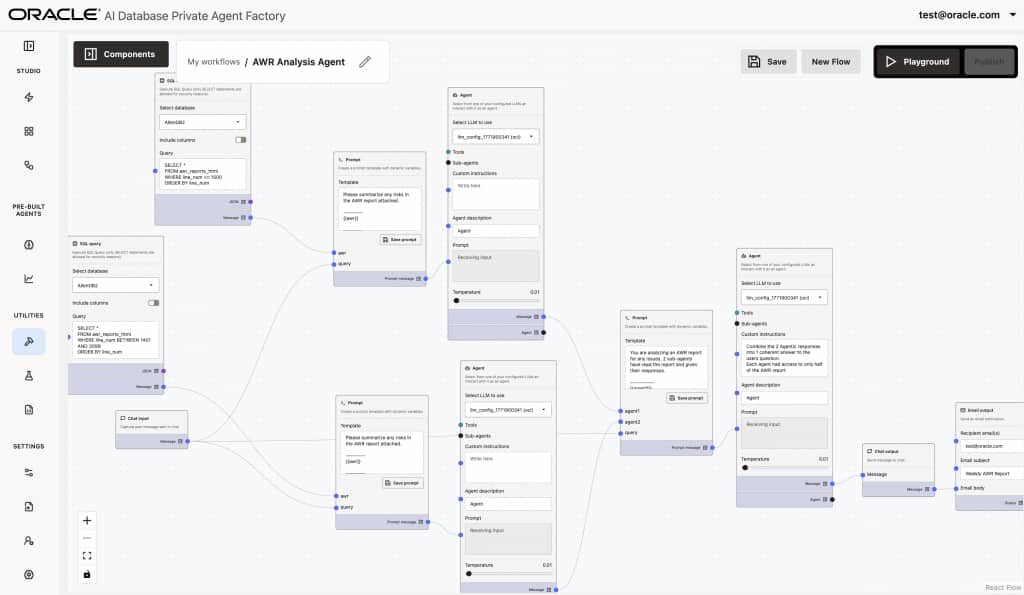
Using the Private Agent Factory, the same AWR Analysis Agent completely changes.
The agent is defined as a flow that:
- Runs inside your Oracle-controlled environment
- Accesses the database through governed roles
- Uses only approved OCI-hosted or internally deployed models (for example, companies can host their own on-prem LLM through frameworks like vLLM and Ollama)
- Is governed by IAM policies defining who can deploy or invoke it
- Keeps interactions within your cloud or on‑prem environment
Access is explicitly defined:
- Which database it can connect to
- Which views or procedures it may call
- Whether historical AWR data is accessible
- Which roles (e.g., DBA) can invoke it
No personal API keys.
No local environment variables.
No unknown third-party transmission.
From Experimentation to Enterprise Deployment
Agent adoption typically starts bottom-up. If governance does not start on day one, data exposure will.
With Private Agent Factory, organizations will be able to:
- Maintain a catalog of approved agents
- Version agent definitions
- Track deployments across environments
- Restrict model usage to sanctioned endpoints
- Apply consistent security policies
This provides visibility for IT leadership and scalability for operations teams.
Instead of one-off scripts maintained by individual DBAs, you can standardize AI-assisted workflows:
- An AWR Agent for production
- A separate version for development
- A capacity-planning analysis agent
- Additional agents for compliance or auditing
All centrally governed.
What the DBA Experiences (and Why It Matters)
Governance makes secure automation usable.
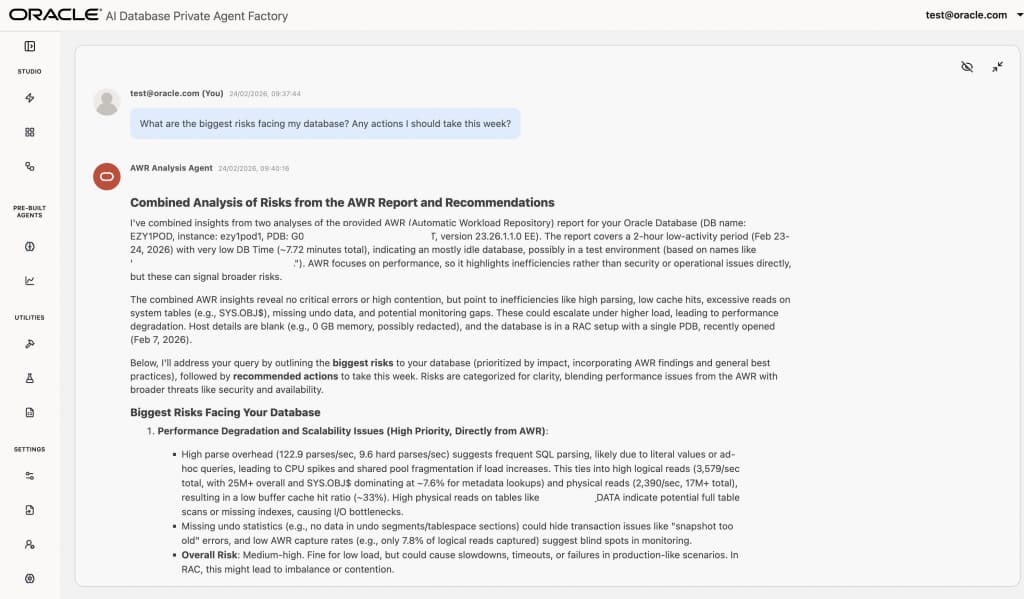
A DBA should be able to ask a straightforward question like:
- What are the biggest risks facing my database? Any actions I should take this week?
…and receive a concise, operationally useful response grounded in the AWR data — without copying reports into public tools or moving sensitive diagnostics outside the enterprise boundary.
A Practical Path Forward
Agents are already being built across organizations, often without formal oversight. Leadership must decide whether their AI strategy will be:
Untracked and credential-based
or
Governed and policy-driven
The Oracle AI Database Private Agent Factory enables Oracle Database customers to embrace agent-driven automation without compromising security, governance, or operational control.
Start with focused use cases like AWR analysis. Demonstrate measurable value. Expand deliberately, without leaving your existing Oracle security model.
If you would like to see this in action, explore the live lab and build your first governed agent.
Agents will reshape how organizations operate. The organizations that succeed will be experimenting quickly AND responsibly.