
A governed operating platform for tokenized money and assets
Oracle expands Blockchain Platform Enterprise Edition (OBP EE) with Hyperledger Besu support as part of an integrated, comprehensive enterprise blockchain stack under a single identity and governance model. OBP EE release 26.3.1 helps institutions reduce the integration effort and operational complexity of building permissioned EVM applications. It brings together identity, custodial wallets, transaction processing, smart contract governance, policy controls, analytics, and Kubernetes operations, reducing the integration complexity for digital assets teams. Institutions can move beyond blockchain infrastructure experiments toward practical and governed digital assets applications.
The platform helps institutions deploy digital assets, incorporate them into financial products and services, and participate in emerging financial ecosystems across four key application areas:
- Tokenized money: Tokenized deposits, stablecoins, and wholesale CBDCs with configurable controls for issuance, transfers, and redemption, institutional wallet services, and integration with existing banking and treasury operations.
- Tokenized assets: Digital bonds and other securities with institutional wallets, controlled transfers, coupon payments, and maturity redemption, including a foundation for tokenized securities ecosystems.
- Payments, settlement, and exchange: Delivery-vs-Payment (DvP), Delivery-vs-Delivery (DvD), and supported conditional or atomic exchange workflows, connecting asset transfers with payment processing, enterprise transaction coordination, and reconciliation.
- Multi-institution and market infrastructure: Interbank and consortium applications, including a foundation for Swift Ledger integration, hosting Swift’s Commitment Smart Contract, and supporting Commercial Bank Money Token (CBMT) applications.
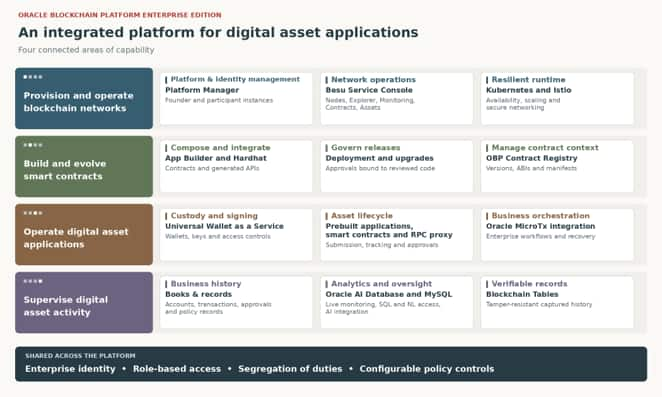
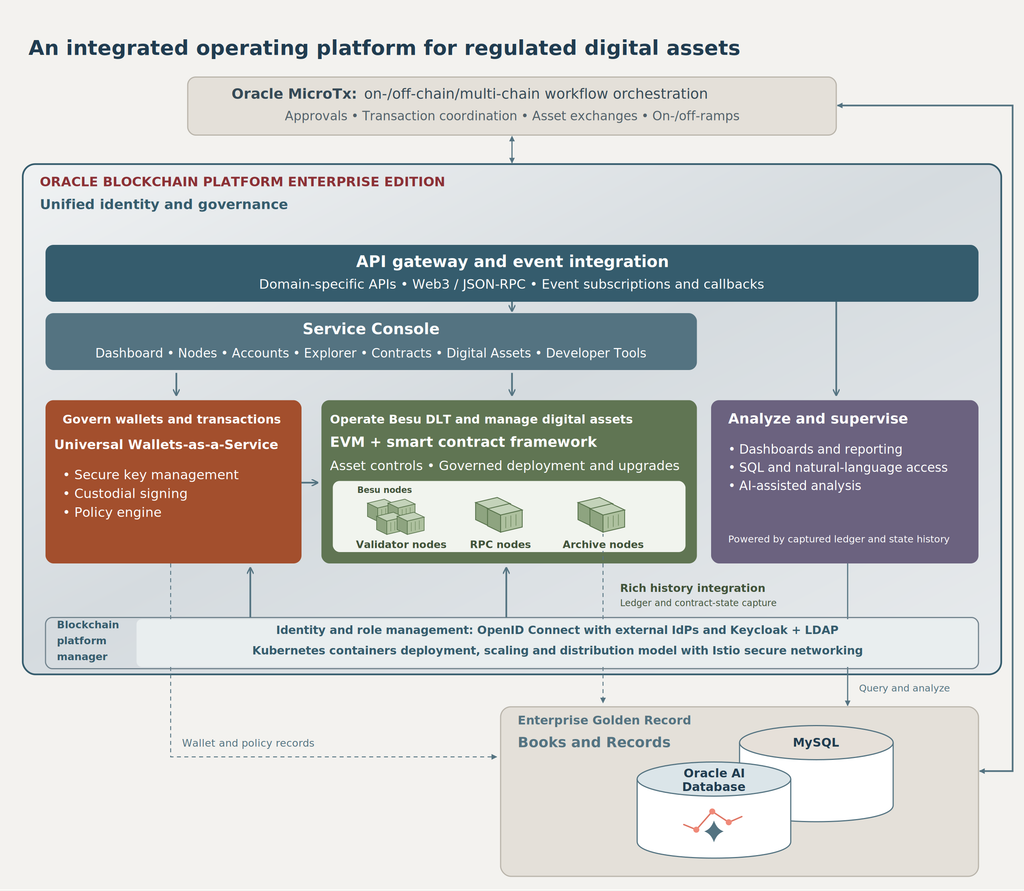
Across these application areas, Oracle connects digital asset development and operations with enterprise controls, workflows, and business records. Application teams can compose asset behavior in Blockchain App Builder, generate domain-specific APIs, deploy through an approval-controlled process, and use Universal Wallet-as-a-Service (UWaaS) for custodial signing. QBFT consensus adds deterministic transaction finality and shared validation by approved organizations to this integrated operating model. MicroTx integration coordinates broader business workflows and supported distributed transactions across blockchain networks and enterprise systems. Operations teams can monitor and analyze transactions, policies, and application history using rich history data continuously replicated into Oracle AI Database, supporting digital asset books and records, reporting, anomaly analysis, and ongoing supervision.
This connected approach reduces the infrastructure and custom integration that teams must assemble, while giving institutions control over application behavior, release approvals, and their deployment environment.
Build digital money applications around institutional requirements
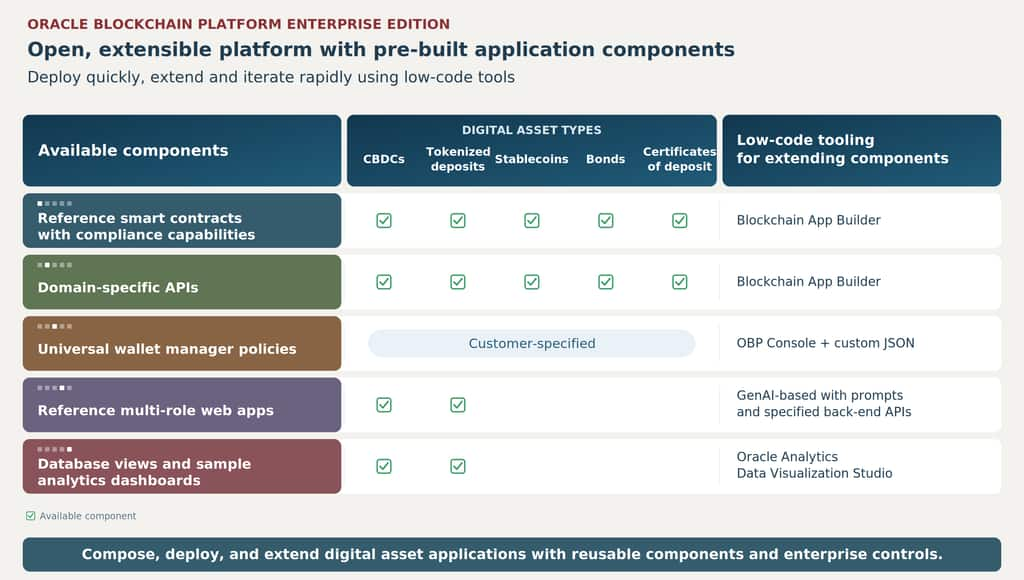
Oracle’s prebuilt tokenized deposits and wholesale CBDC sample applications combine reference smart contracts, domain-specific APIs, database views, and sample Web apps – all of which can be deployed together via a prebuilt single-click provisioning workflow. Institutions can evaluate the workflows, user experience, smart contract-embedded controls, and analytics visualizations, then adapt them using low-code tooling.
The wCBDC application supports a system owner (e.g., a central bank) and participating institutions across account setup, issuance, transfers, and retirement of digital currency. Maker-checker controls strengthen minting and burning oversight. Notary-controlled operations, hold-based transfers, and account-level daily limits support oversight of value movement. The tokenized deposits application supports the full token lifecycle enriched with configurable, multi-tier approval policies with thresholds, required approval levels and sequences—all tracked on-chain for auditability and compliance reviews. Combined with account policies, transaction limits, and visibility into pending approvals, these controls let institutions tailor authorization to their operating model. Administrative and auditor roles support segregation of duties.
| Institutional need | Oracle capability | Business value |
| Control issuance and value movement | Notary-controlled operations and configurable approvals | Separate requests from authorization |
| Apply operating limits | Account policies, transaction limits, and suspension controls | Constrain asset behavior to meet institutional requirements |
| Coordinate conditional transfers | Balance holds, execution, and release | Reserve assets until required conditions are met |
| Track smart contract state details | Version-specific storage layouts and complete tracking of registered contracts’ key-value changes | Continuously capture internal state changes, providing a complete record of asset lifecycle |
| Investigate activity | Account, transaction, policy, and approver history | Connect asset movements with their business context |
These applications build on Oracle’s Digital Asset composable smart contract SDK, which extends OpenZeppelin libraries with enterprise controls for ERC-20 and ERC-1155 based assets. Oracle reference implementations cover tokenized deposits, stablecoins, wholesale CBDCs, and bonds.
Reusable modules cover account suspension and activation, role-based permissioning, daily transfer and transaction-count limits, minting and burning, balance holds and releases, delegated authorization, and freeze or pause controls. Multilevel approvals let teams apply authorization requirements to asset workflows. Developers can select the controls their application requires and retain ownership of its business logic.
The ERC-1155-based bond implementation supports the bond lifecycle from issuance and investor purchase through transfers, periodic coupon payments, and redemption at maturity. Combined with configurable policies in the wallet service and off-chain/on-chain MicroTx workflows, these capabilities support integration of digital asset operations into financial products and services. MicroTx workflows can coordinate lifecycle operations with payment processing and enterprise systems, while rich history integration makes the resulting activity available for reconciliation, reporting, and audit.
Developers can tailor these implementations or build new contracts, with predeployed reference contracts also accessible through the Besu Service Console. The system supplies predeployed helper contracts, including a Hash Time Lock Contract (HTLC) and a platform membership validator, with extensibility for a platform oracle framework and programmable account authorizations. One-way and two-way asset transfers and Delivery-vs-Delivery swaps provide building blocks for more complex applications; HTLCs support exchanges conditioned on a secret and a time limit. OBP EE’s Besu networks use QBFT consensus, providing deterministic finality for committed transactions, giving applications a clear ledger outcome for triggering downstream processing and reconciliation without waiting for additional block confirmations, simplifying payment, asset-transfer, and reconciliation workflows. Consortium members can distribute validators across institutions and infrastructure locations, while Byzantine fault tolerance protects consensus against faulty or malicious validators within the protocol’s tolerance limits.
Connect contract composition directly to application integration
Oracle’s low-code Blockchain App Builder for Besu helps developers choose a token foundation, behaviors, and identity-permission controls, validate required selections, and generate a Hardhat project with a composition preview. Access-control options include ERC-5982 and EIP-6617 adapters, alongside multi-signature upgrade approval capabilities. GUI and CLI support interactive development and automated delivery.
Domain-specific REST APIs are generated alongside composed smart contracts for digital money, bonds, and real-world assets (RWAs), allowing existing applications to work with asset operations through familiar business interfaces. The tokenized deposits and wCBDC APIs expose wallet provisioning, account administration, issuance, transfers, and approval actions. Combined operations simplify tasks such as creating an account with operating limits and assigning its role, reducing coordination in application code.
Oracle’s Hardhat plugins connect development with the operating platform. They integrate custodial signing through UWaaS, publish contract manifests to the OBP smart contract registry, and generate API specifications and Postman collections. Contract artifacts, signing services, and integration interfaces therefore remain connected as teams move from development into deployment.
For custom applications that need finer control, the RPC proxy combines Ethereum and Besu JSON-RPC access with transaction and query services. It supports function signatures and arguments, ABI-based encoding, decoded results, events, and errors, and separate encoding and signing modes. Its transaction service connects wallet-backed signing, network submission, and optional lifecycle tracking through submission, mining, and confirmation, with receipts and failure information available for investigation. Managed nonce allocation helps coordinate tracked submissions. Applications can optionally simulate transactions before signing and submission to identify likely execution failures.
Delivering these applications takes more than smart contracts. This solution brings asset lifecycle, wallets, APIs, and supervision together under shared identity, governance, and platform management.
Coordinate digital asset operations with enterprise workflows
Integration with Oracle MicroTx extends OBP EE’s application APIs into distributed business workflows spanning blockchain networks and existing enterprise systems. Institutions can use a configurable Web3 transaction task within MicroTx workflows to connect asset operations with off-chain services and database processing. Durable execution, automated retries, timeouts, and execution history help manage long-running asynchronous processes at the infrastructure level with declarative settings reducing the need for complex orchestration code in the applications.
MicroTx combines native workflow orchestration with distributed transaction coordination, including XA, Saga, and Try-Confirm/Cancel (TCC) patterns across multiple workflow tasks and participating services. These capabilities equip application teams to declaratively specify automated recovery and compensation logic for partial failures. Application teams can coordinate supported resources through two-phase commit (2PC), extended with Logging Last Resource (LLR) optimization for including a single non-XA resource, such as OBP RPC Proxy, into a coordinated global transaction. Together with MicroTx’s built-in idempotency controls, these capabilities help maintain consistency and manage recovery from partial failures across blockchain and enterprise systems.
OBP EE’s event and transaction callbacks complement this orchestration. Applications can subscribe to new blocks or filtered contract events, configure block ranges and confirmation settings, and receive HTTPS notifications. Retry settings, OAuth 2.0, TLS/mTLS, callback testing, and subscription pause and resume controls support resilient integration with enterprise services. Together, MicroTx and OBP EE help teams connect digital asset activity to existing business processes while maintaining visibility into execution and exceptions.
Provide a foundation for Swift Ledger integration
Swift Ledger is designed to help banks interconnect tokenized deposit platforms across the global banking ecosystem. By coordinating payment commitments, recording interbank liabilities, and orchestrating settlement updates across participant-operated ledgers, it provides a shared framework for interbank payments while allowing each bank to retain control of its own ledger infrastructure.
OBP EE brings together the platform capabilities required to host Swift’s Commitment Smart Contract: a permissioned Besu EVM network with immediate finality and zero transaction fees, ERC-20-compatible tokenized deposits, EIP-712 typed-data signing, and ABI-based contract invocation and event processing. Oracle’s application APIs, event integration, and MicroTx workflow orchestration provide the means to connect participant-side processing with existing payment, treasury, and back-office systems.
Apply governance from account access through application upgrades
Oracle Blockchain Platform connects platform administration, wallet services, transaction policies, and contract release controls through enterprise identity and role-based access. On OCI, OBP EE integrates with Oracle Cloud IAM. Organizations can also use the included LDAP and Keycloak environment or another OpenID Connect-capable identity provider for on-premises or multicloud deployments. Configurable mappings between identity provider groups and platform roles help simplify access administration, while delegated administrative roles support segregation of duties across platform, wallet, and application responsibilities.
The controls address distinct institutional responsibilities. Organizational roles govern infrastructure and wallet administration. Authorized users can define, update, enable, or disable reusable UWaaS policies (rule sets defined for specific scopes) globally or for specific organizations, blockchain instances, and wallets, using targets and tags to select resources. These policies enable applications to evaluate token transfer transactions against individual rules or filtered sets of active rules.
When a transaction satisfies the applicable wallet policies, the wallet service can sign and submit it to asset-specific smart contracts on Besu nodes. These contracts enforce identity-linked access control, operating limits, and multi-tier approval requirements, with on-chain policy and approval records tied to asset operations, reducing reliance on separate platform logs for audit evidence. Approved validators govern participation in network consensus. Once transaction has been committed through the QBFT consensus protocol, the Oracle database plugin on the archive nodes replicates its details to the enterprise golden record maintained by the rich history database (Oracle or MySQL.)
OBP provides a governed deployment mode for smart contracts. This mode ensures contracts are initially deployed inactive and become active only when the configured approval requirements are recorded on-chain through the predeployed Governance contract. The Governance contract helps organizations to link approvals to the reviewed contract components and implementation. The same approval path applies to upgrades, giving developers, deployers, and approvers a shared record of what was authorized for release. Governance APIs manage authorized deployers, approvers, and approval thresholds. Governance workflows use UWaaS for custodial signing.
The OBP smart contract registry maintains the versioned artifacts that support contract review and controlled evolution, including ABIs, bytecode, and storage layouts published through Oracle’s Hardhat plugins. These artifacts provide context for interpreting the transaction details when creating a granular representation in the indexing database.
OBP EE enables upgradeable contracts through its Digital Asset SDK support of UUPS (Universal Upgradeable Proxy Standard) upgrades, allowing approved implementation logic to change behind a stable business-facing contract address. Governance validates and approves the specific new implementation before the proxy can switch to it. With compatible storage layouts and appropriate testing, institutions can preserve balances, on-chain state, and integration addresses as applications evolve. Composer-generated tokenized contracts require no additional Solidity governance hooks, and generated Hardhat scripts use governance intent APIs to support upgrades. Teams select the appropriate Governance contract, configure its policy, identify approvers, and operate the approval process.
Put custodial wallets under enterprise administration
UWaaS provides custodial wallet and signing services connected to organizations, users, roles, and network associations. APIs support provisioning, private-key import, inventory, status, labels, and tags. Private keys are protected in secure storage with encryption at rest and a key management service, reducing the need for applications to implement their own key storage.
Applications can query token balances, sign EVM transactions or EIP-712 typed business data, transfer native assets or tokens, retrieve transfer details, and deploy contracts through the wallet interface. Optional IBAN-based resolution connects a familiar account identifier with a wallet address to link key custody and asset operations with the bank’s routing model.
Capture ledger history and smart contract activity into business and audit records
OBP EE’s rich history integration stores blockchain activity in Oracle AI Database or MySQL, where indexing and SQL queries support analysis alongside off-chain business data. This goes beyond transaction history and event logs by decoding smart contract state changes using version-specific ABIs and storage layouts in the OBP smart contract registry. For Oracle-provided contracts and new contracts composed with Blockchain App Builder and deployed via Oracle’s Hardhat plugins, these artifacts are published to the registry automatically during deployment, extending this visibility to institutions’ custom digital asset applications. When OBP EE replicates transaction history and contract state into the indexing database, the registry enables it to decode and represent granular changes to account balances, policies, approvals, and other contract key-value data to provide full “books and records” view of every transaction. For other deployment paths, these artifacts can be added through registry APIs.
In Oracle AI Database, appropriately prepared data and vector embeddings can support semantic similarity search for comparisons with previously identified anomalies and retrieval-augmented generation (RAG). Administrators can configure rich history to use in-database Blockchain Tables to maintain a tamper-resistant, cryptographically verifiable store for captured history, strengthening the lineage of data used outside the distributed ledger for live monitoring, analytics, and books and records for audit and regulatory review.
Captured history supports governance with end-to-end lineage of token lifecycle operations, any updates to account or policy settings, and smart contract update approvals. The tokenized deposits and wCBDC applications expose APIs for account and transaction history, pending requests, and approver activity. Tokenized deposits also expose policy-change history and approval status through its Web UI and Oracle REST Data Services (ORDS) APIs, supporting reporting, reconciliation, and investigation. Customers can also use Oracle Select AI for natural-language exploration of application history and state.
The OBP smart contract registry maintains version-specific contract metadata to support consistent interpretation of historical state as contracts evolve. Associating captured state changes with the implementation and storage layout active at the time supports analysis across UUPS proxy upgrades. Registry records also capture ownership or authorship, purpose, and tags, while manifest and compiler-metadata imports keep contract artifacts available for review and investigation.
Consortium participants can share an external rich history database provided by the founder or maintain separate databases connected to their nodes. Oracle Globally Distributed Database can place shards in participants’ jurisdictions, with data distribution policies configured to address residency requirements for historical records. Institutions gain flexibility over how they store and analyze the data used to operate the application.
Run your network to meet deployment and data residency requirements
The Blockchain Platform Manager and Besu Service Console bring network provisioning, node configuration, lifecycle operations, and monitoring into Oracle administration tools and APIs. Founder and participant configurations let institutions share a ledger while retaining independent authentication and authorization domains. Founders can export genesis configuration and node connection metadata to support participant onboarding. Console account and transaction operations, block and transaction search, log viewing and download, runtime logging controls, and service health endpoints support investigation. Prometheus metrics and prebuilt Grafana dashboards provide health and performance views.
OBP EE services deploy as Kubernetes containers. On OCI, it runs on Oracle Kubernetes Engine (OKE), with a Resource Manager stack to simplify provisioning. It can also run on premises and in multicloud environments using native Kubernetes stacks or Red Hat OpenShift, allowing consortium members to choose deployment locations that fit their infrastructure requirements.
Kubernetes runtime management supports high availability and dynamic scalability across multiple worker nodes through service replication, container restart, and workload rescheduling. Teams can scale supported components as demand changes, subject to cluster capacity and blockchain consensus requirements. The integrated Istio service mesh adds service authentication and encrypted communication through mutual TLS capabilities, with authorization, traffic controls, and telemetry to help manage service interactions.
Evaluate Oracle digital asset applications on OCI
Begin your evaluation through Oracle Blockchain Platform on OCI Marketplace. Use the tokenized deposits and wCBDC sample applications to explore account setup, approval-controlled asset operations, and business-history review, then tailor their policies and contracts to your institution’s requirements. Evaluate how MicroTx orchestration and Oracle database integration help to connect those workflows with your existing systems.
Release 26.3.1 is available in Limited Availability in October 2026.
Get Started:
Learn more:
- Oracle Blockchain Platform Enterprise Edition on Oracle.com
- Oracle Blockchain Platform Enterprise Edition for Hyperledger Besu documentation