
5,200+ employees | 628 branches | 90% faster | 70%+ less HR effort | ~2.5 months to deliver
A spreadsheet-driven, multi-week employee transfer process transformed into a same-day, AI-assisted decision process.
Tamilnad Mercantile Bank (TMB) is one of India’s oldest private-sector banks, headquartered in Thoothukudi, Tamil Nadu, with a nationwide network of more than 628 branches. As a regulated financial institution, TMB is committed to ensuring that its people, policies, and governance practices support sustainable growth while maintaining high standards of compliance, transparency, and operational excellence.
Managing workforce mobility at this scale requires the bank to balance employee development and preferences with business continuity, statutory tenure requirements, and Reserve Bank of India (RBI) regulations; making fair, consistent, and auditable transfer decisions essential.
Business Challenge
TMB’s annual employee transfer exercise involved matching thousands of employees to branch vacancies while balancing regulatory requirements, employee preferences, operational needs, and career-development objectives. The existing spreadsheet and committee-driven process created several challenges:
- Managing transfers for 5,200+ employees across 628 branches required HR teams to manually consolidate data from multiple sources, including employee history, performance, qualifications, preferences, and vacancy information.
- More than 60 business, policy, and RBI-compliance rules. Including tenure limits, eligibility criteria, skills requirements, career exposure, and no-repeat-location policies had to be evaluated consistently for every transfer decision.
- Manual evaluations were time-consuming and could take several weeks, consuming substantial senior HR and leadership effort while slowing decision-making.
- Spreadsheet-based processing increased the risk of inconsistent rule application, data errors, and difficulty demonstrating fairness across employee transfer outcomes.
- Sensitive employee and transfer data required stronger role-based access, governance, auditability, and traceability than disconnected spreadsheets and reports could provide.
- HR leadership lacked a single, real-time platform to simulate transfer scenarios, review recommendations, make adjustments, and obtain governed approvals.
- The manual process was difficult to scale and could not easily support future employee self-service or broader HR transformation.
Why Oracle APEX
As an existing Oracle Database and Oracle Fusion HCM Cloud customer, TMB selected Oracle APEX because it enabled the bank to build a mission-critical enterprise application within its existing Oracle ecosystem.
Rather than introducing additional middleware or custom application frameworks, Oracle APEX allowed the bank to securely leverage employee, organizational, and performance data while integrating seamlessly with Oracle Autonomous AI Database, Oracle Integration Cloud, OCI Generative AI, and Oracle REST Data Services.
For a regulated financial institution, security and governance were equally important. Oracle APEX provided enterprise-grade authentication, role-based access control, auditability, and database-centric governance, while its declarative development model enabled rapid delivery of a sophisticated workforce management application without compromising scalability or maintainability.
“Oracle APEX helped us transform a complex, manual transfer process into a transparent, scalable, and AI-assisted platform that improves compliance, fairness, and decision-making.” — D. Ramesh, EVP – Head of Human Resources, Tamilnad Mercantile Bank
The Solution: AI-Powered Transfer Matching Engine
The TMB Transfer Matching Engine is an intelligent workforce mobility platform built with Oracle APEX on OCI Autonomous AI Database, designed & implemented in collaboration with Kovaion Consulting that combines advanced business rules, enterprise data, and AI-assisted recommendations to simplify employee transfer decisions.
The platform consolidates employee master data, posting history, performance scores, qualifications, dependents, transfer preferences, and branch vacancy information into a unified decision framework.
At its core is a Deferred Acceptance (Gale–Shapley) stable matching algorithm that evaluates more than 60 configurable business and regulatory policies before generating optimized transfer recommendations.
These policies include eligibility validation, tenure requirements, skills and certification criteria, career exposure objectives, employee preferences, organizational priorities, and RBI compliance requirements.
The result is a ranked, explainable, and auditable recommendation engine that promotes fairness, transparency, and policy adherence throughout the transfer process.
Oracle APEX delivers the application experience around this engine, including:
- Executive dashboards
- Employee 360° and Branch 360° views
- Vacancy and Preference management
- Transfer workbenches and simulations
- AI-assisted recommendations
- Manual overrides
- Cadre-based approval workflows
By bringing these capabilities together in a single application, HR teams can review, optimize, and approve transfer decisions through one secure operational platform instead of multiple disconnected systems.
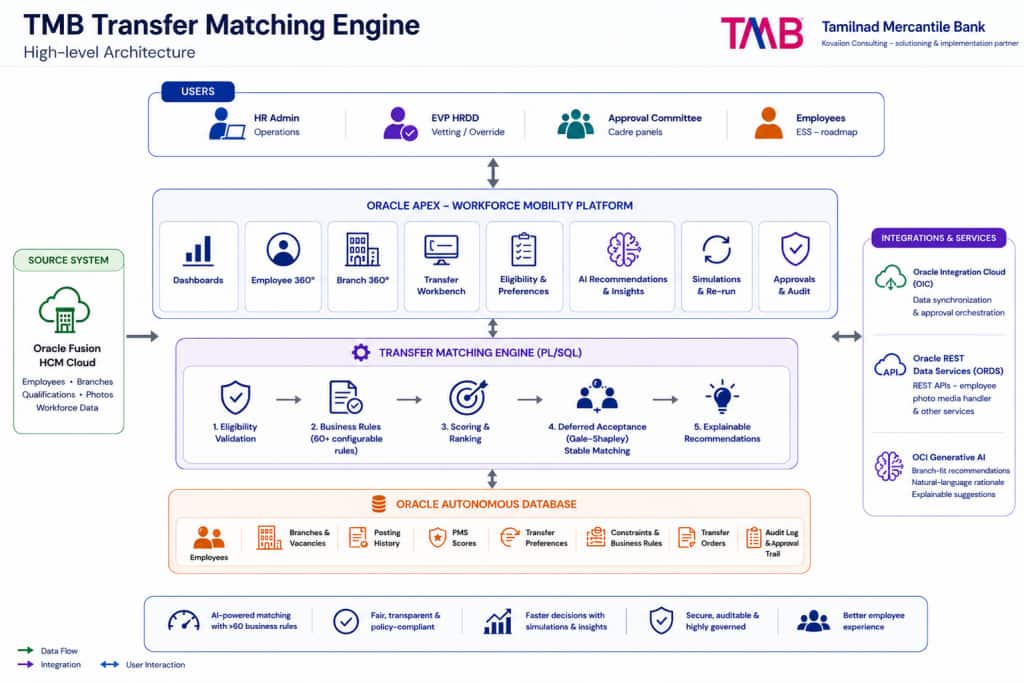
Oracle APEX as the Workforce Mobility Platform
Oracle APEX serves as the operational hub of the Transfer Matching Engine, bringing together enterprise data, business rules, AI-assisted recommendations, and approval workflows into a single user experience.
For TMB, the value of Oracle APEX extended beyond application development:
Rapid delivery
The low-code platform enabled TMB to deliver a sophisticated enterprise application in approximately 2.5 months.
Enterprise integration
Oracle APEX connects the workforce mobility application with Oracle Fusion HCM, Autonomous AI Database, OCI Generative AI, Oracle Integration Cloud, and ORDS, enabling TMB to build on its existing Oracle investments.
Security and governance
Role-based access, auditability, policy enforcement, and governed approval workflows support the security and compliance requirements of a regulated banking environment.
Scalability
The platform provides a centralized foundation for workforce mobility across 5,200+ employees and 628 branches, with the flexibility to support future HR transformation initiatives.
Business Impact
- 90% faster transfer decision-making
- 70% reduction in senior HR administrative effort
- Improved fairness and transparency with ranked, explainable recommendations, human review, and complete audit trails
- Stronger governance through centralized role-based access, policy enforcement, and committee approval workflows
- Higher HR productivity by shifting effort from manual data consolidation and validation toward strategic review and decision-making
- A scalable workforce-mobility platform integrated with Oracle Fusion HCM, Autonomous AI Database, OCI Generative AI, OIC, and ORDS
Conclusion
Oracle APEX enabled Tamilnad Mercantile Bank to modernize workforce mobility across its nationwide branch network. Built on Oracle APEX and Oracle Autonomous AI Database, the Transfer Matching Engine combines enterprise data, configurable business rules, a Deferred Acceptance stable-matching algorithm, and AI-assisted recommendations to deliver fair, transparent, and RBI-compliant employee transfer decisions.
By bringing matching, simulation, review, approvals, and auditability into one secure platform, TMB has gained greater operational efficiency, stronger governance, and faster, higher-quality workforce decisions. The low-code application platform allowed the bank to deliver a complex enterprise application in approximately 2.5 months while building on its existing Oracle investments and avoiding additional technology complexity.