
100% digital RCSA | Centralized KRI tracking | Real-time dashboards | Automated workflows | Delivered within months
A fragmented, manual risk-management process transformed into a centralized digital system for governance, proactive monitoring, and faster decision-making.
Muthoot Microfin Limited (MML), the microfinance arm of Muthoot Pappachan Group, is one of the leading and fast-growing microfinance institutions in India. The company provides micro-loans to women entrepreneurs, with a focus on rural regions of the country.
MML’s microfinance operations are designed to promote entrepreneurship among women and inclusive growth. The organization is also focused on financial inclusion through technology-driven operations and innovation, making strong enterprise governance and risk visibility important parts of its operating model.
Business Challenge
For non-banking financial companies (NBFCs), managing risks associated with third-party service providers is an important part of enterprise risk management. Vendor risk analysis helps assess a provider’s financial stability, regulatory compliance, cybersecurity practices, and operational reliability. These assessments support informed decisions about third-party relationships, helping protect sensitive customer information and maintain business continuity.
Manual vendor assessments can be time-consuming and resource-intensive. Collecting supporting documents, reviewing responses, coordinating evaluations, and consolidating findings require significant effort and can introduce human error. Maintaining consistent evaluation criteria and keeping assessment records current become more difficult as the number of vendors grows. These challenges create a need for a more standardized and automated approach to vendor risk management.
Enterprise risk management requires regular assessments, indicator tracking, reporting, and governed workflows. MML needed a more unified way to manage these activities and give stakeholders timely visibility into risk and control performance. The organization identified several priorities:
- RCSA activities needed to move to a 100% digital process, with a consistent way to capture, review, and monitor risk and controls.
- Key risk indicators needed centralized tracking so teams could identify changes and take action earlier.
- Dashboards, alerts, and reporting were required to replace fragmented visibility with a real-time view of risk status and trends.
- Risk workflows needed to be automated to reduce manual work, support collaboration, and improve operational efficiency.
- Enterprise risk data needed appropriate authentication, user management, and role-based access for secure use across the Risk Management Department.
- Management needed faster reporting and decision-making, with stronger governance and transparency across the risk lifecycle.
- The solution also had to be maintainable and scalable while fitting MML’s existing Oracle Database environment.
Why Oracle APEX
MML selected Oracle APEX as its first low-code platform because it brought together rapid development, Integration with Oracle products, enterprise security, scalability, maintainability, and lower cost.
For an enterprise risk application, the Oracle ecosystem was important. Oracle APEX allowed the team to build on its Oracle Database foundation and use SQL and PL/SQL to create a governed risk platform without adding unnecessary technology complexity.
Speed also mattered. The team learned APEX within weeks and delivered the application within a few months. The solution was developed fully in-house for the Risk Management Department, giving MML direct control over delivery, maintainability, and future enhancements.
The Risk Management System
The Muthoot Microfin Risk Management System (RMS) is an enterprise risk-management application built in-house for the Risk Management Department. It digitizes RCSA and KRI management and brings dashboards, reporting, authentication, user management, and workflows into one application.
At the center of RMS is a digital RCSA process that helps organize risk and control assessments in a consistent, trackable way. Centralized KRI monitoring gives stakeholders one place to review indicators, while dashboards, alerts, and reports make important risk information easier to see and act on.
Automated workflows move risk activities through the right review and approval steps, improving governance and transparency while reducing manual coordination. OTP authentication and user management support secure access, with role-based controls aligning visibility and action to user responsibilities.
RMS also supports automated vendor risk analysis, bringing vendor assessments into a consistent and centralized process. Standardized evaluation criteria and risk scoring help the Risk Management Department assess vendors across financial stability, regulatory compliance, cybersecurity, and operational reliability. Automating assessment and review activities reduces manual coordination and supports faster vendor onboarding while maintaining a structured evaluation process.
Ongoing monitoring helps the team identify emerging vendor risks and compliance gaps earlier, enabling timely review and follow-up. Centralized assessment documentation and audit trails provide visibility into evaluation findings, decisions, and subsequent actions. Together, these capabilities improve transparency and make supporting information easier to retrieve during internal reviews and audits.
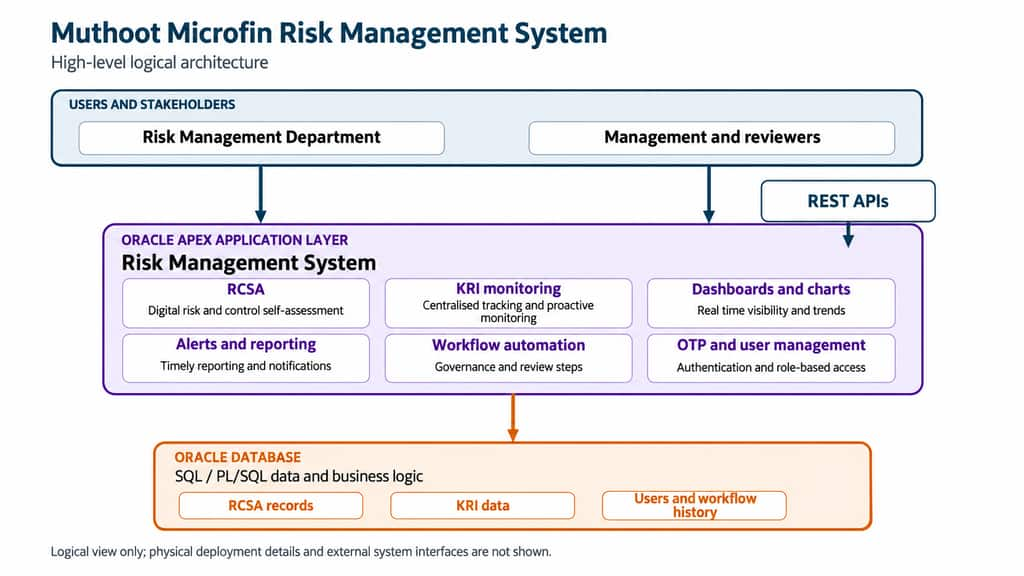
Built with Oracle APEX, Oracle Database, SQL, PL/SQL, Interactive Reports, Charts, Dynamic Actions, and REST APIs, RMS provides a flexible application layer for a critical enterprise function.
Oracle APEX delivers the application experience around this operating model, including:
- Risk and control self-assessment data capture, assessment, and monitoring
- KRI tracking, alerts, and proactive monitoring
- Dashboards, charts, and interactive reports
- Automated workflows for governance and review
- OTP authentication and user management
- Role-based access and secure risk operations
- REST APIs and a maintainable Oracle Database foundation
By bringing these capabilities together, MML replaced disconnected risk activities with a centralized system that supports real-time visibility, faster reporting, and more consistent governance.
Oracle APEX as the Risk Management Platform
Oracle APEX serves as the operational hub of RMS, connecting risk users to assessment data, KRI monitoring, dashboards, reports, alerts, and workflows through a single experience.
For MML, the value of Oracle APEX extended beyond application development:
Rapid delivery
The team learned APEX within weeks and delivered the application within a few months, accelerating the move from risk-management requirements to a working enterprise system.
Oracle integration
RMS is built with Oracle APEX, Oracle Database, SQL, PL/SQL, Interactive Reports, Charts, Dynamic Actions, and REST APIs, enabling MML to build on a familiar technology foundation.
Security and governance
OTP authentication, user management, and role-based access support controlled use of risk information, while automated workflows improve governance and transparency.
Maintainability and scalability
Maintainability and scalability were central selection criteria. The low-code platform gives MML an application foundation that can evolve with the Risk Management Department’s needs.
In-house control and future readiness
Because RMS was developed fully in-house, MML retains direct ownership of its risk platform. The roadmap includes AI-driven analytics, predictive dashboards, enterprise integrations, and mobile access.
Impact on the business
MML transformed enterprise risk management by digitizing RCSA and centralizing KRI tracking in a single Oracle APEX application.
The solution gives the Risk Management Department a more timely, transparent, and governed view of risk through dashboards, alerts, reporting, and automated workflows. It also creates a foundation for continued innovation, including AI-driven analytics, predictive dashboards, enterprise integrations, and mobile access.
Automated vendor risk analysis helps MML accelerate vendor onboarding and assessments while improving consistency across evaluations. Reducing repetitive administrative work helps control operational costs and allows the Risk Management Department to focus on critical risks and follow-up actions. Earlier visibility into emerging risks, supported by centralized documentation and audit trails, strengthens oversight of third-party relationships and improves audit readiness.
Business Impact
- 100% digital RCSA
- Centralized KRI tracking and proactive monitoring
- Faster reporting and decision-making
- Reduced manual effort and improved productivity
- Stronger governance, transparency, and compliance
- Real-time dashboards, alerts, and reporting
- A scalable roadmap for AI analytics, predictive dashboards, enterprise integrations, and mobile access
Conclusion
Oracle APEX enabled Muthoot Microfin to digitize enterprise risk management with an in-house Risk Management System that combines RCSA, KRI monitoring, dashboards, reporting, authentication, user management, and workflows.
By building on Oracle Database with SQL and PL/SQL, MML delivered a secure and maintainable low-code application in a few months. RMS reduces manual work, strengthens governance and transparency, accelerates reporting and decision-making, and provides a foundation for future AI-driven and mobile risk capabilities. Automated vendor risk analysis further strengthens MML’s enterprise risk framework through consistent assessments, earlier identification of third-party risks, and improved audit readiness.