
Spacebank’s RoboViewX platform demonstrates how Oracle APEX can serve as the operational foundation for mission-critical robotics solutions. By combining Oracle APEX, Autonomous Database, ORDS, OCI, and AI services, SpaceBank created a unified platform for orchestrating heterogeneous robot fleets, monitoring operations in real time, and accelerating application delivery.
Key Outcomes
• 60%+ improvement in development velocity
• Delivery cycles reduced from months to 2–4 weeks
• Unified robotics orchestration platform
• AI-assisted diagnostics and reporting
• Scalable hybrid-cloud deployment architecture
The Challenge: Building Modern Robotics Operations
As RoboViewX expanded into industrial, healthcare, and government environments, Spacebank needed to manage telemetry streams, robot scheduling, operational workflows, AI services, and compliance requirements within a single platform. Traditional approaches would have required multiple applications, custom integrations, and significant development effort.
Why Oracle APEX
Oracle APEX provided a unified application platform that enabled rapid development of operational dashboards, fleet management consoles, scheduling applications, reporting solutions, and administrative tools. Combined with Autonomous Database and ORDS, it allowed SpaceBank to implement a database-centric architecture that reduced complexity while improving maintainability and scalability.
Architecture Overview
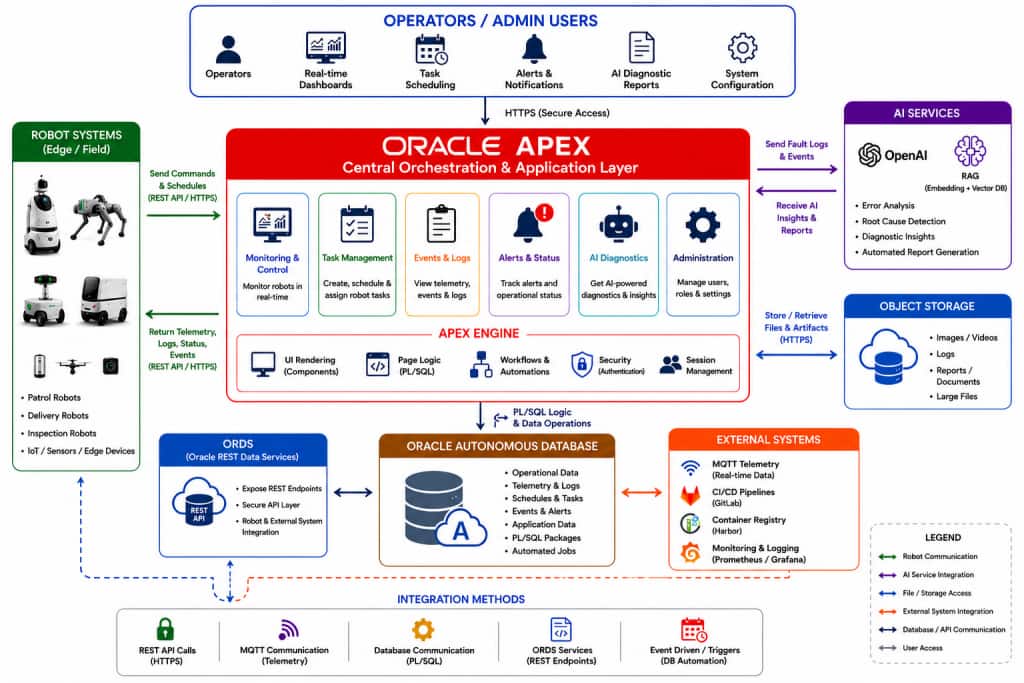
RoboViewX utilizes Oracle APEX as its operational infrastructure, allowing the platform to serve as a unified control center for complex robot fleets.
End-to-End Robot Orchestration Flow
1. Operators create or schedule robot tasks using Oracle APEX.
2. Task definitions and scheduling metadata are stored in Autonomous Database.
3. PL/SQL scheduling services determine execution order and robot assignment.
4. ORDS exposes REST endpoints consumed by robot controllers.
5. Robots execute assigned tasks and continuously transmit telemetry and status updates.
6. Telemetry data is persisted in Autonomous Database.
7. Database events trigger workflow processing and operational updates.
8. APEX dashboards refresh operational views and KPIs.
9. Exceptions automatically trigger diagnostics workflows.
10. AI services analyze errors and generate recommendations presented to operators through APEX.
How RoboViewX Accelerates Innovation through Oracle APEX
Oracle APEX serves as the operational hub for fleet management, task scheduling, diagnostics, reporting, and administration. Interactive dashboards provide visibility into robot status, telemetry, alerts, and operational KPIs. Operators manage workflows through a single application instead of switching between multiple specialized tools.
Database-Centric Event Processing Architecture
One of the key architectural decisions was to place orchestration logic close to the data.
Task Scheduling:
PL/SQL packages allocate workloads, prioritize jobs, manage task queues, and handle retries.
Event Processing:
Incoming telemetry updates robot status, generates alerts, triggers workflows, and updates dashboards.
State Management:
The database maintains workflow state, execution history, audit trails, and operational metrics.
This approach reduces latency, simplifies deployment, and improves transactional consistency.
Detailed Integration Architecture
REST APIs
• Robot command execution
• Job submission and scheduling
• Status updates and operational data exchange
Oracle REST Data Services (ORDS)
• Secure API exposure
• Authentication and authorization
• Service abstraction layer
MQTT and Telemetry Integration
• Robot health monitoring
• Telemetry streaming
• Event publication and subscription
OCI Object Storage
• Images and video references
• Diagnostic artifacts
• Operational evidence retention
AI Services
• Error classification
• Root-cause analysis
• Automated diagnostic report generation
Oracle APEX Features Used
• Interactive Reports and Interactive Grids for operational monitoring
• REST integrations for robot communications and AI services
• Shared Components for reuse and standardization
• Authentication and Authorization frameworks
• Dynamic Actions and Automations for workflow processing
• PL/SQL integration for orchestration and scheduling
• Declarative development for rapid application delivery
The RoboViewX Solution Suite: Advanced Modules for Modern Robotics Applications Built with Oracle APEX
Fleet Operations Console
• Live robot monitoring
• Operational KPIs
Task Management Application
• Scheduling and assignment management
• Execution tracking
Incident Management Portal
• Alert investigation
• Error analysis
Administration Console
• User management
• Configuration and governance
Why APEX Instead of Custom Development
Using traditional development approaches would have required separate frontend frameworks, reporting tools, security implementations, and workflow engines. By offloading complex infrastructure requirements to Oracle APEX, the Spacebank team maximized their resources on core robotics innovation and proprietary AI-driven diagnostics.
Technical Lessons Learned
• Keep orchestration logic close to the data using PL/SQL.
• Use ORDS as a standardized integration layer.
• Treat Oracle APEX as an operational platform, not just a UI framework.
• Build reusable components to accelerate future projects.
Business Impact
SpaceBank achieved a 60%+ improvement in development velocity, reduced delivery cycles to 2–4 weeks, improved scalability across hybrid deployments, accelerated onboarding of new robotics capabilities, and increased operational visibility across distributed environments.