

The future of software development is shifting from writing implementation code to expressing intent. As AI becomes central to developer workflows, the question is no longer just “can AI generate code?” It’s “can organizations trust and govern what AI generates?“. Enterprise-grade generative development requires more than prompts and code snippets. It needs structure, validation, governance, transparency, and trusted abstractions.
Oracle APEX 26.1 addresses this shift with APEXlang
APEXlang is the Open Application Definition Language for Oracle APEX : a declarative, human-readable language for defining Oracle APEX web applications. It represents a strategic shift in how low-code applications are authored, reviewed, and evolved particularly in an era where AI agents are becoming primary development interfaces.
APEXlang Series
- Part 1: Introducing APEXlang: The Future of Generative Application Development with Oracle APEX← You are here
- Part 2: APEXlang in Practice: Export, Edit, Validate, and Import Oracle APEX Applications
What Is APEXlang?
APEXlang is an Open Application Definition Language designed to be understood by AI systems and backed by comprehensive documentation, skills, and prompts. By abstracting the complexities of web application implementation, APEXlang helps organizations reduce technical debt and gain clearer visibility into what they own and how it works. APEXlang is low-code expressed in the form of a compilable language that provides developers with control, transparency, and power.
Oracle APEX has always abstracted complexity through declarative development. APEXlang extends that abstraction into the generative AI era by providing a structured, AI-friendly representation of an application that can be understood by both humans and machines.
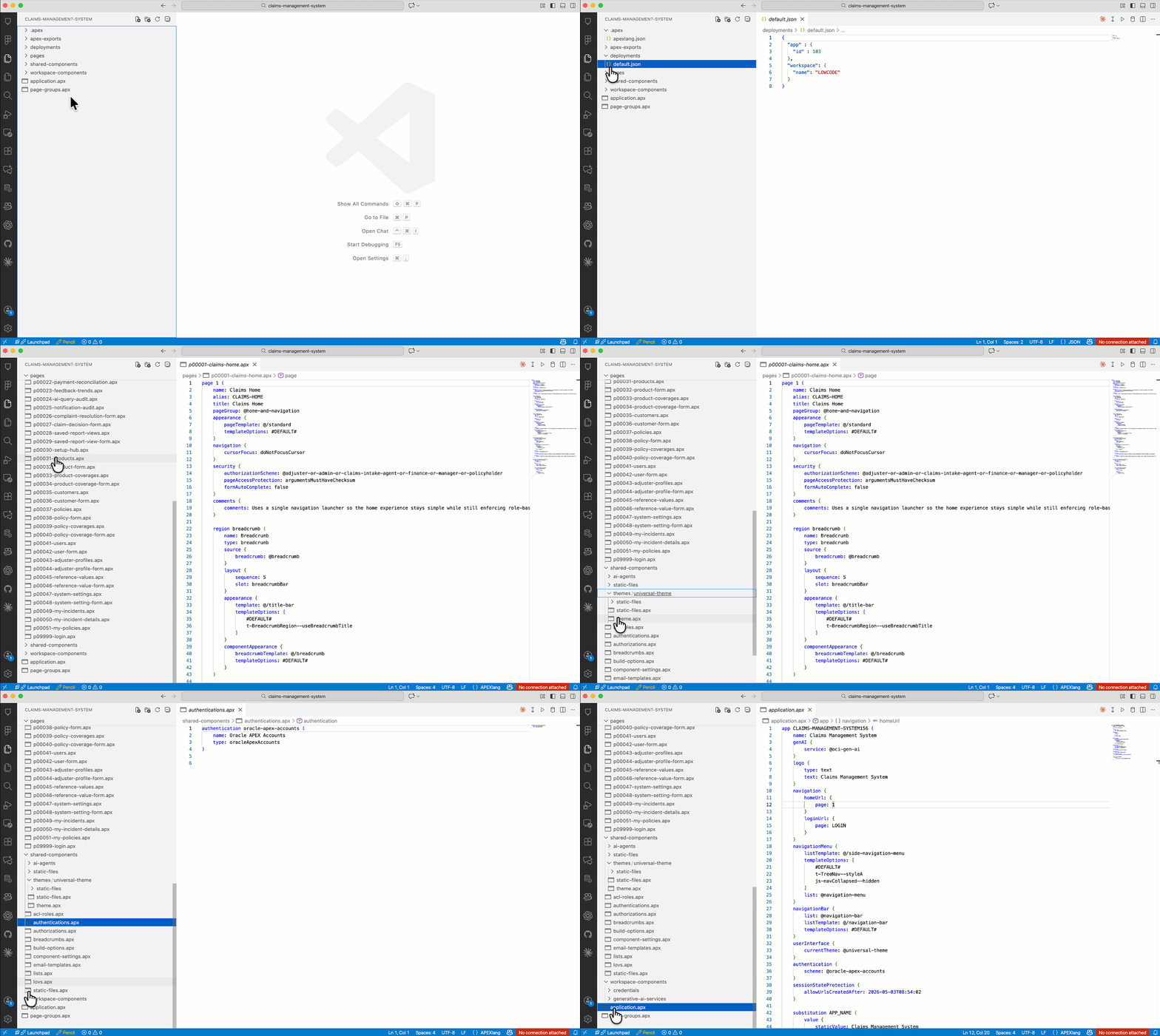
Instead of exporting applications as a single large SQL script, Oracle APEX 26.1 can now export applications as an APEXlang package – a ZIP archive containing:
.apxapplication definition files- Native SQL scripts
- CSS and JavaScript assets
- Static resources such as images
- Structured shared component definitions
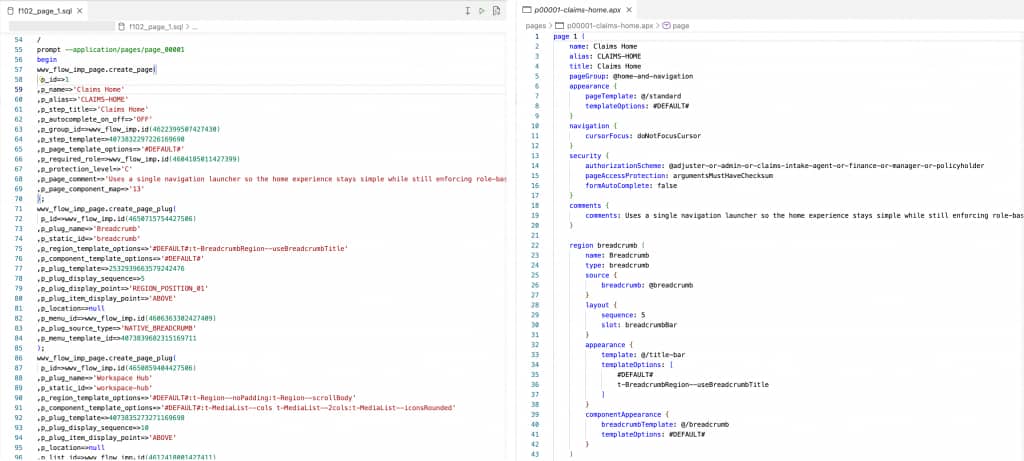
When stored in source control, APEXlang artifacts become the governed source of truth for an Oracle APEX application: reviewable, diffable, validatable, and usable by both developers and AI assistants. This gives teams a structured way to generate, evolve, and refine applications while preserving visibility, control, and enterprise governance.
What Problems APEXlang Solves
Traditional low-code platforms often store applications in proprietary formats that are opaque to both humans and machines. This creates friction across every stage of the enterprise development lifecycle, including code review, source control, security scanning, compliance auditing, and now, AI-assisted development.
When AI assistants cannot read or write the application format, organizations lose visibility into what is being generated, modified, and deployed.
APEXlang eliminates that barrier. Applications are represented as structured, human-readable source artifacts that can be reviewed, versioned, diffed, validated, merged, and governed using standard enterprise workflows and tooling.
The goal is not to generate low-level implementation code. It is to generate application intent in a format that developers, AI assistants, and enterprise processes can all understand.
Why APEXlang Matters
AI-assisted development works best when applications are represented in a structured, predictable, and reviewable form. Natural language prompts can describe intent, but enterprise teams still need an application model that can be versioned, validated, governed, and safely modified over time.
APEXlang provides that model for Oracle APEX applications. It gives developers and AI agents a shared, Oracle-supported language for describing application structure, behavior, navigation, shared components, and supporting SQL assets.
Because APEXlang represents the application as interconnected source artifacts, AI systems can make coordinated changes across forms, reports, charts, navigation, shared components, and SQL scripts while developers retain visibility and control.
Developers can continue using APEX Application Builder, work in standard editors such as VS Code, or collaborate directly with AI agents. Each workflow contributes to the same governed application artifact.
Generative Development Needs a Structured Application Model
Natural language is powerful for expressing intent, but prompts alone are not enough to define and evolve enterprise applications. Enterprise teams still need a durable application artifact that can be reviewed, versioned, validated, governed, and deployed predictably.
That is where APEXlang fits. It turns application intent into a structured, Oracle-supported specification that developers, AI assistants, and enterprise tools can all work with.
For Oracle Database, SQL provides a trusted abstraction for data. For Oracle APEX applications, APEXlang provides the application-level abstraction for generative development.
APEXlang + AI = Generative Application Development
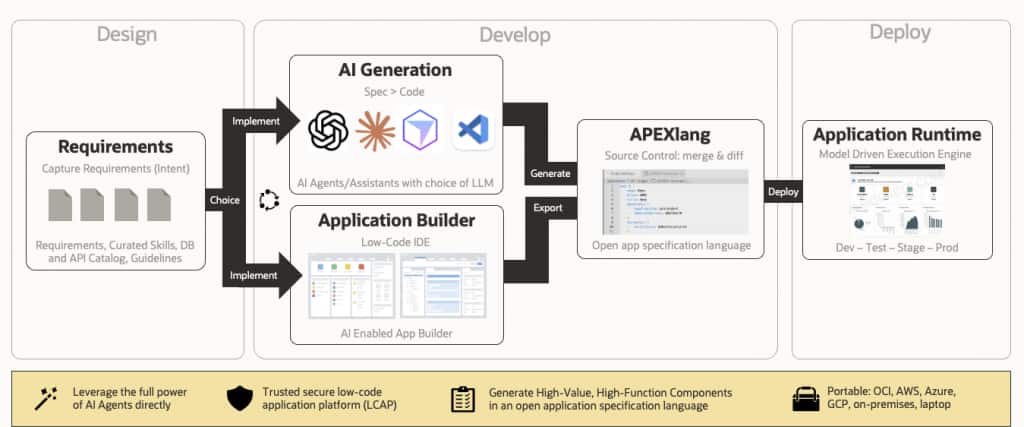
APEXlang is designed to work naturally with AI assistants and modern developer tooling, enabling developers to generate, evolve, and refine applications through prompts, skills, and structured workflows.
Because applications are represented as structured, interconnected source artifacts, AI systems can understand applications holistically and apply coordinated changes consistently across forms, reports, charts, navigation, shared components, and supporting SQL scripts, while developers retain full visibility and control through standard diff and source management tools.
Developers can continue building in APEX Application Builder, work in Oracle SQL Developer for VS Code, or collaborate with AI systems to iteratively generate and evolve applications at the level of business intent.
Oracle SQL Developer for VS Code provides native APEXlang support for source control, editing, and AI-assisted workflows. Oracle SQLcl provides command-line and automation support for CI/CD pipelines and headless environments.
Designed for the Enterprise
APEXlang was built for modern enterprise application development, combining the flexibility of generative AI with the governance, transparency, and lifecycle management organizations expect at scale.
It is open and fully documented, supported and extensible, human-readable, source-controllable, diffable, version-friendly, fully validatable, and designed for AI-assisted workflows.
Because APEXlang is open and structured, organizations can build reusable skills, prompts, templates, governance policies, and development patterns around it.
This enables a more scalable, trusted, and collaborative approach to generative application development.
Conclusion
APEXlang is more than a new export format. It is the foundation for a new style of development where developers work increasingly at the level of business intent, while AI systems help generate implementations through trusted enterprise abstractions. Oracle APEX has always focused on simplifying application development through abstraction and declarative programming. APEXlang extends that philosophy into the AI era. The next era of application development will not be defined by how much code AI can generate, but by how clearly teams can express, validate, and govern application intent. APEXlang provides that foundation for Oracle APEX.
This is Part 1 of a two-part series on APEXlang. Now that we have explored what APEXlang is and why it exists, Part 2 walks through the import, export, and development workflows for Oracle APEX.