
The Oracle AI Data Platform helps organizations unlock the value of their data with a modern, AI-ready foundation. It unifies data storage, cataloging, ingestion, preparation, and analysis in one platform, enabling teams to turn raw data into insight faster.
Users can quickly create secure AI environments, build rich catalogs, manage access with RBAC, and explore data using Spark-powered notebooks. With Oracle Analytics Cloud integration, business users can instantly analyze curated datasets, providing a single, unified view of the data and AI lifecycle—backed by Oracle’s security and reliability.
Getting Oracle Fusion Cloud ERP data and merging it with other data sources and implementing a use case is a common requirement for all Fusion Cloud ERP customers. In this article, we will cover how to leverage AI Data Platform to build an analytics and AI use case with Fusion Cloud ERP and other data sources.
Integrating Fusion Cloud ERP data with other data sources and building meaningful use cases is a common requirement for many Fusion Cloud ERP customers. In this article, I will walk you through how you can leverage the AI Data Platform to develop powerful analytics and AI-driven use cases by combining Fusion Cloud ERP data with other enterprise data sources.
Use Case Overview
This use case focuses on Supplier Risk and Sentiment Analysis, built on the AI Data Platform using a medallion architecture approach.
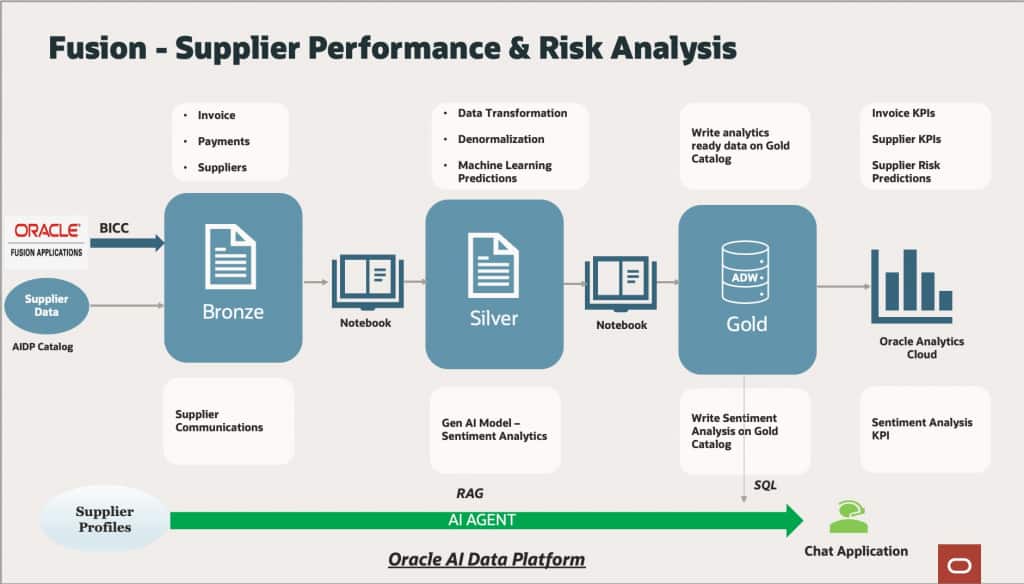
- Integrate data from two key sources:
- Fusion Cloud ERP (invoice and payment data)
- AI Data Platform Standard Catalog (supplier master data and communication data)
- Ingest Fusion Cloud ERP data using BICC extraction jobs into OCI Object Storage (bronze catalog)
- Process data through the medallion architecture:
- Bronze catalog: Raw data ingestion
- Silver catalog: Data transformation, denormalization, and enrichment
- Gold catalog: Curated data stored in Oracle Autonomous AI Database for analytics
- Apply machine learning models to:
- Predict late payments
- Calculate supplier risk scores
- Leverage Generative AI (LLMs) to analyze supplier communication data and extract sentiment across key dimensions:
- Delivery
- Quality
- Invoicing
- Packaging
- Communication
- Generate key insights including:
- Invoice performance metrics
- Supplier risk scores
- Sentiment KPIs
- Visualize insights in Analytics Cloud to provide a unified, AI-driven view of supplier performance and risk
- Enable a conversational AI experience using an AI agent that:
- Queries curated data from the gold catalog using SQL tools
- Retrieves contextual information from a document repository using RAG (Retrieval-Augmented Generation)
- Allows business users to access supplier insights through a natural language chat interface
- Sends notifications on Slack for late supplier payments
How We Built it in AI Data Platform
Building the Supplier Risk and Sentiment Analysis use case in the AI Data Platform Workbench involves orchestrating data ingestion, transformation, machine learning model development, and AI agent creation in a seamless workflow. In this section, we’ll walk through the key steps and components used to implement the solution end-to-end.
AI Data Platform Catalogs
In AI Data Platform, we leverage a medallion architecture consisting of three catalogs — bronze, silver, and gold.
Bronze catalog: Stores all raw invoice and payment data extracted from Fusion Cloud ERP through BICC, ingested into an OCI Object Storage bucket.
Finance external catalog: Contains external supplier data as well as supplier communication information, providing additional context for analytics and AI use cases.(This is an AI Data Platform standard catalog. In this context, “external” indicates that the data is not part of Fusion Cloud ERP.
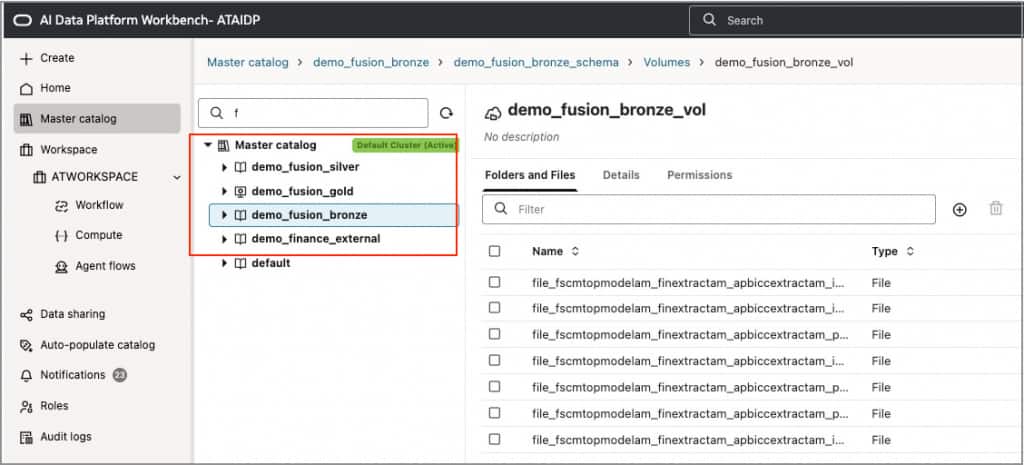
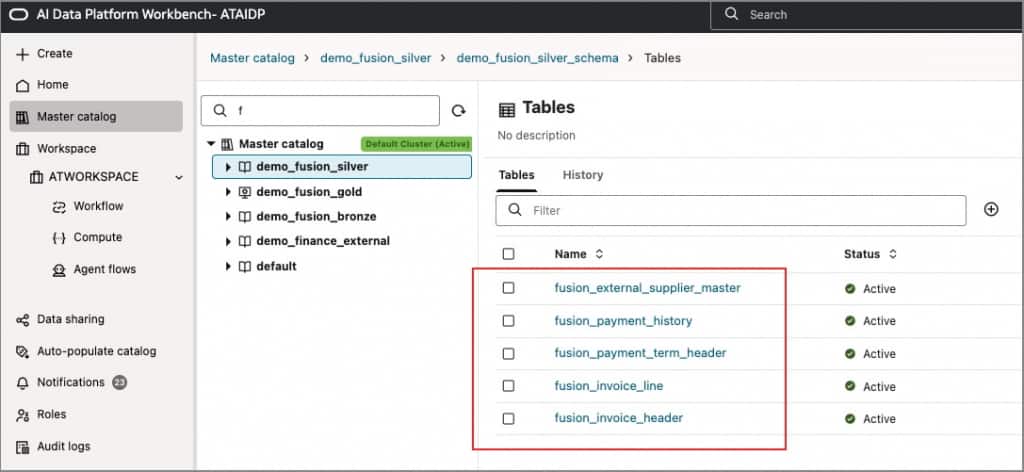
Silver catalog :- In the silver catalog, we use notebooks to join multiple invoice and payment files, extract the required attributes, and perform necessary data type conversions. The cleaned and transformed data is then written to the silver catalog in OCI Object Storage in Parquet format. External tables are also created on this curated data to enable seamless access for further processing and analytics.
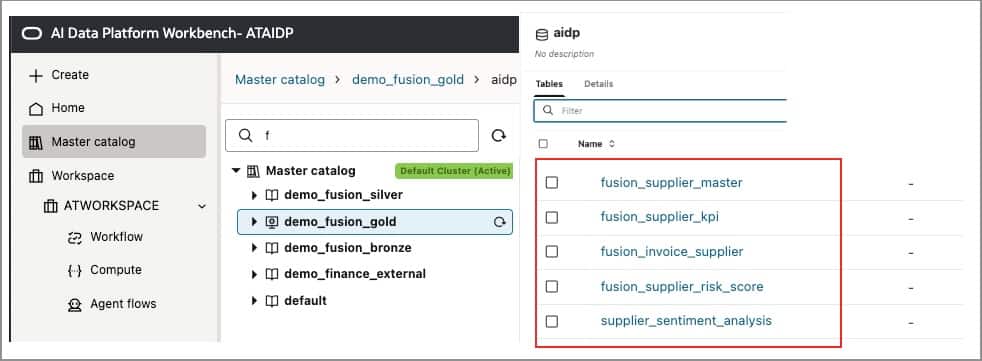
Gold catalog: In the gold catalog, we migrated transformed data from Fusion Cloud ERP, merged it with external supplier data, and calculated the required KPIs. Machine learning models are applied to predict supplier payments, and sentiment analysis is performed on supplier communication data. All the resulting analytics-ready data is then stored in the gold catalog — an Autonomous AI Database — in the form of structured tables, making it ready for reporting, visualization, and AI-driven insights.
AI Data Platform Notebooks
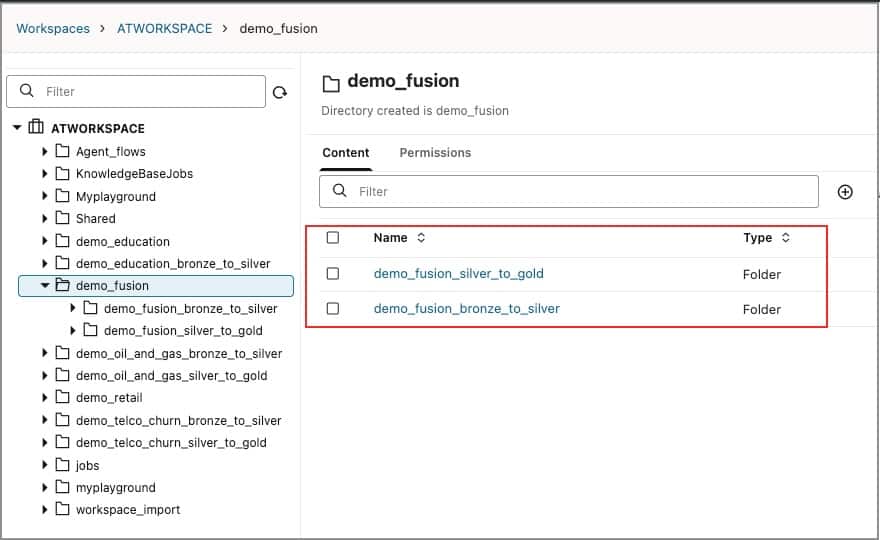
We developed two sets of notebooks in the AI Data Platform:
Bronze to silver migration: This notebook handles the cleansing, subsetting, and transformation of raw data from the bronze catalog, and loads the cleaned data into the silver catalog.
Silver to gold preparation: The second notebook prepares analytics-ready data by merging with external supplier data, calculating KPIs, applying machine learning models, and performing sentiment analysis, before loading the curated data into the gold catalog.
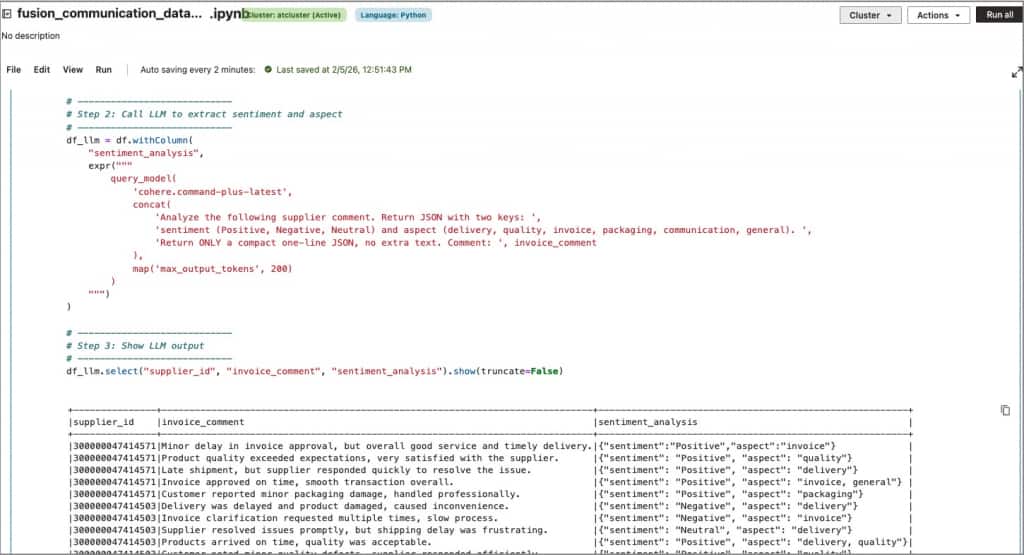
Here’s one example of a notebook where we leverage a large language model (LLM) to analyze supplier communication data. It extracts sentiments across key dimensions such as delivery, quality, invoicing, packaging, and overall communication. The insights generated feed into the supplier risk score and KPIs in the gold catalog.
AI Data Platform Workflow
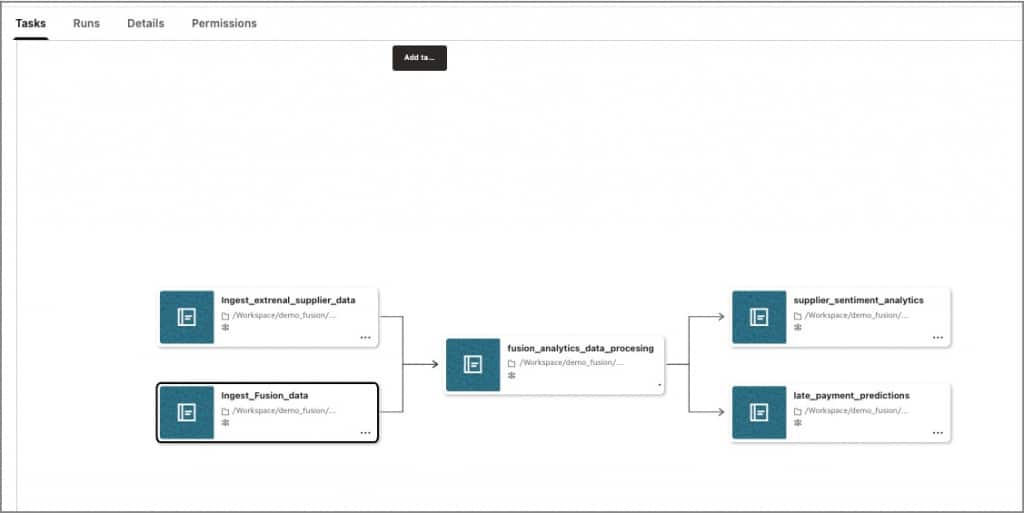
We created a workflow in the AI Data Platform to orchestrate the entire data pipeline end-to-end. This workflow integrates all the notebooks and handles:
Data ingestion: Pulling raw invoice and payment data from Fusion Cloud ERP into the bronze catalog
Data preparation: Cleansing, transforming, and enriching data in the silver catalog
Machine learning predictions: Applying ML models to predict late payments
Sentiment analysis: Using LLMs to extract sentiments from supplier communication
Data curation: Writing all analytics-ready data, KPIs, and insights into the gold catalog
The workflow is scheduled for daily processing, ensuring that the gold catalog is always up-to-date with the latest insights. This automation guarantees consistency, scalability, and timely AI-driven insights for business users.
AI Data Platform AI Agent Flow
The AI Agent feature is planned to be made generally available in a future release.
In AI Data Platform, you can build AI agent workflows either through a visual flow interface or programmatically using a Python library.
An AI agent flow is built to perform the following tasks:
- Queries curated data from the gold catalog using SQL tools to answer questions related to supplier invoices, late payments, risk scores, and other key metrics
- Retrieves contextual information from a document repository using Retrieval-Augmented Generation (RAG) to respond to queries about supplier profiles, including supplier overview, industry, products and services, as well as strengths and weaknesses
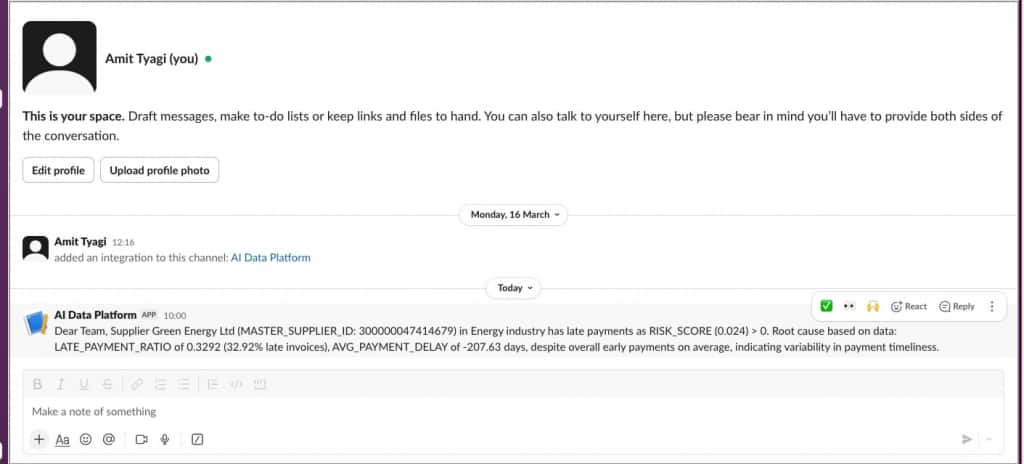
- Proactively identifies predicted late payments and sends notifications to the team on Slack, including root cause insights derived from the underlying data
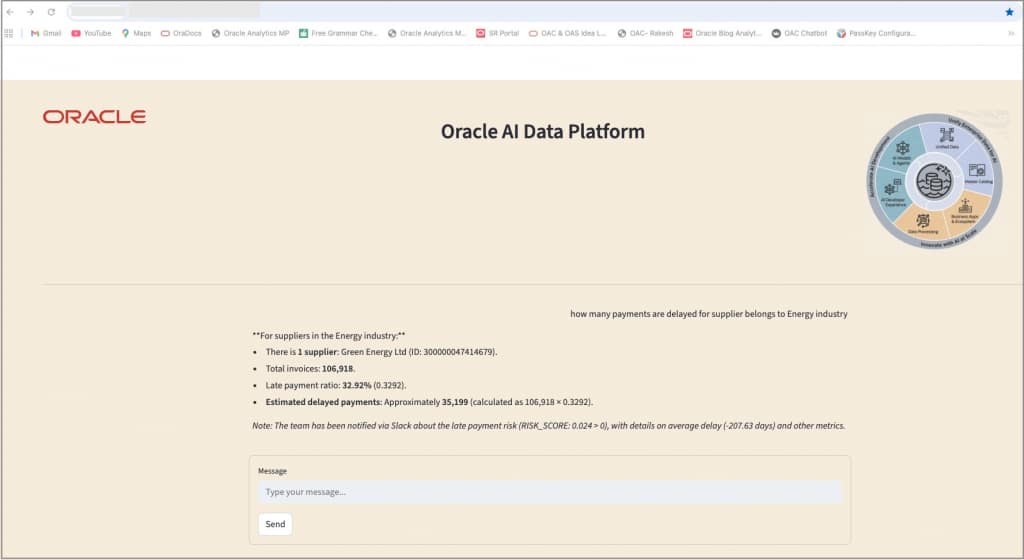
We used Streamlit to develop a chat application with the AI agent flow exposed through an agent endpoint. This enables business users to interact through a conversational interface to access supplier details, as well as invoicing and payment-related insights.
Based on machine learning model predictions, potential late payments are proactively communicated to the team in Slack, enabling timely corrective actions to prevent delays.
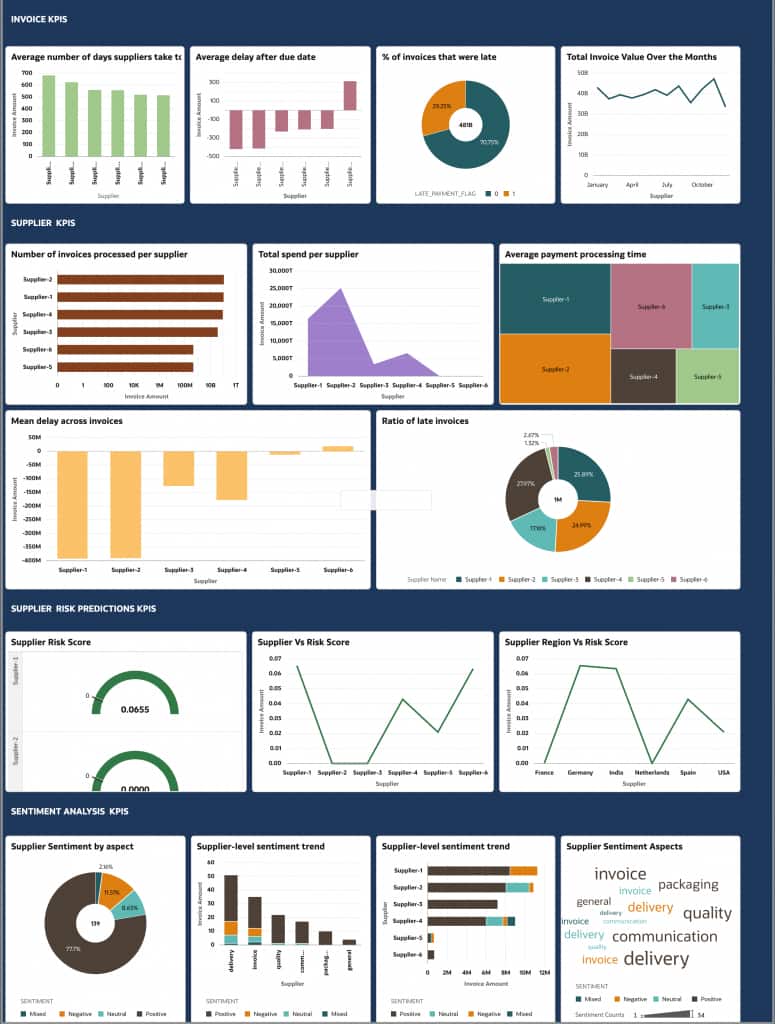
Analyzing KPIs in Analytics Cloud using the gold Catalog
Analytics Cloud uses the curated data in the gold catalog to enable key business insights generation. These include invoice performance metrics to monitor payment efficiency, supplier risk scores to assess and mitigate potential risks, and sentiment KPIs derived from supplier communications. By visualizing these metrics in Analytics Cloud dashboards, business users gain a unified, data-driven view of supplier performance, helping drive informed decisions and proactive actions.
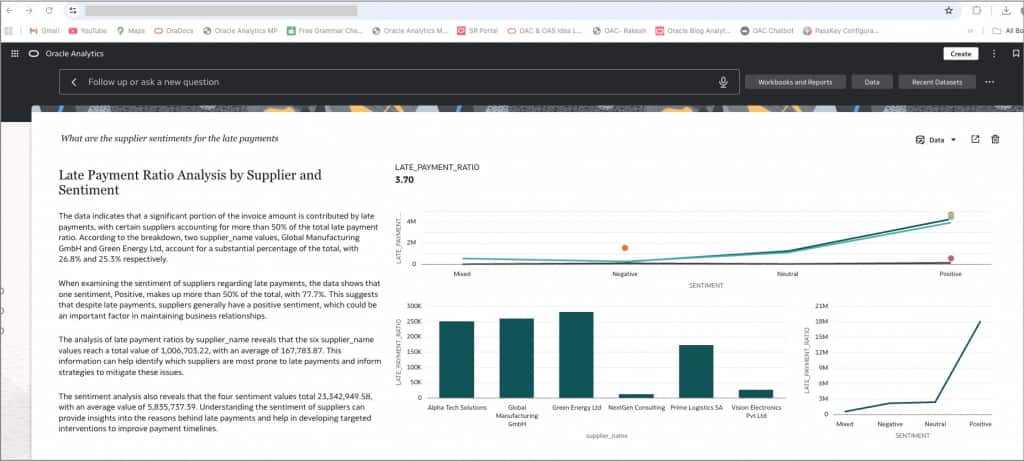
Alongside dashboards, business users can leverage Analytics Cloud’s AI‑powered natural language analytics assistant to query the AI Data Platform gold Catalog and uncover insights using conversational questions.
With AI Data Platform, organizations can harness the power of their enterprise data—integrating sources like Fusion Cloud ERP for invoices and payments, along with supplier master and communication data from the AI Data Platform gold Catalog. The AI agent flow enables business users to interact seamlessly with curated gold catalog data, providing insights on supplier performance, risk scores, late payments, and sentiment—all through dashboards or a natural language chat interface.
By combining predictive machine learning models, generative AI, and conversational analytics in Analytics Cloud, teams can take proactive actions, prevent late payments, and optimize supplier relationships. Platforms like AI Data Platform illustrate how AI-driven workflows and integrated analytics transform raw data into actionable intelligence, empowering faster, smarter, and more informed business decisions.
You can refer to the GitHub repository for sample notebooks and the OAC workbook (DVA) used in this blog.
For more information
You can refer to the GitHub repository for sample notebooks and the OAC workbook (DVA) used in this blog.
To explore more about the Oracle AI Data Platform, check out these resources:-
Oracle AI Data Platform’s workbench Documentation
Oracle AI Data Platform’s workbench Github Repository
Oracle AI Data Platform’s workbench Community
Future Product Disclaimer
The preceding is intended to outline our general product direction. It is intended for information purposes only and may not be incorporated into any contract. It is not a commitment to deliver any material, code, or functionality, and should not be relied upon in making purchasing decisions. The development, release, timing, and pricing of any features or functionality described for Oracle’s products may change and remains at the sole discretion of Oracle Corporation.